While dreams of playing on tour are fun, the reality is that the heart and soul of this game belong to the amateur. Being an amateur golfer isn't a lesser status, it's a mindset that opens up a world of freedom, connection, and pure enjoyment. This article explores the powerful reasons to embrace your place as a recreational golfer and how to get the most out of every single round.
The best AI golf app: Caddie is your personal AI golf coach. Get expert-level golf advice instantly, 24/7 to help you play like a pro. Try it free →
Embracing Golf for the Pure Love of the Game
For a professional, golf is a job. A missed three-foot putt can be the difference between making a cut and going home empty-handed. The pressure is immense, the stakes are high, and performance is directly tied to a paycheck. For an amateur, that same three-foot putt has a completely different meaning. It might be for bragging rights against your friends, to break 90 for the first time, or just to hear the deeply satisfying sound of the ball dropping into the cup. The outcome doesn't define your livelihood - it defines your afternoon.
This is the fundamental beauty of amateur golf: you play for the love of it. You're not trying to appease sponsors or climb a world ranking. You are there to challenge yourself, to enjoy the walk on a beautiful piece of land, and to feel the unparalleled thrill of a perfectly struck shot. It's a return to the essence of sport - play for the sake of playing. This shift in perspective transforms pressure into excitement and obligation into opportunity. Each round is a blank slate, a chance to create a new memory, learn something new about your swing, or just spend a few hours completely disconnected from the stresses of daily life.
Get pro-level golf advice instantly, 24/7
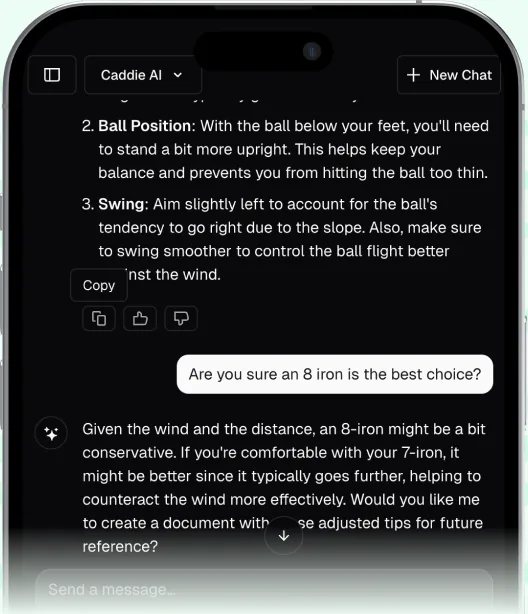
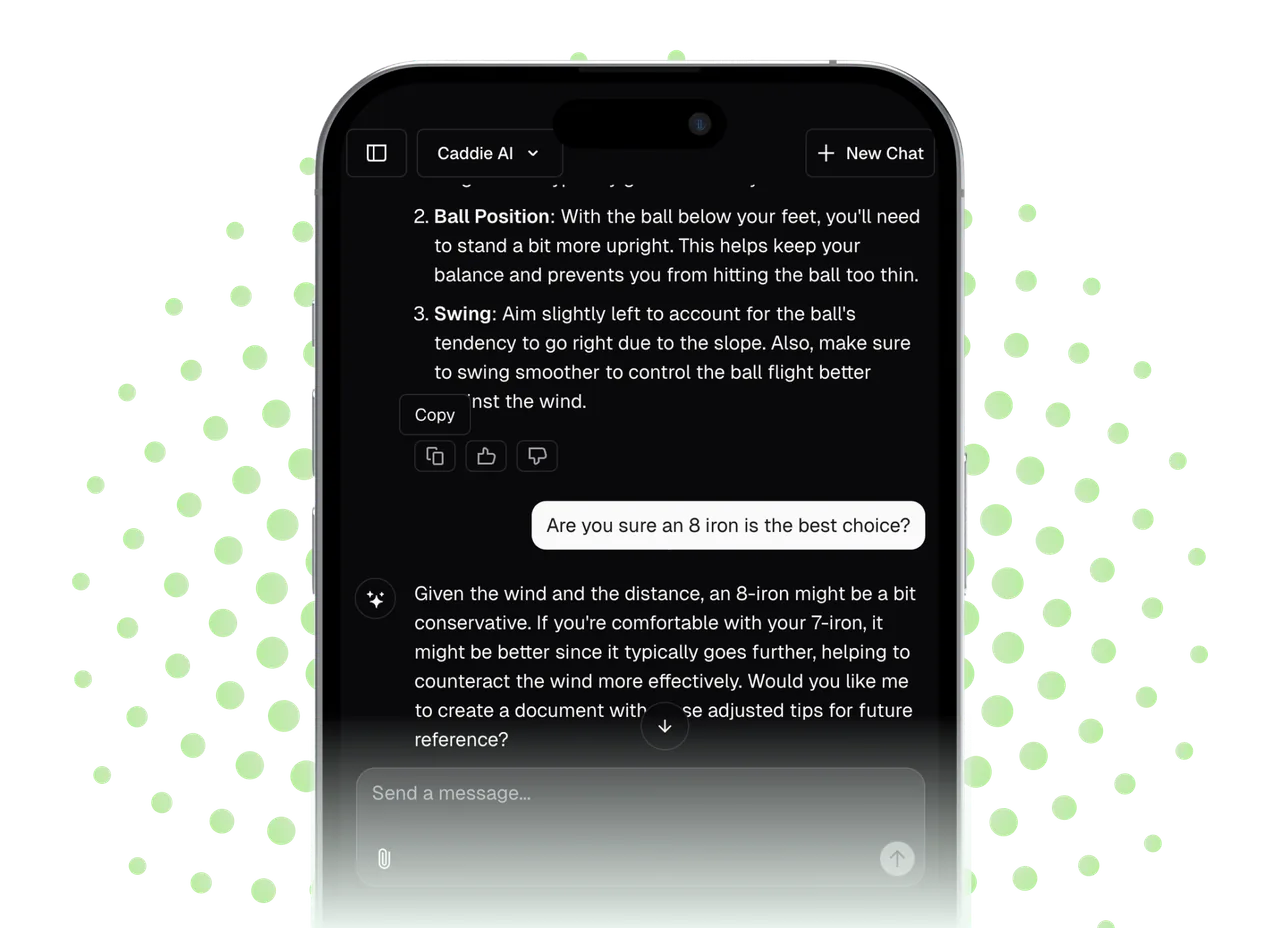
Ask Caddie anything. From “what club should I use?” to “how do I play this shot?” and get instant answers.
Think about the constraints on a professional golfer. Their schedule is a grueling loop of travel, practice, pro-ams, and competition. Their swing is often owned by a coach, and their equipment dictated by a contract. As an amateur, you are beautifully, wonderfully free from all of that. You are the CEO of your own golf game, and you can run it however you see fit.
Do you want to play once a week? Fantastic. Once a month? Perfect. Do you have a funky, self-taught swing that feels comfortable and mostly works? Keep it. Are you still using the clubs your grandfather gave you? As long as you enjoy them, they are the best clubs in the world for you. The amateur golfer answers to no one.
This freedom allows you to experiment and find what brings you the most joy. You're not locked into 18 holes of stroke play every time. Here are a few ways to take advantage of that freedom:
Try different formats: Play a two-person scramble with a partner, enjoy a low-stress skins game with your group, or just try "match play" against a friend where a few bad holes won’t ruin your day.
Play for fun, not a score: Go out in the late afternoon and play just nine holes. Or decide you're not going to keep score at all and just focus on hitting good shots.
Create your own challenges: Try an entire round with only three clubs to improve your creativity and shot-making. This kind of experimentation is what keeps the game fresh and exciting.
Being an amateur means you can define what success and fun look like on your own terms. There's no right or wrong way to do it.
Golf's Unbeatable Health and Social Benefits
The reasons to play extend far beyond what happens on the scorecard. As an amateur, you're free to fully experience the holistic benefits of the game - for your body, your mind, and your relationships.
A Lifelong Physical Pursuit
Golf is a fantastic form of low-impact exercise you can enjoy for your entire life. A typical 18-hole round involves walking four to six miles, often over varied terrain. Swinging a club promotes flexibility, balance, and core strength. This isn't a high-impact, joint-pounding activity, which is why you see people enjoying the game well into their 80s and 90s. Beyond the physical, the mental benefits are profound. Spending four hours outdoors, focusing on a single task, and giving your brain a break from screens and deadlines is an incredible form of stress relief and moving meditation. The concentration required to plan and execute a shot calms the mind and sharpens your focus.
Forging Connections on the Course
In our fast-paced world, finding quality time to connect with people is difficult. A round of golf provides an uninterrupted four-hour window to do just that. It's a social setting unlike any other. Conversations flow naturally between shots, creating an environment perfect for strengthening friendships, building business relationships, or simply bonding with family. The shared experience - the amazing shots and the comical mistakes - builds a common history. The high-five after your partner sinks a long putt or the collective laugh after someone finds a bunker for the third time are the small moments that forge lasting connections. This shared journey around the course is often more memorable than the final scores.
Plan every shot like a pro
Describe your situation and Caddie AI helps you pick your target, shot shape, and club with confidence.
The Never-Ending Challenge: Measuring Success on Your Own Terms
One of the most captivating aspects of golf is that it offers a never-ending ladder of improvement. You will never perfect this game - and that's a good thing. For the amateur, the journey is the destination. The joy comes not from achieving absolute mastery, but from making tangible progress. Golf is a unique contest of you against the course, and more importantly, you against the previous version of yourself.
The "wins" in amateur golf are personal and deeply satisfying. They aren't tied to a trophy or a check, but to milestones that you set for yourself. Beating your personal best score, breaking 100 for the first time, hitting more fairways than you ever have before - these are the victories that matter.
Setting Your Own Goals
Success is what you define it to be. Instead of comparing yourself to others, focus on your own game. Here are some great, attainable goals any amateur can work toward:
Shave two strokes off your handicap over the next three months.
Eliminate three-putts from your game.
Commit to a pre-shot routine and stick with it for every single shot.
Finish a round with the same ball you started with.
Take a lesson to finally understand ball flight laws and fix that slice.
Each of these small victories builds confidence and keeps your passion for the game alive. Every time you tee it up, you have the chance to be a little better than you were before, and that personal quest is one of the most rewarding parts of being an amateur golfer.
Play Golf like a Pro with Caddie
Learn and improve your golf game as you play. Get pro-level tips, strategy and guidance anytime.
Play Smarter, Not Harder: The Modern Amateur's Advantage
Gone are the days when getting better at golf meant aimlessly beating balls at the range for hours, hoping a secret move would suddenly appear. The biggest shift in the game today is the democratization of knowledge. The kind of high-level feedback and strategic thinking that was once exclusive to touring professionals is now accessible to everyone.
Think about how mechanics used to fix cars. An experienced mechanic would listen to an engine and diagnose the problem based on sound and instinct. Today, a technician plugs a computer into the car’s port, and the machine tells them exactly what's wrong. Golf is undergoing a similar evolution. The uncertainty is dissolving, replaced by clarity.
You no longer have to guess what to practice or wonder if a friendly tip is right for you. Modern tools can analyze your patterns and show you that while you *feel* like your putting is the problem, the data shows your biggest losses come from approach shots between 50 and 100 yards. That simple bit of information is revolutionary. It allows you to focus your limited practice time on the one thing that will actually lower your scores. This smarter approach means more efficient improvement and less frustration, making the game more enjoyable right away.
Final Thoughts
Being an amateur golfer is not a stepping stone to something else, it's the destination itself. It's an embrace of freedom, a commitment to personal growth, and an opportunity for health and camaraderie that can last a lifetime. On your own terms, you get to define what victory looks like every time you step onto the first tee.
This is where getting the right information at the right time is so helpful. We designed Caddie AI to put that expert knowledge in your pocket. As an amateur, you get a 24/7 golf coach to answer any question you have without judgment, and an on-course caddie to give you simple strategies or talk you through a tricky lie. Our goal is to take the guesswork out of golf, so you can play with more confidence and enjoy the game more than ever before.
Spencer has been playing golf since he was a kid and has spent a lifetime chasing improvement. With over a decade of experience building successful tech products, he combined his love for golf and startups to create Caddie AI - the world's best AI golf app. Giving everyone an expert level coach in your pocket, available 24/7. Caddie's mission is simple: make world-class golf advice accessible to everyone, anytime.
Other posts you might like
Why Is There a 14-Club Limit in Golf?
Ever wonder why you're only allowed to carry 14 clubs in your golf bag? It feels like one of those rules that has always existed, a fundamental piece of the sport just like an 18-hole scorecard. But this isn't an arbitrary number plucked from thin air. The 14-club limit is a thoughtfully designed regulation with a rich history, put in place to protect the very spirit of the game. This article will walk you through the origins of the rule, the core reasons it exists, and how it actually helps you become a better, more creative golfer.
The leaderboard at any given LPGA Tour event often looks like a who's who of South Korean golf, a trend that's been in place for more than two decades. Their dominance isn't a small statistical anomaly, it's a powerful and consistent force in the women's game. This article will break down the specific cultural, technical, and mental factors that combine to create these world-class competitors and offer practical lessons you can apply to your own game.
Ever stood on a tee box, spotted a perfectly placed bunker guarding the fairway, and wondered why it’s even there? Far from being random pits of sand meant only to frustrate you, bunkers are a fundamental part of a golf course's character and strategy. This article will show you the historical and architectural reasons for bunkers, and more importantly, how understanding them can transform your course management and lower your scores.
That dreaded feeling of your body lifting up as you swing, leading to a topped shot or a thin strike, is one of the most common frustrations in golf. It’s a pesky habit that feels almost involuntary, robbing you of power and consistency. This article will break down exactly why you stand up in your golf swing and provide you with actionable concepts and drills to keep your posture and finally achieve that pure, compressed ball flight you’re looking for.
Ever pure a drive on a chilly morning only to watch it fall out of the sky a good 20 yards short of its usual summer destination? You’re not getting weaker and your swing didn't suddenly get worse. The drop in temperature is a real ball-flight killer, and it's backed by science. This article will break down exactly why your golf ball doesn't fly as far in the cold and give you practical, coach-approved strategies to get that distance back.
It’s a feeling every golfer knows all too well. You've just played the best three, nine, or fifteen holes of your life. The swing feels effortless, the putts are dropping, and you think you’ve finally cracked the code. Then, without warning, the wheels come off. A topped shot, a wild slice, a three-putt that appears out of nowhere - and suddenly you can’t get your game back. This article will break down exactly why your golf game falls apart mid-round and give you clear, actionable strategies to stop the landslide before it buries your scorecard.