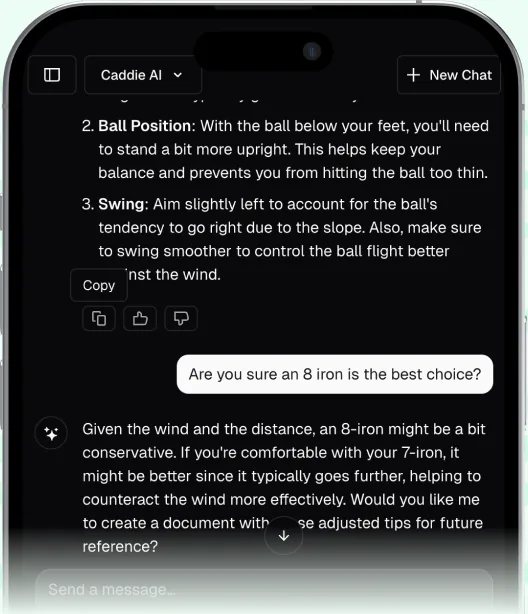
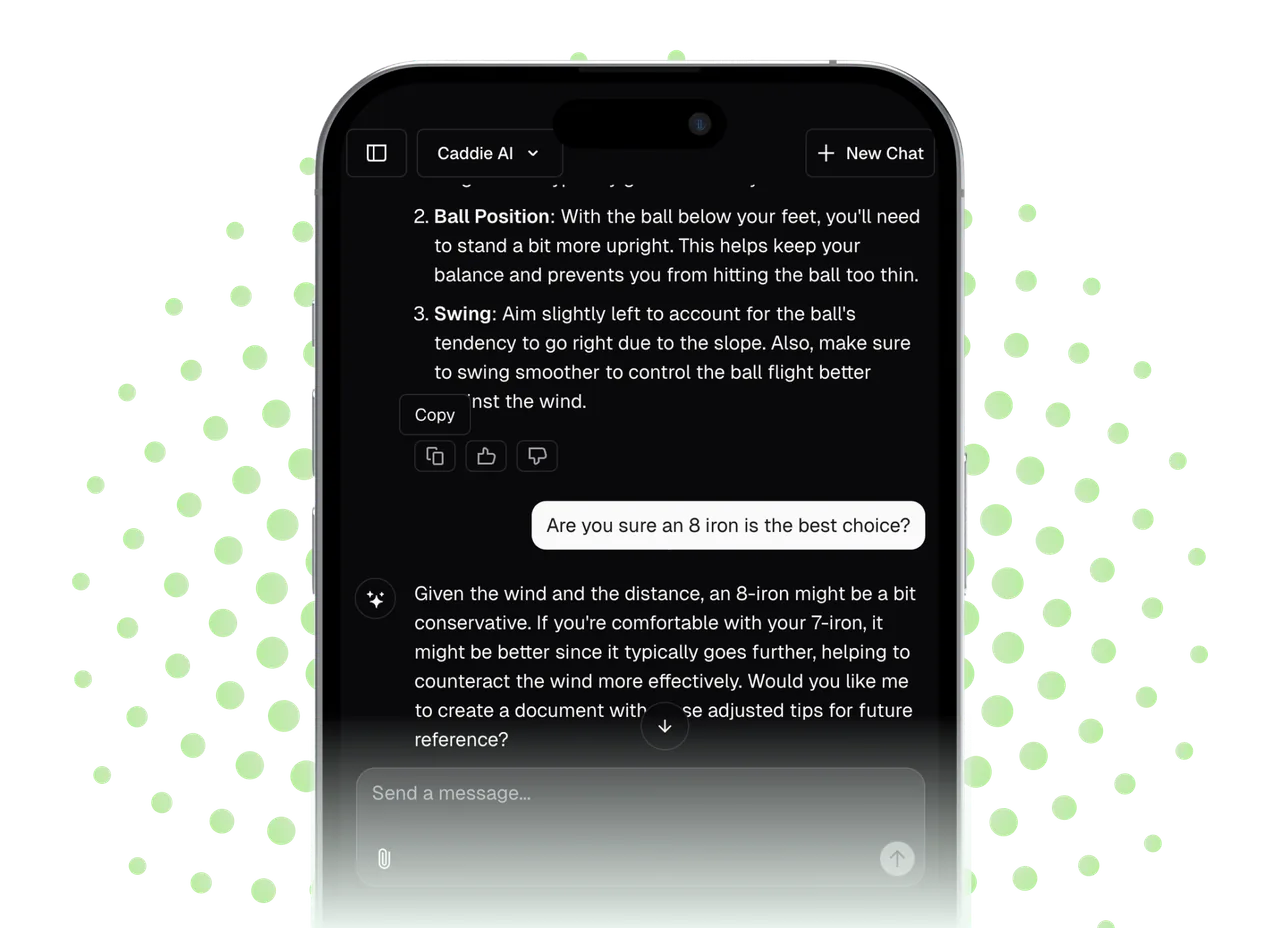
A 3-club isn't a single, specific club but a family of clubs designed for distance, each with a unique purpose and personality. Understanding the difference between a 3-wood, a 3-hybrid, and a 3-iron is an important step in building the right set of tools for your game. This article will break down what each 3-club does, when you should use them, and how to choose the right one for your bag so you can start hitting longer, more confident shots.
The best AI golf app: Caddie is your personal AI golf coach. Get expert-level golf advice instantly, 24/7 to help you play like a pro. Try it free →
What Exactly is a "3-Club"?
When someone refers to a "3-club," they are almost always talking about one of three different clubs: the 3-wood, the 3-hybrid, or the 3-iron. While they all theoretically fill a similar distance slot in your bag (sitting just below the driver), they behave very differently. Think of them as specialized tools for long-range jobs.
The 3-Wood is your powerhouse for maximum distance from the fairway or a reliable alternative to your driver off the tee.
The 3-Hybrid is the versatile problem-solver, designed to be more forgiving and easier to launch than a long iron, especially from tricky lies.
The 3-Iron is the traditionalist's choice, offering a lower, more penetrating flight for precision and control, but it's much less forgiving on mishits.
Most modern golfers do not carry all three. Instead, they choose one or two that best complement their skills, swing speed, and the types of shots they face most often. Let's look at each one in more detail.
Get pro-level golf advice instantly, 24/7
Ask Caddie anything. From “what club should I use?” to “how do I play this shot?” and get instant answers.
The 3-wood is the longest and most powerful club in your bag, aside from the driver. With a large head shape and a loft typically between 14 and 16 degrees, its primary function is to propel the ball a long, long way. For many amateurs, a well-struck 3-wood can travel nearly as far as their driver, but with much more control.
When a 3-Wood is Your Best Bet
Long Second Shots on Par-5s: This is the classic 3-wood situation. You've hit a good drive and you're still 220-250 yards out. The 3-wood gives you a legitimate chance to reach the green in two.
Tight or Dangerous Tee Shots: Faced with a narrow fairway or trouble lurking on both sides? The 3-wood is a smart play. The shorter shaft and extra loft (compared to a driver) make it easier to find the fairway while still providing excellent distance.
Extremely Long Par-3s: While rare, some courses have par-3 holes stretching over 220 yards. For many players, the 3-wood is the only club that can get them there.
How to Hit Your 3-Wood Cleanly
The key to a good 3-wood shot is a shallow, sweeping swing. You want to "pick" the ball off the turf rather than hitting down on it like an iron.
From the Tee:
Use a very short tee, so about half the ball sits above the top of the clubface. Position the ball just inside your lead heel, similar to a driver setup. Focus on making a smooth, wide swing and trust the loft of the club to get the ball airborne.
From the Fairway:
This is where many golfers struggle. Put the ball further forward in your stance than you would for an iron - about a golf ball's width or two inside your lead heel. At address, don't press your hands way forward. The goal is to make contact with the ball right at the bottom of your swing arc. Try to imagine your clubhead "sweeping" through the impact area and chasing the ball down the target line.
A common mistake: Trying to "help" the ball into the air by scooping at it. Trust the club’s design. Your job is to deliver the clubface squarely to the back of the ball with a stable body, and the loft will take care of the launch.
Extreme Forgiveness: The wide sole and low center of gravity make hybrids incredibly easy to launch, even on off-center hits. If you hit a 3-iron thin, the ball will barely get off the ground. A thin hybrid shot might still fly 150 yards and find the green.
Versatility from Bad Lies: This is where the hybrid truly shines. The design of its head allows it to cut through thicker rough far better than a wood or iron. It gives you a great option for advancing the ball a long way out of trouble.
Confidence on Long Approaches: Staring down a 190-yard shot over water is intimidating with a long iron. With a 3-hybrid in your hands, it suddenly feels a lot more possible. The high, soft-landing ball flight helps hold greens better than a low-flying iron shot.
How to Hit Your 3-Hybrid like an Iron
Here’s the simple thought that unlocks the hybrid: swing it like a 7-iron.
Play the ball in the middle of your stance, or just slightly forward of center - it depends on what feels comfortable for you. Unlike the sweeping motion of a 3-wood, you want to hit slightly down on the ball with a hybrid. A very small divot after the ball is the perfect sign of a well-struck hybrid shot.
Don't fall into the trap of thinking you need to help the ball up. The club is engineered to do that for you. Just make a normal, controlled iron swing, and watch the ball launch beautifully high and straight.
Plan every shot like a pro
Describe your situation and Caddie AI helps you pick your target, shot shape, and club with confidence.
The 3-Iron: The Player's Club (and Why It's Disappearing)
The traditional 3-iron is a beautiful but demanding club. For decades, it was a staple in every golfer's bag, the go-to club for long approaches and windy days. With a blade-like head and around 20-22 degrees of loft, it produces a low, piercing trajectory that can bore through the wind and allows skilled players to shape shots with precision.
Strengths and Weaknesses of the 3-Iron
Strength - Workability: For skilled players, the 3-iron offers more control over trajectory and shot shape (draws and fades) than a hybrid.
Strength - Wind Performance: Its low, penetrating flight is perfect for staying under the wind when a high-flying hybrid would get knocked down.
Weakness - Lack of Forgiveness: This is its fatal flaw for most amateurs. A 3-iron has a tiny sweet spot. Unless you strike it perfectly pure, you'll lose a massive amount of distance and accuracy.
Weakness - Requires Swing Speed: To launch a 3-iron effectively and get the proper distance out of it, you need a certain amount of clubhead speed. Slower swingers will struggle to get it airborne consistently.
For these reasons, the 3-iron has become a rare sight in most golf bags. Unless you're a low-handicap player with a consistent, powerful swing, the benefits of a 3-hybrid almost always outweigh the selective advantages of a 3-iron.
Play Golf like a Pro with Caddie
Learn and improve your golf game as you play. Get pro-level tips, strategy and guidance anytime.
Making the right choice comes down to being honest about your abilities and your needs on the course. Here’s a simple guide:
For the Beginner or High-Handicap Golfer (18+ Handicap):
The choice is simple: go with a 3-hybrid. Put one in your bag and forget the 3-iron even exists. The forgiveness and ease of use will save you strokes and build your confidence on long shots. You may also want a 3-wood for tee shots where your driver gets wild, but the hybrid will be your go-to problem-solver.
For the Intermediate Golfer (8-17 Handicap):
At this level, a 3-wood is an essential tool for attacking par-5s and managing your game off the tee. The next choice is between the 3-hybrid and the 3-iron. Over 90% of golfers in this range will benefit more from the 3-hybrid's forgiveness and versatility, especially from the rough. However, if you are a strong ball-striker who plays in a lot of wind, testing a 3-iron (or a more forgiving "utility iron") might be worthwhile.
For the Advanced Golfer (0-7 Handicap):
These players usually have the swing speed and skill to use any of the clubs effectively. The choice is based on filling distance gaps and shot preference. Many carry a 3-wood and then choose between a 3-hybrid (for higher, softer-landing shots) or a 3-iron/2-iron utility club (for lower, more controlled shots into the wind). Some may even carry both, swapping them out based on course conditions.
Final Thoughts
The term "3-club" refers to a family of long-game tools - the wood, the hybrid, and the iron - each built for a specific job. Understanding the unique role of each one and being realistic about your own skill level is fundamental to choosing the right club that will help you most on the course.
Deciding between a 3-wood off the deck or a 3-hybrid for a long approach can feel like a high-stakes guess. To help with moments just like that, we built Caddie AI. It serves as your personal on-course caddie, giving you smart club recommendations based on the shot you're facing. You can even take a photo of a tough lie and Caddie AI will analyze the situation and suggest the best way to play it, giving you the clarity to commit to every swing.
Spencer has been playing golf since he was a kid and has spent a lifetime chasing improvement. With over a decade of experience building successful tech products, he combined his love for golf and startups to create Caddie AI - the world's best AI golf app. Giving everyone an expert level coach in your pocket, available 24/7. Caddie's mission is simple: make world-class golf advice accessible to everyone, anytime.
Other posts you might like
In Golf, How Do You Know What Iron Club to Use?
Standing over an approach shot with your trusty laser rangefinder telling you there are 150 yards to the pin, you face golf's most common and critical decision: choosing the right iron. This isn’t just about picking one club based on a single number, it's about making a smart, confident choice that gives you the best chance for success. This guide will walk you through a simple, repeatable process for selecting the right iron, moving from understanding your stock distances to accurately reading the real-world conditions on the course.
That familiar, frustrating ball flight - starting to the right of your target and then weakly curving even further right - can leave any golfer feeling defeated. This shot, the push fade, signals a disconnect between your swing's path and the club's face angle at impact. This article will break down exactly what causes the push fade in clear, simple terms and provide practical, on-the-range drills to help you straighten out your shots for good.
A finesse shot is the bridge between a delicate chip and a full-power swing - a shot of touch and control, played primarily from those tricky in-between distances of 30 to 100 yards. They are the shots that separate good scorers from average ones because they give you control over distance, trajectory, and spin when brute force isn't an option. This guide will walk you through exactly what these shots are, why they're so important for a lower score, and provide a clear, actionable system to help you master them.
The ten-finger grip, often called the baseball grip, is the simplest way to hold a golf club, yet many players incorrectly dismiss it as only for first-timers. This guide will show you exactly what this grip is, who benefits most from it, and provide a step-by-step tutorial to get it right. By the end, you’ll be able to decide if this comfortable and powerful grip is the right choice for your game.
Ever heard a playing partner say winter rules are on today or we're playing lift, clean, and place? These phrases refer to one of the most common - and commonly misunderstood - local rules in golf: the preferred lie. Far from a cheater's pass, this rule exists for very specific reasons and comes with a strict procedure. This complete guide will walk you through exactly what a preferred lie is, when you can take one, the step-by-step process for doing it right, and the mistakes to avoid, so you can play with confidence no matter the conditions.
A lot of golfers wonder just how ‘vertical’ a golf club can get, so let's get right to it. There is no official rule in golf that puts a hard number on the maximum loft a club can have. However, clubs must conform to traditional shapes and designs, which shuts the door on extreme or unusual gadgets and effectively caps the practical limit around 90 degrees. This article will break down what the rules actually say, introduce you to the highest-lofted wedges you can actually buy, and help you figure out if these specialty clubs are a potential secret weapon or just a recipe for disaster in your bag.