Chasing a score in the 80s for the first time can feel like a huge mountain to climb, but the path to breaking 90 is a lot straighter than you think. It's not about striping every drive or hitting every green in regulation. This guide will give you a practical, no-nonsense strategy focused on simple course management and smarter decisions that will start shaving strokes off your scorecard immediately.
The best AI golf app: Caddie is your personal AI golf coach. Get expert-level golf advice instantly, 24/7 to help you play like a pro. Try it free →
It’s All Math, Not Miracles
First, let’s reframe the goal. Shooting an 89 doesn't require a string of heroic birdies. Think about it this way: a score of 89 is 17 bogeys and one single par. That’s it. On an average par 72 course, that means you have 17 "mistakes" to give and you have to play just one hole to its intended par. When you look at it like that, the pressure comes right off. You don't need a pro-level game, you need a bogey-level game, played consistently. This entire round is about damage control, not highlight reels. Stop trying to play a perfect game and start playing a smart one. Your mission is simply to avoid the big numbers that kill your score.
The Golden Rule: End Double Bogey Tyranny
If there's one single enemy standing between you and a score in the 80s, it's the double bogey. A single double bogey means you now need to make a par somewhere else just to get back on your 89 pace of 17 bogeys. One triple bogey? Forget about it. You can survive a round full of bogeys, but you cannot survive blow-up holes. From this moment on, your primary objective on every single hole is to eliminate the double bogey. How? By respecting the course and playing away from trouble.
Was your drive pulled left towards the water? Don't try to hook a 5-iron around the trees to reach the green. Take your medicine by punching out sideways into the fairway.
Are you staring at a long carry over a bunker to a tucked pin? Aim for the fattest part of the green, even if it leaves you a 40-foot putt.
Is the pin right behind a deep sand trap? Play to the center of the green. Take the two-putt bogey and sprint to the next tee.
Playing for bogey might sound defensive, but it's the smartest offensive strategy for breaking 90. Every time you walk off a green with a 5 or a 6 on a par 4, that's a massive win.
Get pro-level golf advice instantly, 24/7
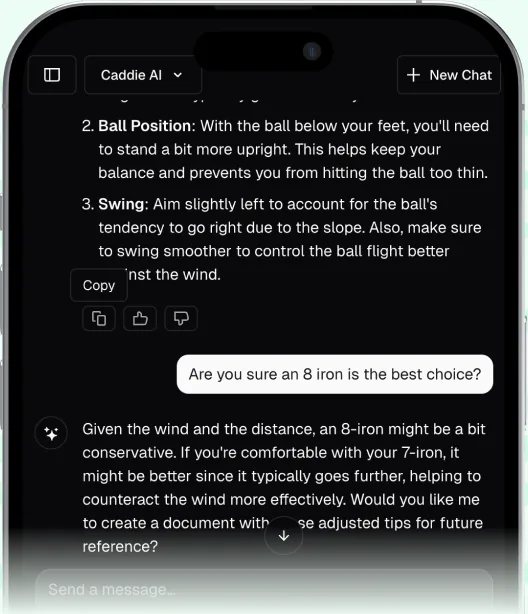
Ask Caddie anything. From “what club should I use?” to “how do I play this shot?” and get instant answers.
The biggest scorecard improvements happen before you even swing the club. Great golf is about thinking, not just hitting. Here’s how you can play smarter from tee to green.
Tee Box Strategy: Put the Driver on Probation
Your driver is not always the right club. If an architect put water down the right side and OB all down the left, they are practically begging you to hit something other than your driver. The goal off the tee is not maximum distance, it’s putting your ball in a position where you can hit your next shot comfortably. If a hole is tight or lined with danger, consider a 3-wood, a hybrid, or even a 5-iron. It's far better to be 170 yards out from the fairway than 120 yards out from the trees. Before you pull the headcover off, ask yourself one question: "What club gives me the best chance of being in play?" Often, that answer isn't the big stick.
The Two-Shot Rule for Par 4s
Stop thinking you need to hit the green in two. This single mindset shift changes everything. For the time being, your goal on every par 4 is to get your ball to a comfortable chipping spot in three shots. A golfer shooting in the mid-90s has a low GIR (Greens in Regulation). Instead of forcing a difficult, low-percentage approach shot to try to hit every green, break the hole down.
Your new par 4 plan:
Shot 1 (Tee Shot): Get the ball in the fairway. As we just discussed, this might mean using a club other than your driver.
Shot 2 (Advance Shot): Hit a comfortable club down the fairway to your favorite yardage. Let's say you love hitting your pitching wedge from 100 yards. Your goal with your second shot is to leave yourself at 100 yards. Don't even look at the green.
Shot 3 (Approach Shot): From your favorite yardage, hit your shot onto the green.
Shots 4 &, 5: Two-putt for a bogey.
This completely removes the pressure. You never feel like you HAVE to pull off a miracle. You’re just advancing the ball into positions where you’re comfortable. You will probably make some pars by accident just by getting really good at your approach shot from your target lay-up position.
Forget Your Ego: The Art of the Smart Layup
We’ve all been there: a wayward tee shot leaves you in the trees, 150 yards from the green, with a little window to the flag. The ego screams, "I can totally thread this through that gap!" The scoreboard begs, "Please don't."
The hero shot is a myth for 99% of golfers. The odds of pulling it off are incredibly low, and the penalty for failure is a crooked number on the card. Learning to take your medicine is a sign of a maturing golfer. A punch-out back to the fairway is never sexy, but it saves strokes.
Think about this scenario: You have a clear lane sideways back to the fairway. That's a guaranteed shot. Hitting out to the fairway and then hitting an approach onto the green will take you two shots. But suppose you try for the miracle gap... You hit a tree, and the ball kicks further into the woods. Now... You will still have to punch out sideways onto the fairway. You not only didn't save yourself a shot, but you lost at least one in the process. Punching out from trouble isn't giving up on the hole, it's the smartest way to minimize damage and keep that double bogey off your card.
A poorly hit bump-and-run will still end up closer to the hole than a bladed or chunked sand wedge. It’s a higher-percentage play that dramatically reduces the chance of a costly mistake.
Plan every shot like a pro
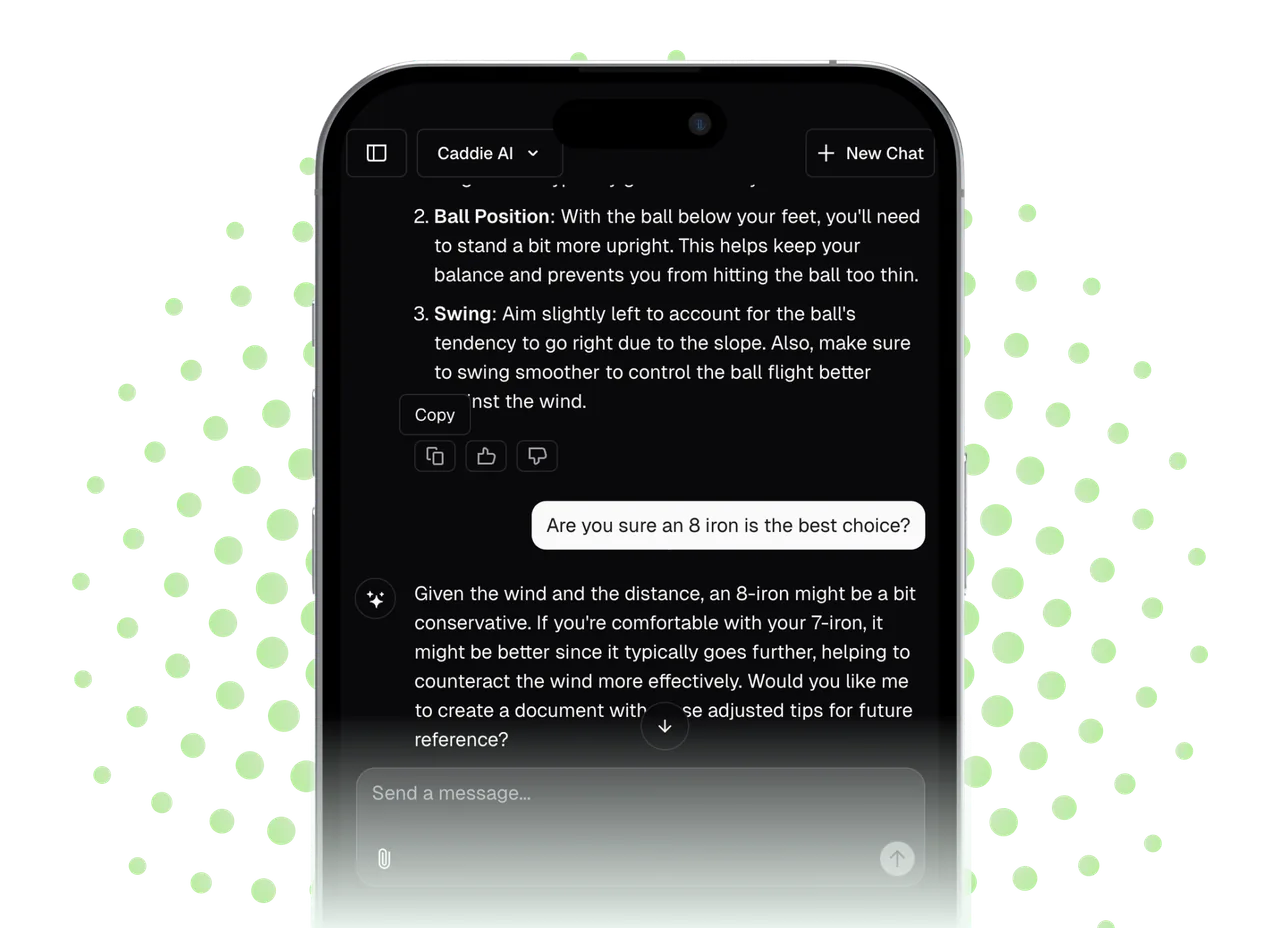
Describe your situation and Caddie AI helps you pick your target, shot shape, and club with confidence.
You’re going to miss greens. That’s a guarantee. Your ability to get the ball "up and down" - or, more realistically, up and near the hole for a tap-in bogey - is the secret sauce. You don’t need a variety of fancy flop shots. You need one or two reliable chip shots you can trust under pressure.
The "Go-To" Chip Shot
Instead of trying to master four different wedges, simplify your life. Pick one wedge - a 54 or 56-degree sand wedge is a great choice - and learn to do everything with it. Use it from the fairway, the rough, and from bunkers. By using the same club for almost all your chips and pitches, you develop an incredible feel for how the ball will react.
Think about it as a throwing motion. You wouldn't use a different arm to throw a ball 20 feet versus 40 feet. You'd use the same arm, but with a longer throwing motion. The same applies to your chipping. Practice making small, medium, and large swings with your one "go-to" wedge to control your distances.
Become a Master of the Bump-and-Run
When you have a tight lie and plenty of green to work with between you and the hole, the high lofted shot is not always the best play. The most reliable shot in golf is the one that gets the ball on the ground and rolling like a putt as quick as possible. This is the bump-and-run.
Grab an 8-iron or 9-iron. Stand closer to the ball and use your putting grip and stroke. Your goal is simply to "bump" the ball over the longer grass and let it "run" the rest of the way to the hole. A poorly hit bump-and-run will still end up closer to the hole than a bladed or chunked sand wedge. It’s a higher-percentage play that dramatically reduces the chance of a costly mistake.
Play Golf like a Pro with Caddie
Learn and improve your golf game as you play. Get pro-level tips, strategy and guidance anytime.
Three-putts are silent killers. They don't feel as disastrous as a shot into the water, but they add up just as fast. The mission on the greens is to eliminate them entirely. Your primary putting goal on any putt over 10 feet is not to make it. Your goal is to get it close.
Imagine a giant three-foot circle - like a hula hoop - around the hole. On every single long putt, your only objective is to get the ball to stop somewhere inside that circle. That’s it. Stop trying to ram every putt into the back of the cup. Focus on speed and distance control. By becoming a great lag putter, you leave yourself simple tap-ins. This eliminates the three-putt, lowers your score, and takes so much pressure off your putting stroke.
Every time you walk onto a practice green, don't just putt for the hole. Putt for that imaginary three-foot circle. Rolling 20 putts from 30 feet within this safe zone is way more useful than making one from that distance and having 17 of them finishing more than 6 feet from the hole.
Final Thoughts
Breaking 90 is an attainable goal that is defined by strategy, not by skill. Forgetting your ego, avoiding double bogeys, simplifying your short game, and focusing on lag putting are the building blocks that will turn your 90s into 80s consistently.
This process of making smarter on-course decisions is precisely why we built our app. Using Caddie AI is like having a course management expert in your pocket. In those moments of doubt, like when you're stuck in the trees and temptation is knocking - instead of making an emotional decision, it gives you the smart strategies right when you need them - for every hole, every lie, and every situation. You learn course management by thinking like a golf coach and learning how to get out of trouble by punching out sideways to your layup position and finally scoring that bogey instead of a devastating double.
Spencer has been playing golf since he was a kid and has spent a lifetime chasing improvement. With over a decade of experience building successful tech products, he combined his love for golf and startups to create Caddie AI - the world's best AI golf app. Giving everyone an expert level coach in your pocket, available 24/7. Caddie's mission is simple: make world-class golf advice accessible to everyone, anytime.
Other posts you might like
How to Focus on the Target, Not the Ball
What if the secret to better golf shots wasn't found by staring harder at the ball, but by almost ignoring it? Getting caught up in swing mechanics and body positions over the ball is one of the quickest ways to create tension and inconsistency. This article will show you how to shift your attention from yourself and the ball to your ultimate destination - the target - and provide simple, actionable drills to make this liberating approach a natural part of your game.
Heading out to play a round of golf by yourself might feel a little strange at first, but it’s one of the most effective and rewarding ways to experience the game. This guide will walk you through everything you need to know, from booking a tee time and navigating the course to turning your solo round into the most productive practice session you've ever had.
Perfectly cutting a fresh hole is one of the most quietly satisfying jobs on a golf course. It’s a task that directly shapes the challenge and character of the green, setting the stage for every putt that follows. Whether you’re a greenskeeper aiming for tour-level standards or a dedicated golfer with a personal putting green, mastering this skill is essential. This guide will walk you through the entire process, from selecting the right spot to setting the cup for a perfect finish.
A throbbing blister on your thumb is one of golf’s most frustrating (and painful) minor injuries, capable of turning a beautiful day on the course into a grind. It’s a literal pain point that affects your grip, your swing, and ultimately, your confidence. This post will walk you through exactly why thumb blisters form and provide clear, actionable steps to prevent them, so you can focus on making great swings, not nursing a sore hand.
A bigger, smoother turn is the secret ingredient for adding more power and consistency to your golf swing. It’s what separates the clunky, arms-only swing from that effortless, powerful motion you see from skilled players. But improving your turn can feel like a vague piece of advice. What does it actually mean? This guide will break down the turn into simple, manageable pieces, showing you exactly how to build a better rotation from the ground up so you can stop forcing shots and start swinging with authentic power.
Nothing brings a golfer to their knees faster than a shanked chip shot. That horrifying, sideways dart into the trees or an adjacent bunker can shatter your confidence in an instant. The good news is that the shank, especially around the greens, isn't a mysterious swing disease, it’s a simple geometry problem. This article will show you exactly why it happens and give you practical, step-by-step drills to eliminate it for good.