A perfectly organized golf bag does more than just look good, it makes the game simpler so you can focus on hitting great shots. This guide will walk you through exactly how to set up your bag, from selecting the right 14 clubs to assigning a home for every single tee, ball, and jacket. You'll learn a system that removes guesswork and adds a huge dose of confidence to your on-course routine.
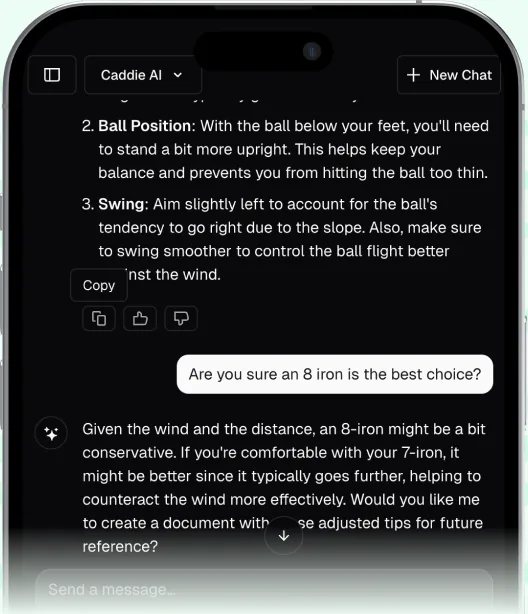
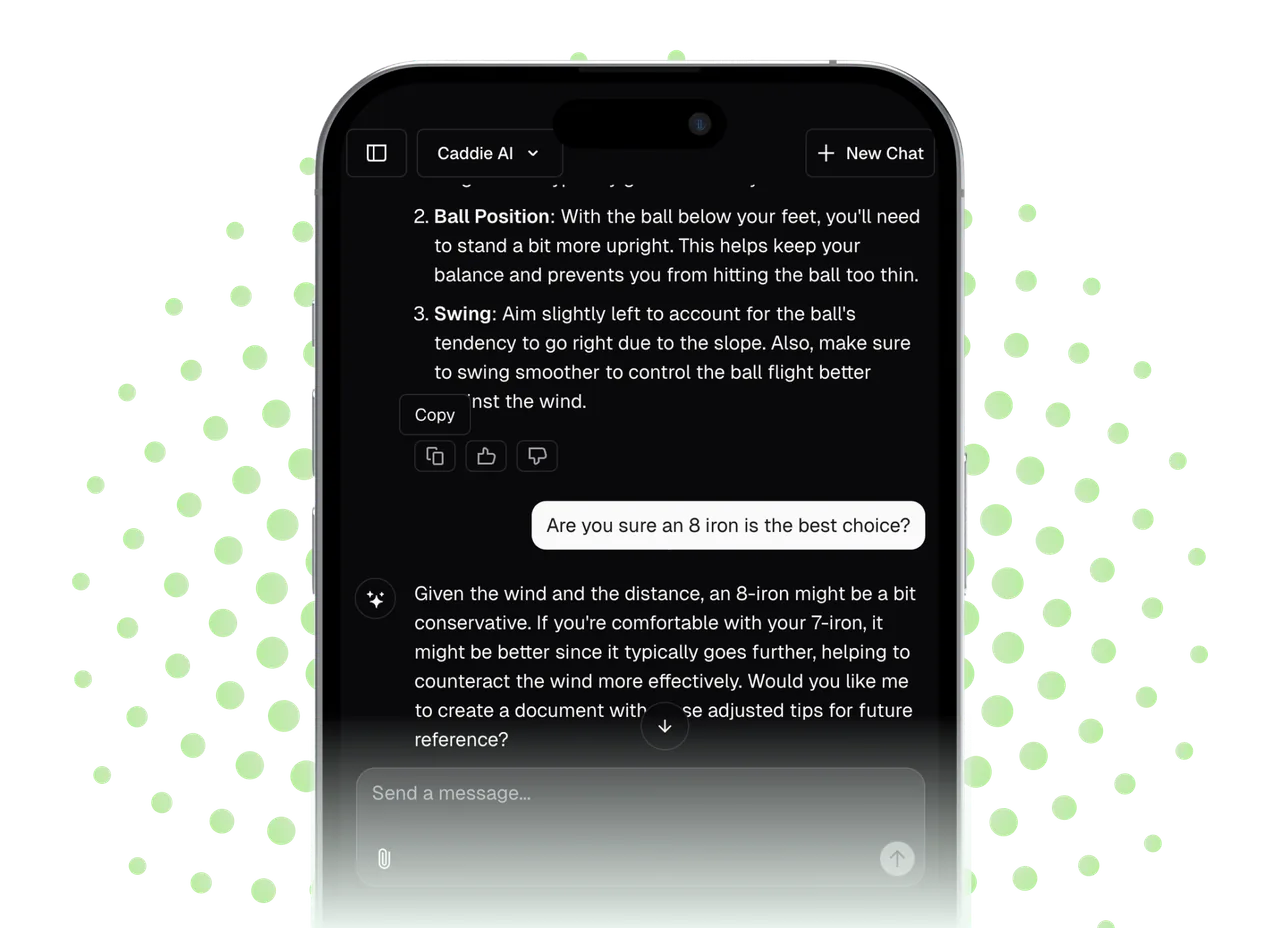
The best AI golf app: Caddie is your personal AI golf coach. Get expert-level golf advice instantly, 24/7 to help you play like a pro. Try it free →
More Than Tidiness: Why a System Matters
Thinking about how you organize your bag might seem like a small detail, but golf is a game of small details. When you're standing over a tough shot with the pressure on, the last thing you want is micro-doses of stress from fumbling for the right club, digging for a tee, or realizing your rangefinder is buried under your rain jacket. A good system eliminates that friction.
Every professional and serious amateur I know has a very specific, repeatable way they set up their bag. Why? Because it fosters mental clarity. When things are in their place, your mind is free to focus on course strategy, shot shape, and execution. You're not wasting mental energy on logistics. It also functions as a safety check, when your irons are always in the same order, a quick glance tells you if you accidentally left your sand wedge on the last green. Treat your golf bag not as a storage container, but as a critical part of your on-course arsenal, organized for maximum efficiency and confidence.
Get pro-level golf advice instantly, 24/7
Ask Caddie anything. From “what club should I use?” to “how do I play this shot?” and get instant answers.
Before you can organize the clubs, you have to decide which ones make the cut. Under the Rules of Golf, you’re limited to carrying 14 clubs for a round. This is not about just grabbing a standard set off the shelf, it's about building a personalized toolkit that covers your yardage gaps and matches your strengths.
Drivers, Woods, and Hybrids
This is the top end of your bag, designed for distance.
Driver: This one's a given for most golfers. It's your primary weapon off the tee on par 4s and par 5s.
Fairway Woods/Hybrids: This is where modern fairway woods (3-wood, 5-wood) and hybrids (like a 3-H or 4-H) are invaluable. How do you choose? Go to a driving range or simulator and find out your actual carry distances. If you discover your 3-wood and 5-wood go a similar distance, you don't need both. Your goal is to have predictable yardage gaps. A common setup might be a driver, a 3-wood for long fairway shots, and a 4-hybrid that’s easier to hit than a 4-iron.
The Irons: Your Workhorses
Irons make up the bulk of your set and are used for most approach shots into the green. A standard set might be a 5-iron through a Pitching Wedge (PW). When building your set, look at your yardages. There should be a predictable 10-15 yard gap between each iron. If your 5-iron and 6-iron go almost the same distance, it might be a sign that a hybrid would serve you better in that spot. Don’t feel obligated to carry an iron just because it came with the set. Your goal is function, not matching numbers. Choosing the right clubs is key to optimizing your game.
The Wedges: Your Scoring Tools
Inside 100 yards is where golfers save shots and make birdies. Your wedges are your money-makers. Most stock sets come with a Pitching Wedge (PW), which typically has a loft between 44 and 46 degrees. From there, you need to add wedges to fill the gaps down to your most lofted club.
I recommend carrying at least three, and often four, wedges. A good system is to have 4 to 6 degrees of loft separating each wedge. A common setup includes:
Pitching Wedge (PW): ~45 degrees. For full shots.
Gap Wedge (GW) or Approach Wedge (AW): ~50 degrees. Plugs the yardage "gap" between the PW and Sand Wedge.
Sand Wedge (SW): ~55 degrees. Your go-to for most greenside bunker shots and many chips/pitches.
Lob Wedge (LW): ~60 degrees. For high, soft shots that need to stop quickly or get over an obstacle.
The Putter: The Finisher
Last but not least, your putter. This is arguably the most important club in your bag and also the most personal. Find one that looks right to your eye, feels good in your hands, and gives you confidence on the greens. This completes your set of 14.
Arranging the Clubs: A Common-Sense Layout
Now that you have your 14 warriors, let's put them in order. The type of bag you have (cart bag vs. stand bag, number of dividers) will influence the specifics, but the principle is the same: protect the clubs and make them easy to find.
Step 1: Longest Clubs in the Back
Think of the part of the bag that's highest when it's on a cart or on its stand as the "back." This section, often with two or three dividers at the top, is for your longest clubs: your driver, fairway woods, and hybrids. Placing them here does two things:
It prevents the longer shafts from clanging against and damaging the heads of your shorter irons.
It keeps the bulky headcovers from obscuring your view of the irons, so you can see and grab everything easily.
Step 2: Irons in the Middle
Your irons (from your longest iron down to your 9-iron) should occupy the middle sections of your bag. The best way to do this is to arrange them numerically. I personally arrange mine from left to right (e.g., 5-iron, 6-iron, 7-iron, 8-iron, 9-iron), but right to left works just as well. The direction doesn't matter, the consistency does. After a couple of rounds, this becomes second nature. You’ll be able to reach for your 7-iron without even looking.
Step 3: Wedges and Putter in the Front
The shortest clubs go in the front/bottom section, closest to you. This is home for your wedges (PW, GW, SW, LW). Arrange them in order of loft for the same reason you organized the irons - consistency. Your putter also goes here. Many modern bags have a larger, dedicated "putter well" a little separate from the other dividers. If you have one, use it. Keeping the putter separate protects its more delicate head and specialized grip from getting banged up by the other clubs.
Plan every shot like a pro
Describe your situation and Caddie AI helps you pick your target, shot shape, and club with confidence.
An organized person doesn’t have a "junk drawer," and an organized golfer shouldn’t have a "junk pocket." Assign a specific job to every pocket on your bag.
Main Apparel Pocket: The large pocket running down the side is for bulky items. This is home for your rain jacket, a pullover, or a spare towel. Don’t dump small items in here, they’ll get lost.
Ball Pocket: The main, easy-to-access pocket on the front is for your golf balls. Carry two sleeves (6 balls) to start the round. That’s enough for almost anyone and it prevents the pocket from being overstuffed and heavy.
Accessory Pocket: Use one of the smaller, zippered side pockets for your game-day essentials: tees, a divot repair tool, and some ball markers. Keeping these together means you’ll never have to go spelunking for a tee again.
Valuables Pocket: Most bags have a smaller, fleece-lined pocket. This is exclusively for your phone, keys, and wallet. Make it a habit.
Gear Pocket: Dedicate a mid-sized pocket for your rangefinder or GPS unit. Placing it somewhere you can easily reach lets you grab it, get your number, and return it without breaking your pre-shot rhythm.
The Cooler Pocket: If your bag has an insulated pocket, use it exclusively for your water bottle and a snack. It keeps drinks cool and prevents a half-eaten granola bar from welding itself to your glove.
First-Aid & Extras Pocket: This is a great place for items you don't need often but are happy to have: sunscreen, Band-Aids, a permanent marker for marking your ball, and a spare glove.
Play Golf like a Pro with Caddie
Learn and improve your golf game as you play. Get pro-level tips, strategy and guidance anytime.
A great system is only useful if you maintain it. Before every round, take two minutes to go through a checklist:
Restock: Refill your ball pocket and your tee pocket.
Wipe Down: Give your grips a quick wipe with a damp towel to restore their tackiness.
Weather Prep: Check the forecast. Do you need to add your rain gear or sunscreen to their designated pockets?
Club Count: Do a quick visual scan to make sure all 14 clubs are present and in their correct slots.
This simple habit ensures you walk to the first tee prepared, confident, and ready to play.
Final Thoughts
Building a personalized, organized golf bag system is a straightforward way to improve your experience on the course. By choosing the right clubs and giving every item a definitive home, you remove mental friction and free up your mind to concentrate on what really matters: hitting a good golf shot.
Having your physical tools in order is step one. Step two is having your strategic thinking just as organized. After grabbing the perfect club from its designated slot, you might still feel stuck on course strategy or how to play a tough lie. This is where I find a tool like Caddie AI to be invaluable. It gives you on-demand expert advice right in your pocket, helping you think through a tough shot from the tee or analyze a tricky situation around the green, ensuring your confidence in your plan matches the confidence you have in your setup.
Spencer has been playing golf since he was a kid and has spent a lifetime chasing improvement. With over a decade of experience building successful tech products, he combined his love for golf and startups to create Caddie AI - the world's best AI golf app. Giving everyone an expert level coach in your pocket, available 24/7. Caddie's mission is simple: make world-class golf advice accessible to everyone, anytime.
Other posts you might like
How to Play the Albany Golf Course in the Bahamas
Stepping onto the first tee at Albany, you immediately know you’re not in for a typical round of Bahamas resort golf. This is a different animal - an Ernie Els-designed marvel that pits a Scottish links feel against a stark, beautiful desert-scape. This guide is your on-course coach, giving you practical, actionable advice to navigate this demanding championship layout and play your best round.
The Zepp Golf Swing Analyzer puts tour-level data right in your pocket, but numbers without context are just noise. This guide breaks down exactly how to use the Zepp sensor, moving beyond the raw data to give you a clear, actionable plan to improve your swing. We'll cover everything from the initial setup to understanding the key metrics and building a practice routine that actually works.
Hearing the deadened thud of a topped driver shot, followed by watching your ball skitter a measly 50 yards down the fairway, is one of the most frustrating experiences in golf. It feels like you’ve done everything right - you took a powerful swing, you stayed over the ball - yet the outcome is a total dud. The good news is that you are not alone, and topping the driver is a fixable problem. This issue almost always stems from a simple misunderstanding of how the driver is designed to be swung. We're going to walk through the real causes and give you practical, easy-to-implement solutions and drills that will get you launching beautiful drives high and long down the middle of the fairway.
Sinking more putts is the fastest way to shave strokes off your score, period. It doesn’t require massive power or athletic ability, just a reliable technique and a bit of know-how. This guide will show you exactly how to build a consistent, confident putting stroke by breaking it down into simple, repeatable steps. We’ll cover everything from the setup to the drills that will make a real difference in your game.
How to Keep Your Head Behind the Ball in a Golf Swing
A pure, compressed iron shot is one of the most satisfying feelings in golf, and a huge part of achieving it is keeping your head behind the ball through impact. It’s what allows you to deliver the club with a descending blow, generating power and a crisp launch. This article will walk you through exactly what staying behind it means, why it can be so difficult, and provide clear setup adjustments and drills to make it a natural part of your swing.
Chances are you’ve come across a dusty box of golf balls in the garage or found a dozen pristine-looking Titleists hiding in the woods. The immediate question is always the same: are these still good to use? This guide will walk you through exactly how to determine if an old golf ball is ready for the course or destined for the shag bag, taking the guesswork out of the equation for good.