Setting up your new Ogio golf bag correctly goes beyond just making it look tidy, it’s about creating a system that makes every round smoother and more enjoyable. A well-organized bag means you can find what you need without a second thought, allowing you to focus completely on your next shot. This comprehensive guide will walk you through setting up your Ogio bag club-by-club and pocket-by-pocket, leveraging its unique features to give you an on-course advantage.
The best AI golf app: Caddie is your personal AI golf coach. Get expert-level golf advice instantly, 24/7 to help you play like a pro. Try it free →
First, Understand Your Ogio Bag’s Innovative Design
Ogio doesn’t make run-of-the-mill golf bags. They are engineered with specific, purposeful features that, once understood, can be a game-changer for your on-course efficiency. Before we start loading it up, let's get familiar with the hardware.
The Woodē Divider Top
The most iconic feature on many Ogio bags is the Woodē™ Hybrid Top. This isn't just a random arrangement, it's designed to protect your most expensive clubs. You'll notice a separate, often wood-grained section with larger openings, positioned at the back or high side of the bag. This area is specifically for your driver and fairway woods.
Why is this important? The graphite shafts on your woods are more susceptible to damage from the constant clattering of steel-shafted irons. By isolating them in the Woodē Top, Ogio protects those shafts from nicks and scratches, adding an extra layer of protection and extending their life. You’ll find different configurations like the 8-way, 14-way, or 15-way tops, but the principle remains the same: woods have their own designated home.
Purpose-Built Pockets
Walk around your bag and you’ll notice that each pocket seems to have a personality. That’s by design. Ogio creates intuitive storage solutions. You’ll typically find:
A Full-Length Apparel Pocket: The largest pocket running down the side, perfect for bulkier items like rain gear or a pullover.
A Fleece-Lined Valuables Pocket: This soft-lined, often water-resistant pocket is your sanctuary for your phone, keys, and wallet. No more screen scratches.
An Insulated Cooler Pocket: Exactly what it sounds like. It's designed to keep your drinks and a snack cool throughout your round. On some models, this is called the "Chill-ax" pocket.
A Ball Pocket or Silo: Positioned for easy access, this is where your golf balls live. Some models have a sleeker, zip-off ball pocket.
Accessory Pockets: Smaller compartments for all the bits and pieces: tees, divot tools, ball markers, and rangefinders.
The Cart Strap Pass-Through: This is a brilliant feature on their cart bags. It’s a channel behind the main pockets that the cart's security strap threads through. This secures your bag without blocking access to any of your pockets - a huge convenience.
Get pro-level golf advice instantly, 24/7
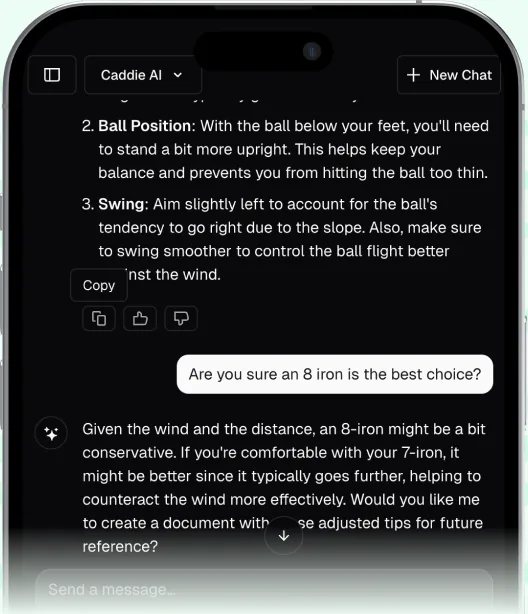
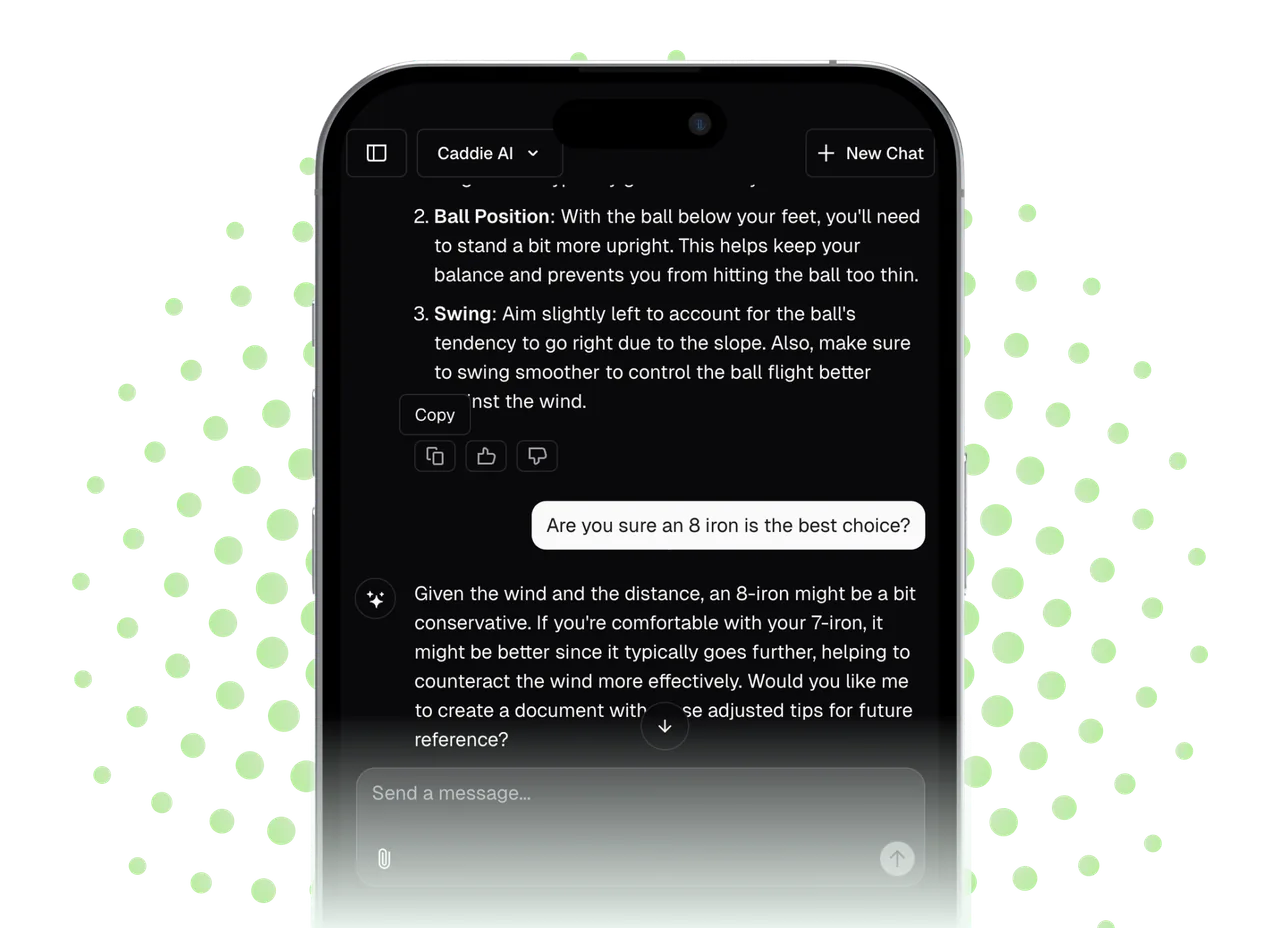
Ask Caddie anything. From “what club should I use?” to “how do I play this shot?” and get instant answers.
There is a time-tested logic to golf bag organization that pros and good amateurs follow. The goal is twofold: protect your gear and make it effortless to grab the right club. A good system eliminates confusion and lets you walk with more confidence.
The universal rule is this: longest clubs at the back, shortest clubs at the front.
Think of how your bag sits on a push trolley or a riding cart. It’s tilted backward. Placing the longest clubs (driver, woods) at the rear (the highest point) and the shortest clubs (wedges, putter) at the front (the lowest point) creates a cascading effect. This "stadium seating" for your clubs means you can see every single clubhead at a glance. You’ll never have to hunt for your 9-iron behind your 3-wood again. This system also significantly reduces "club chatter" - that annoying clanking sound that can damage club heads and shafts.
Step-by-Step: Arranging Your Clubs in Your Ogio
Now, let’s apply that logic to your Ogio bag. We’ll use a 15-way Woodē top as our primary example, as it’s one of their most popular layouts, but the principles apply to all models.
Step 1: The Woodē Top for Your Woods and Driver
This is your starting point. Identify the dedicated Woodē divider slots. This is the non-negotiable home for your longest clubs.
Place your driver in the top-most, single slot. It has the longest shaft and the biggest headcover, so giving it pride of place prevents it from obstructing your other clubs.
In the adjacent Woodē slots, place your fairway woods (e.g., 3-wood, 5-wood).
If you carry hybrids, they often fit nicely here too, or in the top row of the iron section right below the woods. Grouping them all together makes sense functionally.
Step 2: Placing the Irons in Cascading Order
With the woods settled, move on to your irons. You're going to arrange them in descending order from the back to the front.
Top Row (Below Woods): This is where your long and mid-irons go. Start with your lowest-numbered iron (e.g., 4-iron or 5-iron) on one side and work your way across to the higher-numbered mid-irons (e.g., 6-iron, 7-iron). If you keep your hybrids here, they'll sit happily next to your long irons.
Bottom Row: This row is for your scoring clubs. Arrange your short irons (e.g., 8-iron, 9-iron) and your wedges (Pitching Wedge, Gap Wedge, Sand Wedge, Lob Wedge) here. These are the clubs you reach for most frequently inside 125 yards, so having them at the front makes them incredibly easy to see and grab.
Step 3: The Dedicated Putter Well
Your putter is arguably the most important club in your bag, so treat it that way. Nearly every Ogio bag features a large, oversized putter well, separate from the other dividers. It’s usually located at the front.
Using this well keeps your putter isolated, protecting its more delicate face and headcover from being bashed by other clubs. Its prominent position also makes it easy to grab and stow when you’re on the green.
Plan every shot like a pro
Describe your situation and Caddie AI helps you pick your target, shot shape, and club with confidence.
With the clubs in order, it's time to stock your pockets. Distribute weight thoughtfully and group similar items together. Think of it as setting up your mobile golf office.
Primary Apparel Pocket
Use the large, full-length side pocket for your bulky but lightweight items. This isn't the place for heavy gear.
Roll up your rain jacket and pants and keep them at the bottom. You won't need them often, but you'll be glad they're there when you do.
An extra pullover or wind-vest can sit on top.
Ball Pocket and Tee Storage
This front-facing pocket is about quick access. Don’t overstuff it.
Unbox one sleeve of your primary golf balls and have them loose in the pocket. You can grab one without fumbling with cardboard.
Keep one or two more backup sleeves in the same pocket but deeper in. You shouldn't need more than 9-12 balls for a round.
Many Ogio bags have designated tee holders on the exterior. Use them! It's much faster than digging through a pocket. Keep a handful of extras inside the ball pocket.
Valuables and Accessory Pockets
These smaller pockets are for the essentials.
Valuables Pocket: This is for your phone, wallet, and keysonly. The soft fleece lining is there to protect them. Keeping it dedicated prevents you from accidentally pulling out your car keys when you're looking for a ball marker.
Accessory Pocket: Use another small, accessible pocket for your divot repair tool, ball markers, and maybe a spare glove. Grouping these small items prevents them from getting lost.
Rangefinder Pocket: Choose a conveniently located side pocket for your rangefinder or GPS device so you can grab it before every approach shot.
Additional Storage
Insulated Pocket: Two bottles of water and a snack. Perfect.
Towel Loop: Hang your towel here. Invest in one with a loop or carabiner for easy attachment.
Umbrella Sleeve: Don't just jam your umbrella in with your clubs. Use the dedicated strap or sleeve. It's usually a loop at the top and a small pocket or anchor point at the bottom of the bag.
Glove Velcro®: Many Ogio bags have a small Velcro patch. This is an awesome spot to stick your glove between shots or while you putt to let it air out.
Play Golf like a Pro with Caddie
Learn and improve your golf game as you play. Get pro-level tips, strategy and guidance anytime.
Organizing your Ogio bag this way isn't just about aesthetics, it’s about translating the smart design of the bag into a better on-course experience. By setting your gear up logically, you reduce mental clutter and can move from shot to shot with confidence, knowing exactly where everything is.
With your bag set up for success, we think about what's next: simplifying decisions on the course. With Caddie AI, you can get the same level of brilliant simplification for a complex shot as Ogio brings to bag organization. When you're facing a tricky lie in the rough or you’re stuck between clubs on a windy par-3, you have a 24/7 expert right in your pocket. We can help you analyze the situation and get a clear, confident strategy, taking the guesswork out of the equation so you can just focus on making a great swing.
Spencer has been playing golf since he was a kid and has spent a lifetime chasing improvement. With over a decade of experience building successful tech products, he combined his love for golf and startups to create Caddie AI - the world's best AI golf app. Giving everyone an expert level coach in your pocket, available 24/7. Caddie's mission is simple: make world-class golf advice accessible to everyone, anytime.
Other posts you might like
How to Square the Shoulders in a Golf Swing
A slice that sails out of bounds or a pull-hook that dives into the woods can often be traced back to a simple, fundamental error: incorrect shoulder alignment. Getting your shoulders square - or, more accurately, learning to control their rotation - is a huge factor in hitting powerful, accurate golf shots. This tutorial will break down what it really means to have square shoulders, why it matters, and provide simple, actionable drills to sync up your upper body for more consistent ball striking.
Dragging mud, grass, and sand back to your car isn't just messy, it's a sign that your golf shoes are crying out for a little attention. A proper cleaning routine is about more than just looks - it restores grip, maintains breathability, and can double the lifespan of your favorite pair of FootJoys. This guide provides a straightforward method for washing your leather, synthetic, and mesh FootJoy golf shoes to keep them looking and performing their best.
A simple piece of rope might be one of the most effective tools for rebuilding your golf swing from the ground up. This article will show you exactly how to make your own rope swing trainer in just a few minutes with items you likely already have, and then teach you the drills that engrain proper tempo, sequencing, and effortless power into your motion.
Building your own golf practice net is a genuinely game-changing project that gives you the freedom to work on your swing anytime. This guide provides a straightforward plan to build a reliable and safe practice net, walking you through everything from choosing materials to the final assembly so you can start hitting balls in your own backyard or garage.
Finding the right golf instructor can be the single best investment you make in your game, cutting years off your learning curve and making every round more enjoyable. This isn’t about finding a magician who will grant you a perfect swing overnight, it’s about finding a guide who understands your goals and knows how to get you there. We're going to walk through the exact steps to find a coach you trust, covering what to look for, where to search, and what questions to ask to make a confident choice.
Slippery, worn-out golf grips are costing you strokes, and paying shop fees to replace them adds up. The good news is that changing your grips at home is a straightforward, satisfying project that can give you a better feel for the club and more confidence over the ball. This guide will walk you through exactly what you need and every step of the process, a few practical tips included.