Your Garmin watch is more than just a fancy GPS, it's a powerful tool designed to track every detail of your golf game, helping you pinpoint exactly where you’re losing strokes. To get the most out of that powerful tool requires using the Garmin golf ecosystem the right way. This guide will walk you through setting up your device, using it on the course, and, most importantly, deciphering the data afterward to make real improvements to your game.
The best AI golf app: Caddie is your personal AI golf coach. Get expert-level golf advice instantly, 24/7 to help you play like a pro. Try it free →
First Things First: Garmin Connect vs. The Garmin Golf App
Before we go any further, it's a good idea to clear up a common point of confusion. You have two primary apps: Garmin Connect and the Garmin Golf app. Think of it like this:
Garmin Connect is your general health and activity hub. When you finish a round, it syncs the basic activity (like a "Golf" workout) here, showing your heart rate, steps, and time played.
The Garmin Golf App is where all the detailed analysis lives. This is your command center for scorecards, shot-by-shot breakdowns, performance stats, strokes gained analysis, leaderboards, and course information. For our purposes, this app is where we'll spend most of our time.
To get started, make sure your Garmin watch is paired with your phone via Bluetooth and that you have downloaded both apps. The data syncs from your watch to Garmin Connect, which then pushes all the specific golf information over to the Garmin Golf app. The golf app is truly where your golf game lives.
Get pro-level golf advice instantly, 24/7
Ask Caddie anything. From “what club should I use?” to “how do I play this shot?” and get instant answers.
A great round starts before you even step on the first tee. A few minutes of prep on the Garmin Golf app will make your on-course experience much smoother and your data much more accurate.
Step 1: Download Your Courses
While your watch can find nearby courses using GPS, it's always faster and more reliable to download the course beforehand, especially if cell service is spotty at the club.
Open the Garmin Golf app.
Tap on "Course Search" (you'll usually find it under the "Play" or "More" tabs).
Search for the course you're playing by name.
Once you've found it, tap "Download."
The next time you sync your watch, the course will be sent to your device, ready to go.
Step 2: Set Up Your Virtual Golf Bag (Do Not Skip This!)
For accurate shot tracking and club suggestions, Garmin needs to know what clubs you carry. The AutoShot feature on your watch detects when you swing, but it has no idea if you hit a 7-iron or a 5-iron unless you tell it.
How to Add Your Clubs:
In the Garmin Golf app, go to 'More'.
Select 'Garmin Devices'.
Select "Golf Clubs."
From here, you can add, remove, and edit every club in your bag, from your driver down to your putter.
Be honest and specific. If you carry a 3-hybrid and a 3-iron, make sure they are both listed. This data is what powers the system's ability to analyze your performance with each club.
Part 2: Using Your Garmin On the Course
With your prep work done, it's time to play. Your watch is now your "assistant caddie," a powerful digital assistant helping you gather useful information for every shot.
Starting a Round and Scoring
Starting a round of golf is simple. On your watch, navigate to Activities and select "Golf." When your watch acquires a GPS satellite signal, it will display a list of local courses. Select the course you downloaded, choose the tees you’re playing from, and confirm if you want to keep score. That's it.
The screen will automatically show you the front, middle, and back distances to the green. You can often swipe or press a button to see hazard distances, get a view of the green layout, or an overview of the full hole.
After each hole, your watch will prompt you to enter your score and your number of putts. It's also at this moment that you should specify if you hit any penalties and whether your tee shot was in the fairway, the left rough, or the right rough. This bit of input only takes a few seconds but is hugely important for the post-round stats analysis.
Understanding Key On-Course Features
AutoShot Tracking: During your swing, your watch detects the impact and automatically records the shot's location. As you walk or drive to your ball, it's measuring the distance for you. After each hole, you can even review and edit shots if any were missed (e.g., small chips or putts).
PlaysLike Distance: This fantastic feature gives you an adjusted distance that accounts for elevation changes your eye might miss. A 150-yard shot playing severely uphill might actually be a 165-yard shot. PlaysLike Distance tells you that, helping you to finally trust in pulling out that extra club you knew in your heart you probably needed.
PinPointer: Have you ever faced a blind tee shot or an approach shot to a hidden green? PinPointer is your secret weapon. It provides a digital compass arrow that points directly to the pin, so even when you can’t see the flag, you always know exactly which direction to aim. It's a huge confidence booster when navigating tricky doglegs.
Hazard &, Layup View: With a quick swipe, you can see a map of the hole with distances to all hazards (bunkers, water, etc.) as well as pre-set layup distances (100, 150, 200 yards). This feature promotes better course management because it prompts you to think proactively to play away from trouble on a course. As a golf coach, my experience is that the number one thing separating amateurs from pros is proactively avoiding trouble.
Plan every shot like a pro
Describe your situation and Caddie AI helps you pick your target, shot shape, and club with confidence.
Part 3: The Post-Round Goldmine - Analyzing Your Game
This is where the magic happens. Your on-course efforts gathering data pay off here. After you save and end your round in your watch, sync your watch to your phone, and head to the Garmin Golf app to dig in.
Your Digital Scorecard
Don't just glance at your score and move on. Tap into the round to see the Scorecard Analysis. Here, you'll see a hole-by-hole visual of every shot you hit, laid out on a map of the course. You can see how long each shot traveled and where it ended up. This is a great way to reality-check your distances. You might think your 7-iron goes 160 yards, but the data will show you the real story.
Performance Stats: The Big Picture
Under the "Performance Stats" tab, you'll find your traditional stats like Greens in Regulation (GIR), Driving Accuracy, and Putts Per Round. But Garmin does a much better job than that of making sense of that type of information.
Driving Accuracy: Instead of just seeing you hit 50% of fairways, Garmin shows you where you missed: right or left. If you see that 9 out of 10 of your misses are to the right, you’ve just identified a huge pattern. That's not a random shot - that's a trend that gives you something incredibly specific to work on.
Approach Shots: This stat tracks your GIR based on which club you used. You might discover that you are surprisingly good with your 8-iron hitting greens 60% of the time, but struggle to hit the green with your PW - perhaps indicating you get too "handsy" with a delicate club in situations that just call for a putting-like chipping motion.
Garmin Golf premium members can also gain insights at a new level of sophistication entirely using advanced statistics - a level that used to be reserved for Tour professionals only.
Greens In Regulation: By showing a chart of misses–long, short, left, and right of the green–the approach shot analysis chart provides direct feedback on what you need to practice. Are all of your misses short? Then you may need to reconsider that your club yardages are less than what you believe, or if you should be taking the extra club more often. With time and more tracked rounds, the GIR chart gives you a crystal-clear summary by showing your misses organized around a 'bull's eye'-like target on the green from different yardages, providing insight into what club and what shot you should be practicing. As a coach, this tool alone is one of the most valuable resources you can tap into to practice the shots that can improve your game.
The Crown Jewel: Strokes Gained Analysis
Strokes Gained is arguably the most powerful game-improvement metric in golf, and having a basic understanding of it will completely transform how you practice. In simple terms, it compares your performance on every shot to that of a benchmark golfer (typically a scratch player) and tells you exactly where you are gaining or losing ground with an exact shot count attached to each category in a single round in relation to a scratch player.
The app breaks it down into four simple categories:
Off-the-Tee: Did your drive put you in a better or worse position than a scratch golfer from that same tee box? A great drive that finds the fairway will gain strokes, while a bad slice into the trees will lose strokes.
Approach: From your position in the fairway (or rough), how close a shot to the pin you're able to produce relative to a scratch player. Sticking one to 5 feet will gain you strokes, while leaving yourself a 60-footer will cost you shots. In our experience, this category is far and away the most important area to help amateur golfers improve their game.
Short Game: This covers your chipping, pitching, and bunker play around the green. For example, did your chip shot leave you with a relatively easy, short putt to save par? If so, chances are you are gaining strokes in a category that it's easy to differentiate yourself.
Putting: Did you make that 10-foot putt? A scratch player might only make it 40% of the time. If you drain it, you gain 0.6 strokes right there. If you three-putt from the same distance, you’ll lose strokes.
After a round, don't just look at the total Strokes Gained. Look at the categories. If you played a round and see you lost +5.2 strokes on Approach but only +0.5 strokes on Putting, your path to improvement becomes crystal clear. Your putting isn't the problem! Instead, your practice time should be laser-focused on your iron and wedge play. That kind of targeted feedback is something that, until recently, was only available to PGA Tour pros with a team of statisticians around them.
Play Golf like a Pro with Caddie
Learn and improve your golf game as you play. Get pro-level tips, strategy and guidance anytime.
In short, the Garmin golf ecosystem is a powerful system transforming your watch from a simple GPS device telling you distances to a comprehensive game analysis tool. By setting it up correctly, taking a few minutes to input your data, and a few minutes more reviewing it, you stop guessing about your game and start making informed decisions that lead to lower scores.
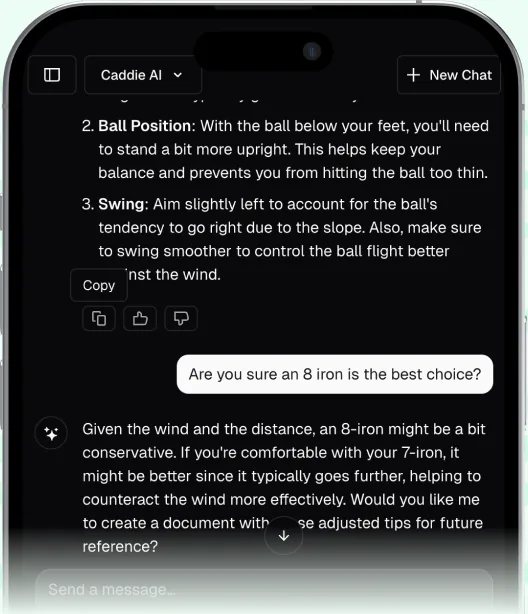
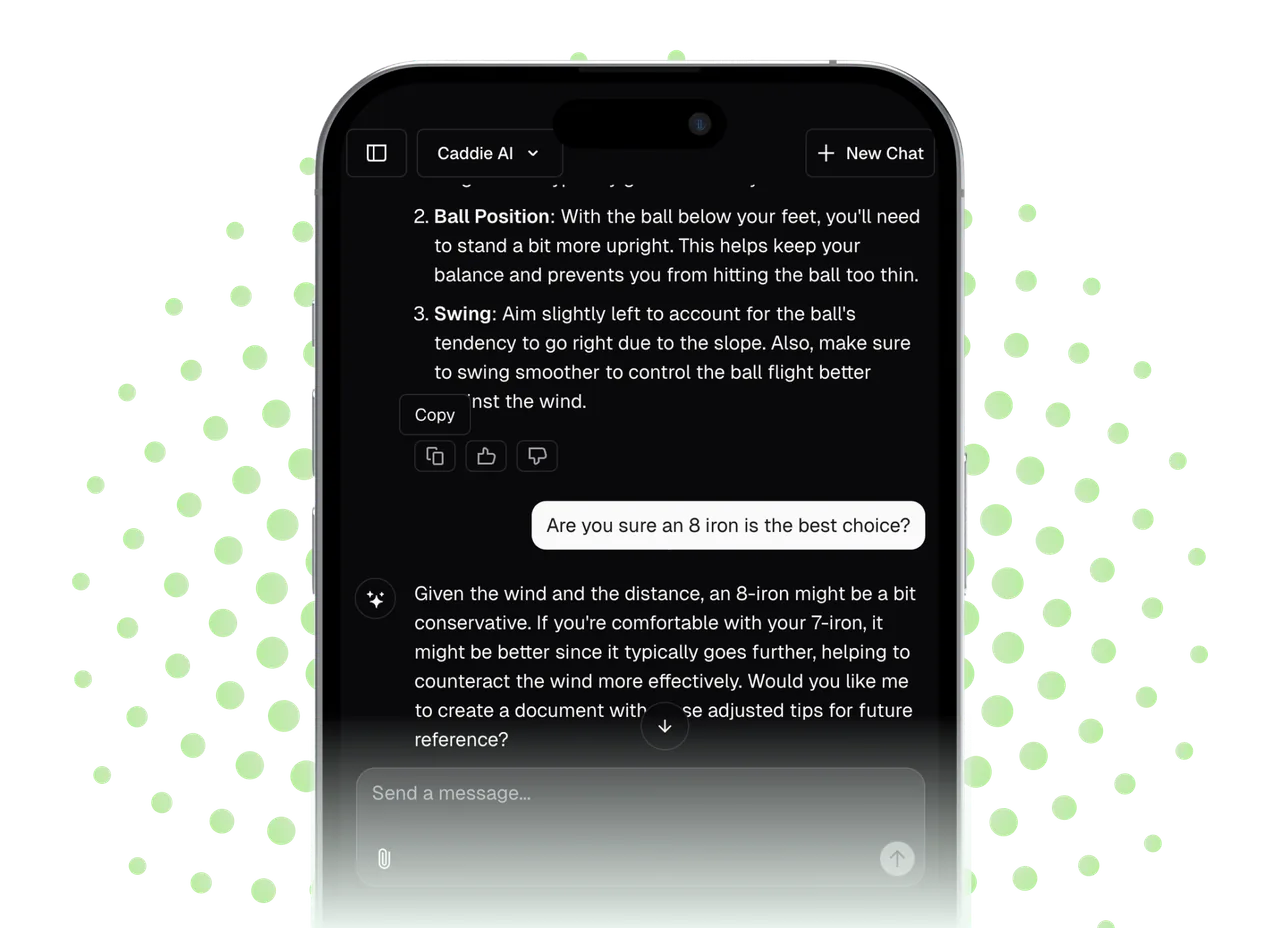
While the post-round data from Garmin gives you an objective look at what happened, our app, Caddie AI, can give you the real-time strategic advice you need on the course, when and where you need it. Think of it like a pro caddie in your pocket you can rely on on-demand. When you're standing over a shot not sure what to do, snap a picture of the lie, understand your options, and make the best decision for your next move. That type of simple, on-demand advice will give you the confidence you need, taking the second-guessing out of your game, and allowing you to focus on hitting your shot with confidence.
Spencer has been playing golf since he was a kid and has spent a lifetime chasing improvement. With over a decade of experience building successful tech products, he combined his love for golf and startups to create Caddie AI - the world's best AI golf app. Giving everyone an expert level coach in your pocket, available 24/7. Caddie's mission is simple: make world-class golf advice accessible to everyone, anytime.
Other posts you might like
How to Play Par Golf
Shooting par golf consistently isn't the result of a handful of perfect shots, but a solid strategy executed hole after hole. It’s less about a flawless swing and more about making smarter decisions on the course that avoid big numbers and keep your scorecard clean. This guide breaks down the strategic blueprint for playing par golf, from a new mindset down to specific tactics for your tee shots, approaches, and short game.
Building a great golf swing without shelling out for lessons is more achievable than you might think. It’s all about focusing on a few core fundamentals, using drills you can do on your own, and understanding the cause-and-effect relationships within your swing. This article will show you how to audit your own swing and make real improvements by breaking it down into simple, repeatable pieces.
That steep, chopping motion that takes a huge divot and sends the ball weak and to the right is one of golf's most common frustrations. It feels powerful, yet the results are anything but. The ball slices weakly, the contact feels jarring, and you're left staring at a crater in the fairway wondering what went wrong. In this guide, we’ll move beyond simply telling you to 'swing more from the inside.' We’ll dig into the real reasons you chop down on the ball and give you practical, step-by-step drills to replace that steep, unsatisfying motion with a powerful, connected golf swing.
How to Correct Hitting a Golf Ball on the Toe of the Club
There's nothing quite like the hollow, powerless sting of a golf shot hit on the toe of the club. You feel the vibration shudder up the shaft, watch the ball fall short and often leak disappointingly to the right. This article will cut right to the chase, showing you exactly why you’re making this common mistake. We’ll walk through the root causes, from your initial setup to your balance during the swing, and give you practical, easy-to-follow drills to find the sweet spot again.
A powerful and consistent golf swing starts with an efficient and correct backswing. This single move sets up everything that follows, from the club’s path on the way down to the power you deliver at impact. This guide will walk you through the essential components of building a backswing you can trust, ditching the common errors and replacing them with solid, repeatable mechanics.
Joining Merion Golf Club is one of golf's most elusive honors, born from a blend of history, character, and deep-rooted personal connection. The path isn't paved with an application form, rather, it’s a quiet, private process that unfolds over years. This article will peel back the curtain, moving beyond the myths to provide a clear, realistic guide on how membership at this iconic club actually happens.