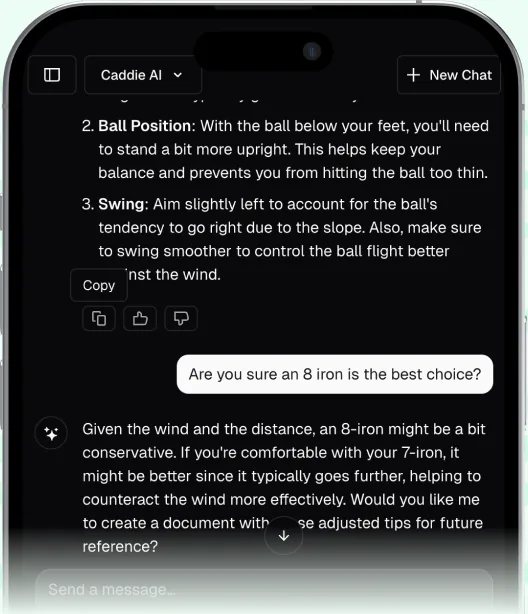
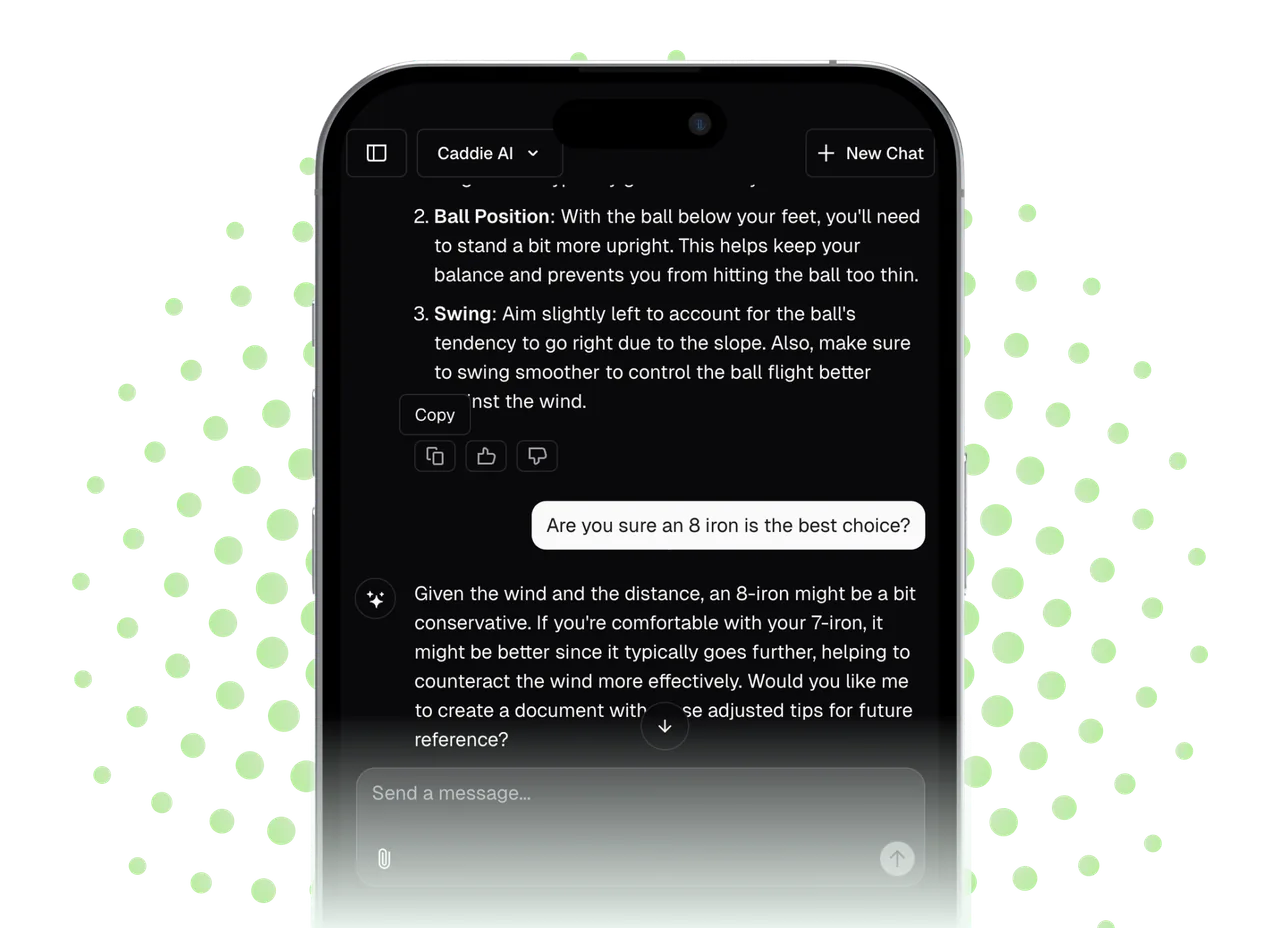
Yes, there is a hard limit to how many golf clubs you are allowed to carry in your bag, and that number is 14. This isn’t just a casual suggestion, it’s a fundamental rule of the game. This guide will walk you through everything you need to know about the 14-club rule, including the official rule, the penalties for breaking it, and - most importantly - how to strategically build your perfect 14-club set to play your best golf.
The best AI golf app: Caddie is your personal AI golf coach. Get expert-level golf advice instantly, 24/7 to help you play like a pro. Try it free →
The 14-Club Rule: What the Official Rules Say
The regulation governing the number of clubs you can carry is detailed in Rule 4.1b of theRules of Golf. It’s pretty straightforward, stating that a player must not start a round with more than 14 clubs or have more than 14 clubs during the round.
This rule exists for a simple but profound reason: to make golf a game of skill, not just equipment. Without a limit, players might carry 20, 25, or even 30 clubs, one for every conceivable distance and lie. The limit forces you to become a more creative and versatile golfer. You have to learn how to hit different types of shots with the same club - a three-quarter 8-iron, a choked-down 7-iron, or a hooded gap wedge. It's this type of shot-making that lies at the heart of the game.
It's important to understand what "counts" as a club:
All your clubs: This includes your driver, woods, hybrids, irons, wedges, and your putter.
Assembled components: If you're carrying a clubhead and a shaft separately, and they can be fitted together, they may count as a single club.
Broken clubs: Even a club that breaks during a round still counts toward your 14 until you can properly remove it from play.
Counting your clubs before you head to the first tee is one of the most basic, yet most important pre-round habits you can develop. It's a simple check that can save you from a completely avoidable penalty.
Get pro-level golf advice instantly, 24/7
Ask Caddie anything. From “what club should I use?” to “how do I play this shot?” and get instant answers.
Oops, I Have 15 Clubs! Understanding the Penalties
So, what happens if you tee off, reach the third green, and suddenly discover that old hybrid you were testing on the range is still in your bag, giving you a total of 15 clubs? First, don't panic. The rules have a clear procedure for this.
The penalty depends on the format you're playing:
In Stroke Play:
The penalty is two strokes for each hole where the breach occurred. Don't worry, you won't rack up an infinite number of penalty strokes. The maximum penalty for the entire round is four strokes. So, if you discover the extra club on hole 3, you get a two-stroke penalty for hole 1 and a two-stroke penalty for hole 2, for a total of four penalty strokes added to your score.
What to do Immediately:
Identify the extra club(s).
Declare them out of play. You can do this by telling your playing partners or a marker. You must take an action to indicate it's not being used, such as turning the club upside down in your bag or placing the headcover on it and setting it aside.
Do NOT use the extra club for the rest of the round.
Once you’ve taken it out of play, you won't accumulate any more penalties. The key is taking swift, clear action the moment you discover the mistake.
In Match Play:
The penalty is an adjustment to the state of the match. You will receive a one-hole deduction for each hole where the breach occurred. The maximum deduction is two holes from your current match score.
For example, if you were 1 Up in the match and discovered the extra club on the 3rd tee, you'd incur a two-hole penalty (for playing hole 1 and hole 2 with 15 clubs). Your score in the match would drop from 1 Up to 1 Down. Just like in stroke play, you must immediately declare the extra club out of play to avoid further penalties.
Plan every shot like a pro
Describe your situation and Caddie AI helps you pick your target, shot shape, and club with confidence.
How to Strategically Build Your Perfect 14-Club Set
The 14-club limit isn't just a restriction, it's an opportunity for you to tailor your equipment to your specific game, the courses you play, and your personal strengths. Building your ideal set is an ongoing process of discovery, but here's a framework to get you started.
The Foundational "Big Three": The Autopicks
For almost every golfer on the planet, three clubs are non-negotiable selections.
Driver: Your go-to club for maximum distance off the tee.
Putter: Self-explanatory. You'll use this more than any other club in your bag.
Pitching Wedge (PW): Typically comes with your iron set, this is your foundational club for short approaches and chipping.
Clubs used: 3 / Clubs remaining: 11
Crafting Your Iron &, Hybrid Section (About 7 clubs)
This is the heart of your bag, covering distances from about 75 yards up to 200+ yards. The biggest decision here is how you handle your long irons.
Mid and Short Irons (8-iron, 9-iron): These are scoring clubs used for approach shots where precision is paramount. Almost every golfer will carry these.
Mid Irons (6-iron, 7-iron): Staples for most players, covering those critical mid-range approach shots on par-4s and par-5s.
The Long Iron Debate (3, 4, 5-irons vs. Hybrids): This is where self-awareness is your best friend. For many golfers, especially high-to-mid handicappers, a 3, 4, or even 5-iron is notoriously difficult to hit consistently. They have very little loft and require a precise, downward strike to get airborne. Hybrids, by contrast, are designed with a wider sole and a lower center of gravity, making them much easier to launch high and land softly from a variety of lies.
A Common Strategy: Replace your 3 and 4-iron with equivalent-lofted hybrids (e.g., a 21° hybrid replaces a 3-iron, a 24° hybrid replaces a 4-iron). Some players even replace their 5-iron.
The Top of the Bag: Woods and Hybrids (About 2 clubs)
You have your driver, but you need options for long par-4s, reachable par-5s, or tight tee shots where a driver brings too much trouble into play.
Fairway Woods (3-wood, 5-wood): A 3-wood is a classic choice for the second-longest club in the bag, great from the tee and the fairway. A 5-wood is often easier to hit off the deck than a 3-wood and provides a higher ball flight.
Hybrids: A lower-lofted hybrid (like a 19° or "3-hybrid") can be a fantastic, versatile club that bridges the gap between your longest iron and your 3-wood. It's often easier to control than a fairway wood while offering more distance than an iron.
Example top end setup: 3-wood and 5-wood. OR 3-wood and a low-lofted hybrid.
Clubs used so far: 12 / Clubs remaining: 2
The Short Game Arsenal: Filling Your Wedge Gaps (2-3 clubs)
Your Pitching Wedge is a great start, but to have a complete short game, you need to "gap" your wedges properly. This means having consistent distance increments between them.
Gap Wedge (GW or AW): Usually around 50-52°. This club fills the critical “gap” between a full Pitching Wedge (around 45-47°) and a Sand Wedge. It’s perfect for full shots of 80-100 yards and longer pitch shots.
Sand Wedge (SW): Typically 54-56°. This is your primary club for greenside bunker shots and is also extremely versatile for pitching and chipping from the fairway and rough. Pay attention to the bounce - higher bounce is generally better for players with steep swings or who play on soft sand/turf.
Lob Wedge (LW): Typically 58-60°. A specialty club used for high, soft flop shots that need to stop quickly. Not every golfer needs one, but for those with confidence, it can be a lifesaver around the green.
Example wedge setup: GW (52°) and SW (56°).
Clubs used so far: 14 / Clubs remaining: 0
Sample 14-Club Setups for Different Golfers
Beginner / High-Handicapper Setup (Focus on Forgiveness)
Driver
5-Wood
4-Hybrid
5-Hybrid
6-Iron through 9-Iron
Pitching Wedge (PW)
Gap Wedge (GW)
Sand Wedge (SW)
Putter
Mid-Handicapper Setup (A Balanced Approach)
Driver
3-Wood
4-Hybrid
5-Iron through 9-Iron
Pitching Wedge (PW)
Gap Wedge (GW, 52°)
Sand Wedge (SW, 56°)
Lob Wedge (LW, 60°)
Putter
Low-Handicapper Setup (Focus on Precision)
Driver
3-Wood
Driving Iron (2-Iron or 3-Iron) or a lower-lofted hybrid
4-Iron through 9-Iron
Pitching Wedge (PW, 46°)
Gap Wedge (50°)
Sand Wedge (54°)
Lob Wedge (58°)
Putter
Play Golf like a Pro with Caddie
Learn and improve your golf game as you play. Get pro-level tips, strategy and guidance anytime.
The 14-club rule is much more than just a number, it’s an invitation to think critically about your game and build a set that empowers you to succeed. By understanding the core rule, the penalties, and the strategic possibilities, you can turn this limitation into a genuine competitive advantage by carrying only the clubs that truly work for you.
Once you’ve perfectly selected your 14 clubs, the challenge shifts to choosing the right one for each unique shot on the course. That’s where having an expert second opinion can make all the difference. Our goal with Caddie AI is to give you that confidence, acting as a personal caddie in your pocket. Whether you need a smart strategy for a tricky par-5 or are stuck between a 7-iron and an 8-iron for a tough approach shot, our app provides instant recommendations to help you commit to your swing and play smarter golf.
Spencer has been playing golf since he was a kid and has spent a lifetime chasing improvement. With over a decade of experience building successful tech products, he combined his love for golf and startups to create Caddie AI - the world's best AI golf app. Giving everyone an expert level coach in your pocket, available 24/7. Caddie's mission is simple: make world-class golf advice accessible to everyone, anytime.
Other posts you might like
Can You Get Old Golf Clubs Fitted?
Thinking about getting your trusty old golf clubs fitted is one of the smartest questions you can ask. The simple answer is yes, you absolutely can get older clubs fitted, but it’s not always a straightforward process. This article will walk you through what's possible, what's practical, and how to decide if breathing new life into your old gamers is the right move for you, or if it might be time for something new.
Thinking about using white spirit to regrip your golf clubs? It’s a common thought for any golfer looking to save a few bucks with a bit of DIY. We’ll get right to it - this article will walk you through whether it's a good idea, its pros and cons, and a much safer, more reliable method for getting your clubs feeling new again.
Almost every golfer has stood over a ball with a noticeable nick and wondered, Is this thing still good to go? The truth is, there’s no magic number of holes or hits before a golf ball officially retires. The real answer depends on a mix of its physical condition, your skill level, and what you’re trying to accomplish on the course. This guide will walk you through exactly when to keep a ball in play and when it’s time to send it to the shag bag.
Ever found your ball in a challenging spot, like a deep greenside bunker or nestled near a water hazard, and felt that moment of uncertainty? You look down at the ball, then at your club, and a question pops into your head: Am I allowed to rest my club behind the ball here? This single question can be the difference between a penalty-free shot and adding two frustrating strokes to your score. This guide will clear up all that confusion, showing you exactly when and where you can ground your club, so you can play with confidence and an understanding of the rules.
Seminole Golf Club in Juno Beach, Florida, stands as one of the most private and revered golf layouts on the planet, making a tee time there an exceptionally rare privilege. If you've ever wondered if you can simply book a round, the short answer is a definitive no. This article explains precisely why Seminole is shrouded in such exclusivity and details the very specific, and often elusive, paths to getting a chance to play this Donald Ross masterpiece.
Thinking about golf in Dubai likely conjures images of pristine, emerald fairways carved into the golden desert, with a futuristic skyline as your backdrop. You’re not wrong. The answer to whether you can play golf in Dubai is a resounding yes, and it’s an experience unlike any other. This guide will walk you through exactly how to make it happen, covering the best times to play, the must-visit courses, and some coaching tips to help you score well in the unique desert conditions.