Hearing your buddy yell "You piped that one!" is one of the best compliments you can get on a tee box. But what does 'piped' actually mean, and more importantly, how can you do it more often? This guide breaks down this classic golf term and gives you an actionable plan to start hitting those pure, powerful drives that make your foursome take notice.
The best AI golf app: Caddie is your personal AI golf coach. Get expert-level golf advice instantly, 24/7 to help you play like a pro. Try it free →
What Does It Mean to "Pipe" a Golf Shot?
In golf, to "pipe" a shot means to hit it perfectly - i ncredibly straight and with a lot of power. The term is almost exclusively used for drives with a driver or 3-wood. When you pipe a drive, you send the ball screaming down the center of the fairway, exactly as you intended. There's no major slice, no weak hook - just clean, penetrating ball flight.
The imagery is clear: think of the ball traveling a pre-determined path as if it were shot down a massive, invisible pipe right to its target. It's the kind of shot that feels effortless, sounds fantastic, and sets up your entire hole for success. It’s the drive we all chase every time we step onto the tee.
Get pro-level golf advice instantly, 24/7
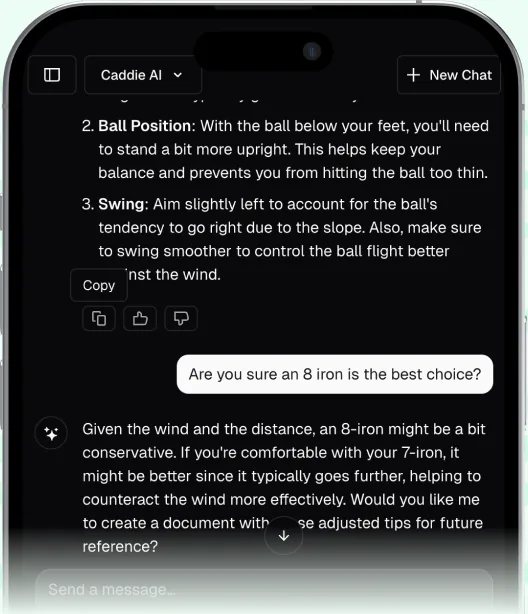
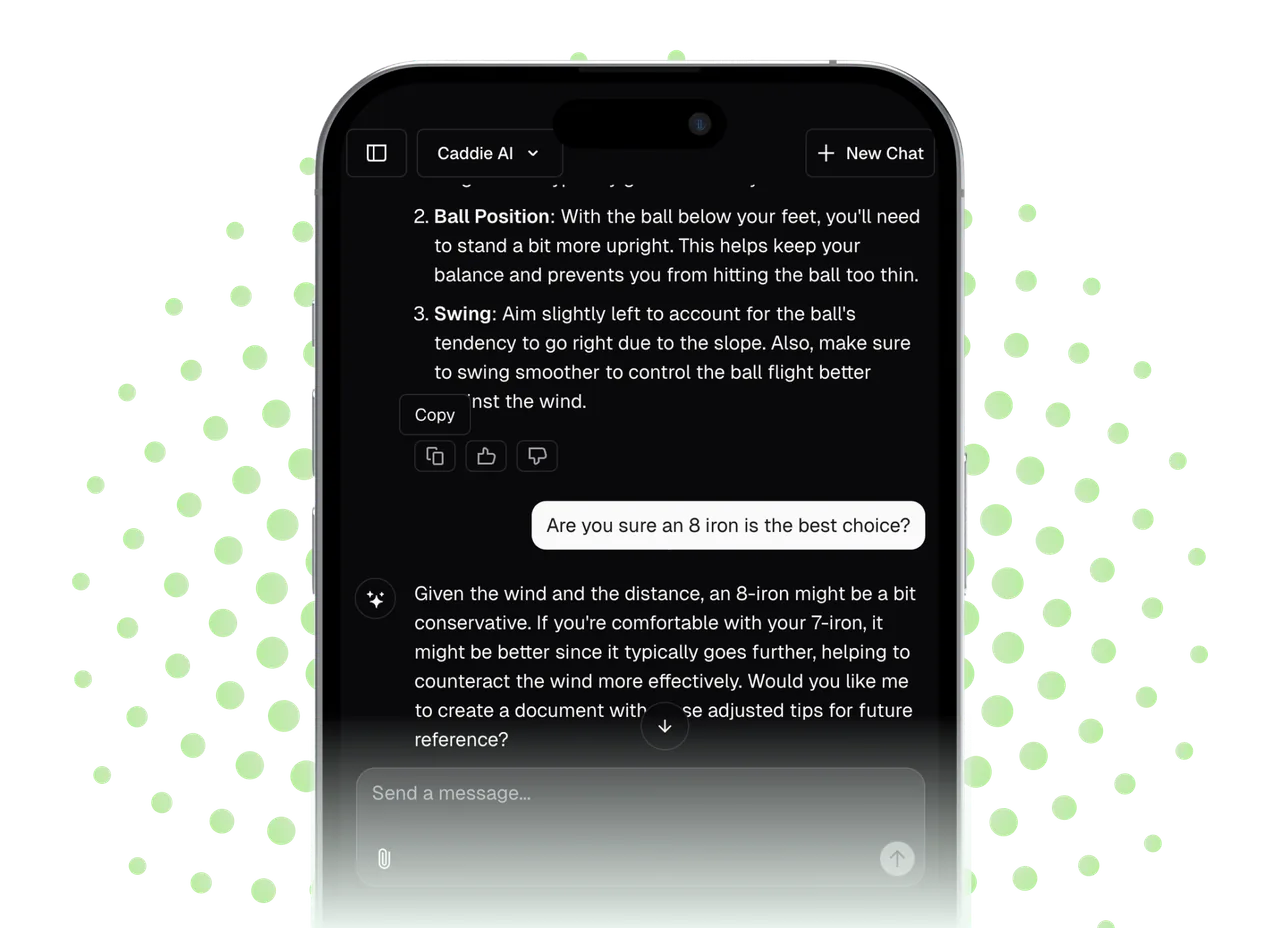
Ask Caddie anything. From “what club should I use?” to “how do I play this shot?” and get instant answers.
The Anatomy of a Piped Drive: What Does it Look and Feel Like?
Hitting a flush, piped drive is a full sensory experience. It's more than just a good result, it's a feeling that resonates from the clubhead up through your hands and arms. For new players, recognizing this feeling is the first step toward repeating it. Here’s what to look for:
The Sound: A piped shot has a distinctive sound. Instead of a high-pitched 'tink' or a thin 'click', it produces a solid, compressed 'thwack'. It’s a deep, satisfying percussion that signals a square strike and perfect energy transfer. You’ll know the sound when you hear it, and it's addictive.
The Feel: The feeling is one of supreme stability and quiet power. It’s often described as “hitting nothing” because the ball feels like it simply disappears off the clubface without any vibration or twisting in your hands. It feels smooth, balanced, and strangely effortless, even though the ball explodes off the face.
The Ball Flight: The visual is just as important. A piped drive has a strong, penetrating trajectory. It gets up in the air quickly but flies an arrow-straight line, sometimes with a very slight, controlled draw or fade, and rolls out for maximum distance.
Why Every Golfer Dreams of Piping Their Drives
Piping a drive isn’t just about showboating (though it is fun to watch it sail past your friends’ shots). It has a profound impact on your game and your mindset.
First, it's a massive confidence booster. Starting a hole with a perfect drive eliminates pressure and replaces it with a feeling of control and capability. That positive momentum can carry through the entire hole, and often, the rest of the round.
Second, and more practically, it makes the game easier. A piped drive that finds the middle of the fairway leaves you with a much shorter and simpler approach shot into the green. Instead of punching out from the trees or hitting a long iron from the rough, you're hitting a wedge from a perfect lie. This is the cornerstone of good scoring: taking the big numbers out of play and giving yourself more scoring opportunities.
Plan every shot like a pro
Describe your situation and Caddie AI helps you pick your target, shot shape, and club with confidence.
How You Can Start Piping More Drives: An Actionable Guide
That incredible feeling isn’t reserved for professionals. By focusing on the correct fundamentals, you can build a more consistent swing that produces solidly struck drives time and time again. Let’s break down the key movements.
Step 1: Build a Solid Foundation with Your Setup and Grip
Consistency starts before you ever take the club back. Your setup and your grip are the steering wheel of the swing, if they are off, you'll be making compensations the entire time.
Start with your grip. It should feel natural and neutral, not too strong (knuckles rolled over) or too weak (hand shifted under the club). A good checkpoint is to look down and see two knuckles on your top hand. This helps the clubface return to a square position at impact without you having to manipulate it.
Your setup should be athletic. Lean over from your hips, pushing your bottom back, until your arms hang naturally beneath your shoulders. Don’t stand too upright or hunch over too much. Your stance should be about shoulder-width apart to create a stable base that allows your body to rotate freely. For the driver, the ball should be positioned forward in your stance, just inside your lead heel. This setup promotes an upward angle of attack, which is ideal for launching the driver with high loft and low spin - the recipe for distance.
Step 2: Understand the Swing's Rotational Engine
Many amateur golfers try to create power by swinging their arms as hard as they can. This rarely works. True power comes from the body. The golf swing is a rotational action of the golf club moving around the body in a circle-like manner. It's powered by the big muscles in your torso and hips, not just your arms.
Think about winding up a spring. In the backswing, you rotate your shoulders and hips away from the target to store energy. In the downswing, you unwind that energy. The arms and club are just along for the ride, accelerating as a result of your body's powerful rotation. Focusing on this "rounded" motion instead of an "up and down" chopping motion is a game-changer for many golfers.
Step 3: Master the Takeaway and Backswing
A good backswing sets you up for a powerful downswing. A simple thought here can save you a world of trouble. As you start the backswing by turning your torso, allow your wrists to hinge slightly. This subtle move helps get the club on the correct plane, preventing it from getting stuck too far behind you or lifting too vertically.
As you rotate, imagine you are swinging inside a giant cylinder. You don’t want to sway from side to side, you want to turn within that space. Rotate your shoulders as much as your flexibility comfortably allows. You’re not trying to look exactly like a tour pro, you’re trying to find your most powerful and repeatable position.
Step 4: Unleash Power with the Correct Downswing Sequence
This is where that pure, compressed strike is born. From the top of your swing, the first move is not to throw your arms at the ball. The downswing should be initiated from the ground up. Start by making a slight shift of your weight and pressure onto your lead foot. This small move toward the target is what allows you to hit the ball first and compress it against the clubface.
Once you've made that initial move to your front side, all you have to do is unwind. Let your hips and torso rotate open toward the target aggressively. Because you started with that slight forward shift, your club will naturally approach the ball from the inside and on a path to strike it solidly. Your job is to keep turning and let the speed happen naturally. This sequence is what creates that effortless power you feel on a piped drive.
Step 5: Follow Through for Balance and Full Speed
The swing doesn’t end at impact. A full, balanced finish is a sign that you've transferred all your energy through the ball correctly. As you unwind through the shot, keep your body rotating all the way through until your chest and hips are facing the target.
A great goal is to hold your finish until the ball lands. You should feel about 90% of your weight on your front foot, with your back heel completely off the ground. Your arms should extend out toward the target after impact and then fold naturally around your body. A balanced finish shows you stayed in control and committed to the shot.
Play Golf like a Pro with Caddie
Learn and improve your golf game as you play. Get pro-level tips, strategy and guidance anytime.
Piping a drive is the pinnacle feeling for any golfer - the reward for a swing where everything comes together in perfect harmony. It's about combining technique, rhythm, and trust to send the ball exactly where you envisioned it, long and straight down the fairway.
Getting that perfect sequence consistently requires understanding your own unique swing patterns and having a plan. That's where we can help. Instead of guessing what to work on, you can use an app like Caddie AI to get instant, personalized feedback. By analyzing your shot data on the course or giving you simple, clear answers to your swing questions off it, we help you understand the "why" behind your shots. Caddie AI will give you the specific, expert-level advice you need to turn frustrating misses into piped drives, making the game simpler and a lot more fun.
Spencer has been playing golf since he was a kid and has spent a lifetime chasing improvement. With over a decade of experience building successful tech products, he combined his love for golf and startups to create Caddie AI - the world's best AI golf app. Giving everyone an expert level coach in your pocket, available 24/7. Caddie's mission is simple: make world-class golf advice accessible to everyone, anytime.
Other posts you might like
What Is a 2-Ball 3-Way in Golf?
Ever find yourself in a group of three on the first tee, wondering how to make the round more interesting than simple stroke play? Enter the 2-Ball 3-Way, a golf game that turns a standard threesome into an exciting web of competition. This article will show you exactly what a 2-Ball 3-Way is, how to set it up, how to keep score, and the best strategies to walk away a winner.
Imagine being able to stitch together your perfect round of golf - that booming drive you hit on the 1st hole three weeks ago, combined with the perfectly pure iron shot you struck on the 4th last Sunday, and topped off with that miracle 30-foot putt you drained on 17. This dream round isn't just a fantasy, it's the basis for a fun, engaging, and performance-tracking format called a Ringer Board. This article breaks down exactly what a ringer board is, how you can set one up for yourself or your club, and how to use it to not only have more fun but to become a better, smarter golfer.
Ever wondered how top golfers generate that effortless, explosive power you see on TV? A big part of their secret isn't just a picturesque swing - it's specific training designed to move the club <em>faster</em>. This is precisely where speed sticks come into play. If you've been looking for a proven way to add legitimate yards to your drives, you've come to the right place. This guide will walk you through exactly what speed sticks are, the science explaining why they work, and a step-by-step program you can use to add serious speed and distance to your game.
Standing over a putt that looks more like a small mountain range than a putting surface can intimidate any golfer. Golf course architects use these slopes and contours - collectively known as undulation - to test your skill and strategic thinking. This guide will walk you through exactly what undulation is, where you'll find it on the course, and how to adjust your game step-by-step to handle these slopes with more confidence.
Backstopping is when a player, on purpose, leaves their golf ball unmarked and in a position near the hole to potentially stop a playing partner's ball from rolling too far past the cup. This article will break down exactly what this is, what the official rules say about it, and the proper etiquette every golfer should follow to protect the integrity of the game.
The term 'rookie' in golf means so much more than just being a new player picking up a club for the first time. While it certainly describes beginners navigating their first rounds, it also has a very specific, formal definition in the world of professional golf. This guide will break down what it means to be a rookie, whether you’re just starting your golf journey or are curious about the official status you see on TV.