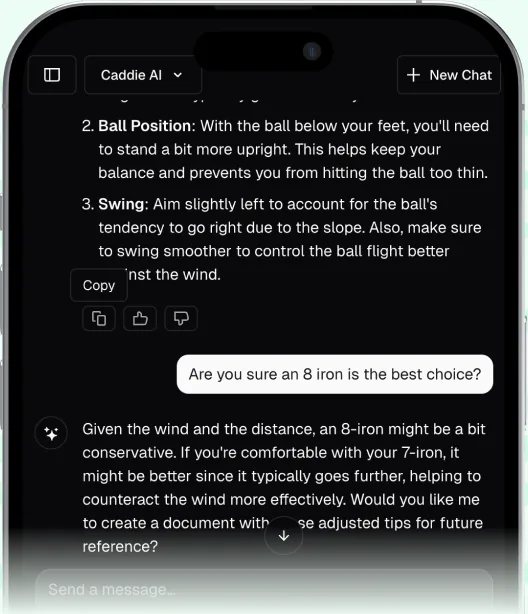
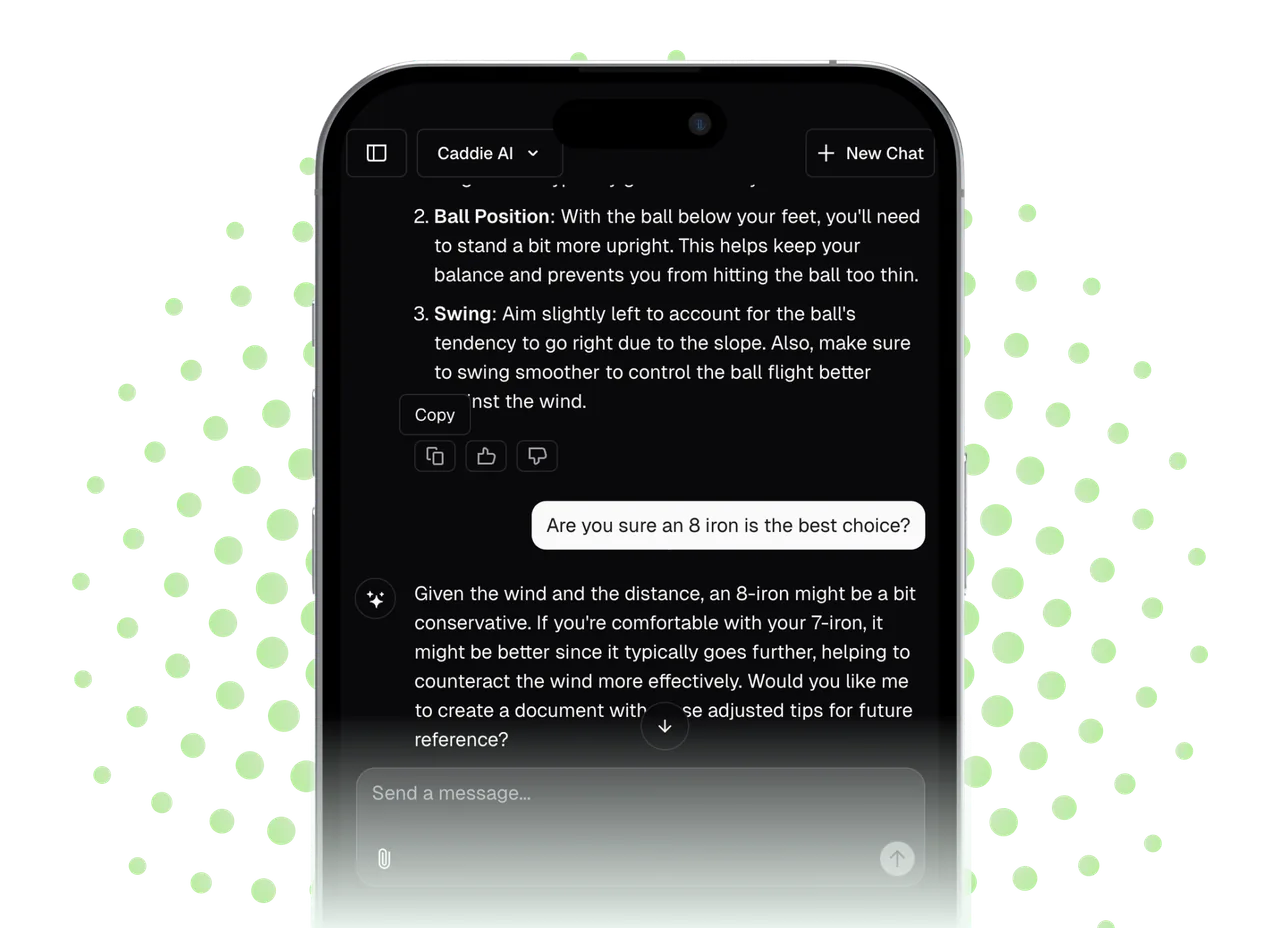
The definitive island green - the one that lives in the minds of golfers everywhere - is the 17th hole at TPC Sawgrass in Ponte Vedra Beach, Florida. This article will not only tell you about this iconic hole but will also give you a professional coach's strategy for how to conquer it. We'll even look at a few other spectacular island greens that owe their existence to the famous original.
The best AI golf app: Caddie is your personal AI golf coach. Get expert-level golf advice instantly, 24/7 to help you play like a pro. Try it free →
The Original (and Most Famous) Island Green: The 17th at TPC Sawgrass
There are many par-3s in golf, and many are surrounded by water. But none have captured the imagination - and instilled fear - quite like the 17th at The Players Stadium Course at TPC Sawgrass. At only 137 yards from the back tees, it looks innocent enough on paper. But as millions of golfers can attest, both professionals and amateurs, it is anything but simple.
A Happy Accident of Design
One of the most interesting things about the 17th is that it was never supposed to exist. During the course's construction in the late 1970s, the design team, led by the legendary and diabolical architect Pete Dye, needed a large amount of sand to build up the fairways and green complexes across the swampy Florida property. The area that would become the 17th happened to have the best quality sand.
So, they kept digging. And digging. By the time they were done, all that remained was a small patch of land marooned in the middle of a massive man-made lake. The story goes that Pete Dye's wife and design partner, Alice Dye, looked at the remaining mess and said, "Pete, why don't you just put a green on it?" With those simple words, golfing history was made. What started as a practical excavation site turned into a stroke of genius, creating a hole that is both beautiful and terrifying.
The Hole's Vital Statistics and Annual Drama
The 17th is the signature hole of TPC Sawgrass and the star of The Players Championship, arguably the fifth major in men’s professional golf. Every year in March, the best players in the world step up to this tiny tee box with a wedge or 9-iron in hand, with everything on the line.
Yardage: Approximately 137 yards for the pros, but it can play as short as 120 yards. For amateurs, it can play from around 100 yards.
Green Size: Deceptively large at around 78 feet in length and depth but features a narrow "pot bunker" on the front right.
The Victims: It is estimated that a stunning 100,000+ golf balls are hit into the surrounding water by amateurs each year. Even the pros aren't immune, as dozens of balls find a watery grave during The Players Championship every tournament.
What makes it so tough? It's a pure "do-or-die" shot. There is no bailout area. There is no fringe to run up onto. Your only options are the small strip of grass on the walkway connecting the green or the putting surface itself. A miss of just a few yards in any direction results in a penalty stroke and another attempt from the drop zone. The pressure is immense, amplified by thousands of spectators and the knowledge that a single poor swing can ruin a great round.
Get pro-level golf advice instantly, 24/7
Ask Caddie anything. From “what club should I use?” to “how do I play this shot?” and get instant answers.
So, You’re Standing on the Tee Box: A Coach’s Guide to Taming the Island Green
As a golf coach, I’ve seen what a hole like this can do to a golfer's mind and swing. The key to success isn't hitting a "hero" shot, it's about making a smart, committed swing. If you ever get the chance to play the 17th at Sawgrass or a similar island green, here is your game plan.
Step 1: Quiet Your Mind and Pick Your Target
The first challenge is mental. Your mind will be screaming "Don't hit it in the water!" The trick is to replace that negative thought with a positive one. Instead of focusing on the water, focus on your target. And your target should not be "the green." Be more specific. Pick the absolute dead center of the green. Ignore the pin if it's tucked near an edge. Your goal is simply to land the ball safely on the putting surface. Give yourself the largest possible margin for error.
Step 2: Club Selection - Trust, Don't Guess
This is where most amateurs go wrong. They select a club based on their absolute best-case-scenario distance. "My perfect 9-iron goes 135 yards," they think. But pressure and nerves often cause players to decelerate, leading to a weak shot that comes up short.
Here’s the pro approach: take one extra club. If you think it’s a perfect pitching wedge, pull the 9-iron. Hitting the ball a little long and ending up on the back of the green is infinitely better than landing in the water at the front. The wind is also a massive factor here, as it can swirl unpredictably. If you feel any wind in your face, add another club. It's better to be comfortably long than riskily short.
Step 3: The Pre-Shot Routine is Your Anchor
Under pressure, the worst thing you can do is rush. Your pre-shot routine is your anchor - your source of consistency and calm. Stick to it religiously.
Stand behind the ball and visualize the shot you want to hit: a high, soft shot landing in the center of the green.
Take a smooth, balanced practice swing, focusing on the tempo and feeling the weight of the clubhead.
Step up to the ball, take one last look at your target (the center of the green), and let it go.
Don't dawdle over the ball. Once you're set, it's time to swing.
Step 4: Commit and Swing Smooth
You've done the mental work, selected the smart club, and gone through your routine. Now, all that's left is to trust it. The only thought you should have in your mind is "make a smooth swing." Remember that power in the golf swing comes from rotation, not from hitting at the ball. It's a rounded action around your body. Allow your torso to turn back, and then unwind through the shot. Trying to "guide" the ball or "steer" it onto the green will only lead to disaster. Commit to your shot and make a full, confident swing.
Plan every shot like a pro
Describe your situation and Caddie AI helps you pick your target, shot shape, and club with confidence.
Beyond Sawgrass: Exploring Other Famous Island Greens
The success and infamy of the 17th at TPC Sawgrass inspired other course designers to create their own versions of the thrilling island green challenge. Here are a few notable ones:
PGA West (Stadium Course), La Quinta, CA - Hole 17, "Alcatraz": Another Pete Dye creation, this one feels even more like a stadium. Surrounded by a deep-blue lake and rock walls, "Alcatraz" demands a precise mid-iron shot to a green that slopes severely from back to front. Any shot that is not perfect will likely roll off into the water.
The Coeur d'Alene Resort Golf Course, ID - Hole 14: This is perhaps the most unique island green in the world - because it actually floats. The 15,000-square-foot green is moved daily via an underwater cable system, allowing the hole's yardage to change from 100 to over 200 yards. After you (hopefully) land your tee shot on the surface, you take a small electric ferry called "Putter" to the green to finish the hole.
TPC Danzante Bay, Loreto, Mexico - Hole 17: Set dramatically on a clifftop overlooking the Sea of Cortez, this green is an island in the sky. It's a true visual stunner, where the beauty of the surroundings is as big a distraction as the challenge of the shot itself. The drop-offs are extreme, making it a pure, all-or-nothing approach shot.
Apple Tree Resort, Yakima, WA - Hole 17: For a more lighthearted take, this course features an island green shaped exactly like a massive apple, complete with a stem-shaped bunker. It's a fun and memorable version that still provides a formidable challenge to any golfer.
Play Golf like a Pro with Caddie
Learn and improve your golf game as you play. Get pro-level tips, strategy and guidance anytime.
The 17th hole at TPC Sawgrass cemented its place in golf history as the original and most famous island green, a shot that tests skill, nerve, and decision-making all at once. Its legacy extends far beyond Florida, inspiring architects to create their own versions of this definitive golfing challenge all across the country. Success on these holes is less about physical talent and more about a solid mental process.
Even with a solid plan, standing over a do-or-die shot can cloud your judgment. That's why having a trusted voice for course strategy can be so powerful. With Caddie AI, you can get instant guidance for any situation, whether it's navigating an intimidating tee shot like an island green or figuring out your club choice when the wind picks up. We give you that clear-headed second opinion right in your pocket, taking the guesswork out of tough decisions so you can swing with confidence.
Spencer has been playing golf since he was a kid and has spent a lifetime chasing improvement. With over a decade of experience building successful tech products, he combined his love for golf and startups to create Caddie AI - the world's best AI golf app. Giving everyone an expert level coach in your pocket, available 24/7. Caddie's mission is simple: make world-class golf advice accessible to everyone, anytime.
Other posts you might like
What Determines the Par of a Golf Hole?
Ever stood on a tee box, glanced at the sign reading Par 4, 410 Yards, and wondered where that number Par 4 actually came from? It’s a number we see on every hole of every golf course, yet most players aren't entirely sure what goes into deciding it. This article breaks down exactly what determines the par of a golf hole, clarifying the primary factors and busting a few common myths along the way so you can understand the course architect's mindset.
When you're trying to figure out which golf club to swing first, the wall of choices can feel overwhelming, but the answer is simpler than you think. There is one club that stands out as the perfect tool for building a solid foundation. This guide will show you exactly which club to start with, explain why it's the best choice, and give you a clear path for moving forward.
The PGA Tour's Houston Open is played on the storied fairways of Memorial Park Golf Course, a truly unique public facility located in the heart of Houston, Texas. This article will walk you through the specifics of its current home, touch on the tournament's past venues, and give you a coach's perspective on what makes this Tom Doak-redesigned course a brilliant challenge for both the pros and amateurs lucky enough to play it.
Chants of Beeeef! once echoed across fairways from Europe to America, following a bearded, grinning golfer who became an instant fan favorite. But in recent years, those chants have grown quieter and Andrew 'Beef' Johnston has been a less frequent sight on tour leaderboards. This article breaks down exactly what happened to Beef, covering his meteoric rise, the physical and mental injuries that sidelined him, and what the lovable Englishman is up to today.
The single most debated question in golf instruction might be, What moves first in the golf swing? It sends golfers down endless rabbit holes, trying to isolate one body part to kickstart their entire motion. Here's a little secret: it's the wrong question. A powerful, consistent golf swing isn't about one body part moving first, it's about a <strong>chain reaction</strong> where every part moves in the right <em>sequence</em>. This article will stop the guessing and clearly explain the correct sequence for both the backswing and the downswing, giving you drills to finally feel how it all fits together.
Using the wrong practice golf ball can send your game in the wrong direction without you even realizing it. The feel, spin, and flight of the ball you use during your training sessions have a massive impact on how your skills translate to the actual course. This guide will walk you through the different types of practice balls, explaining exactly when and why to use each one to make sure your hard work pays off when it counts.