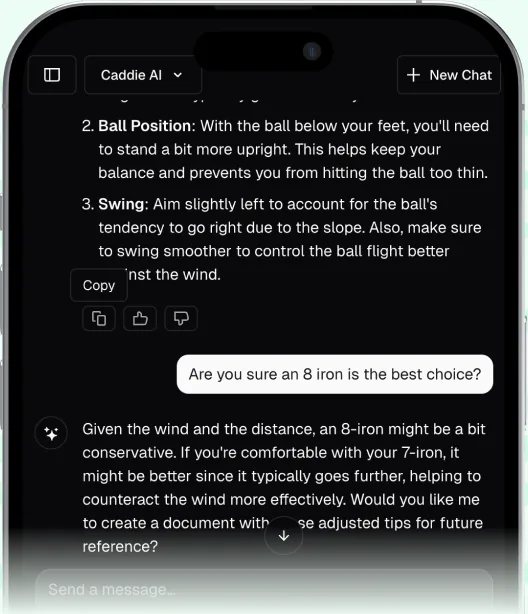
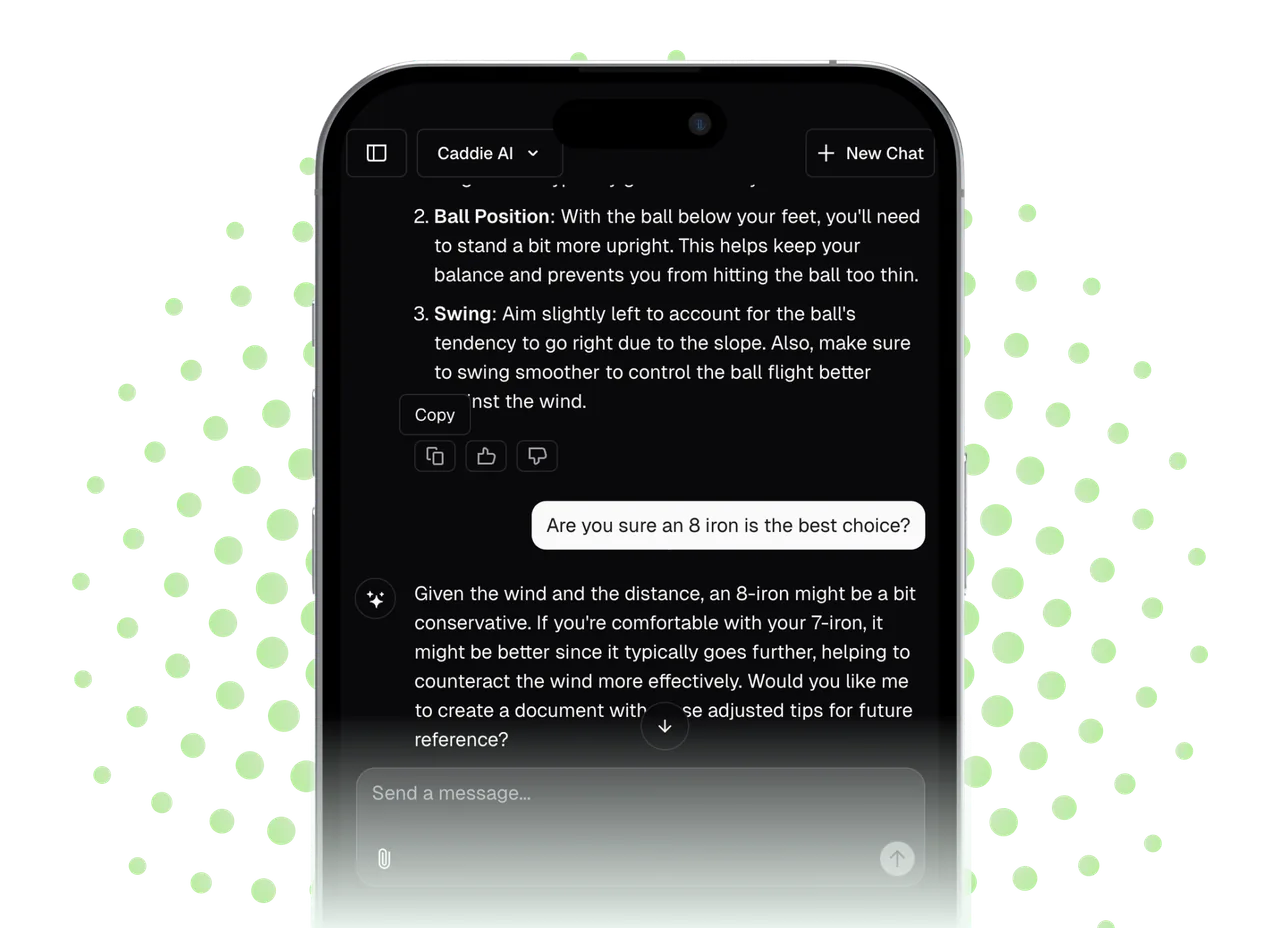
Ready to tee it up in the Land of Enchantment? New Mexico's golf scene is an incredible mix of high-desert jewels, alpine escapes, and award-winning championship designs. This guide breaks down exactly what courses are open throughout the year, from the constant sunshine of the south to the seasonal mountain layouts of the north, and gives you a coach's perspective on how to play them well.
The best AI golf app: Caddie is your personal AI golf coach. Get expert-level golf advice instantly, 24/7 to help you play like a pro. Try it free →
Understanding New Mexico's Golf Seasons
Unlike some states where golf shuts down entirely for months, New Mexico offers a diverse climate that allows for play nearly every day of the year, provided you know where to look. The state neatly divides into two primary golf climates: the year-round warmth of the south and the distinct four seasons of the north.
Southern New Mexico: Your Winter Oasis
From Las Cruces up through Socorro and Alamogordo, southern New Mexico is a golfer's paradise, especially from October through May. While the rest of the country might be shoveling snow, you can enjoy pristine conditions under brilliant blue skies. Summers get hot, making early morning or late afternoon tee times the smart play. But for the most part, courses in this region are open and thriving 365 days a year. The dormant, golden-brown rough framing lush green fairways is a beautiful and common sight during the cooler months.
Northern New Mexico: Alpine Peaks and High-Desert Plains
Northern New Mexico, which includes Albuquerque, Santa Fe, Taos, and Ruidoso, is a land of contrast. The operational status of a course here is a direct function of its elevation.
High-Altitude Mountain Courses: Layouts tucked away in the mountains of Ruidoso or near Taos and Santa Fe are highly seasonal. They typically open around April or May, once the last of the snow has melted, and close for the winter in late October or November. These months offer the reward of cooler summer temperatures and breathtaking scenery you just can't find elsewhere.
High-Desert Courses: The areas in and around Albuquerque and Santa Fe (that aren't in the mountains) are at a lower "high" altitude. Courses here are reliably open year-round. The primary challenge during winter isn't snow - it's frost. Be prepared for frost delays, where tee times are pushed back until the sun has had a chance to thaw the greens. Calls to the pro shop are essential for morning tee times between November and March.
Coach's Tip: When playing at New Mexico’s high altitudes (anywhere from 5,000 to 8,000 feet), your ball will fly farther than it does at sea level - often about 10% farther. You don't need to swing harder to get more distance. Instead, trust the science. Take one less club than you normally would for the yardage and make a smooth, controlled swing. A 150-yard shot might feel like a soft 8-iron instead of a full 9-iron.
Plan every shot like a pro
Describe your situation and Caddie AI helps you pick your target, shot shape, and club with confidence.
If you're looking for a guaranteed great round of golf any day of the year, the courses around Albuquerque are your best bet. These layouts combine incredible scenery with championship-level design and are kept in fantastic condition from January to December.
Twin Warriors Golf Club (Santa Ana Pueblo)
Just north of Albuquerque, Twin Warriors is a stunning Arthur Hills design that masterfully weaves through native high-desert terrain. The course is characterized by its rolling fairways, dramatic arroyos, and panoramic views of the Sandia Mountains. With 200 acres of undisturbed land surrounding the course, playing here feels like a true escape. It’s a resort course connected to the Hyatt Regency Tamaya, but it brings a serious challenge.
What Makes It Special: The bunkering is both beautiful and penal, and the course demands thoughtful strategy on every hole. The reverence for the native land is palpable, with many holes named after features of the Santa Ana Pueblo's history and culture.
Coach's Tip: Twin Warriors features several forced carries over deep arroyos. The key is to commit fully to your shot. Indecision is your enemy here. On the famous "Cave Hole," a short par-3 with a green tucked below a rock overhang, trust the yardage and don't let the visual intimidation trick you into taking too much club.
The University of New Mexico Championship Course (Albuquerque)
Don't be fooled by the "University" name, this is one of the most respected and challenging public courses in the entire Southwest. Known simply as "The Champ Course," this track has hosted numerous NCAA Championships and is a true ball-striker's course.
What Makes It Special: It's a public course with a private club feel and a professional tournament pedigree. There are no houses lining the fairways, just the natural desert landscape, giving it a pure and tough feel.
Coach's Tip: Your focus here needs to be on your approach shots. Leaving your ball on the correct tier of the green is everything. If you find yourself on the wrong level, your top priority should be lag putting. A two-putt from the wrong tier is a victory. Forget about making the putt and focus on getting it close to avoid a three-putt or worse.
Sandia Golf Club (Albuquerque)
Located at the Sandia Resort &, Casino, this Scott Miller design offers a more forgiving, resort-style experience compared to The Champ Course, but with equally spectacular views of the Sandia Mountains. The fairways are generous and the greens are large, yet strategic bunkering and water features on a few key holes keep you on your toes. It’s an exceptionally fun and scenic round of golf.
What Makes It Special: The conditioning is always immaculate, and the elevated tees provide some of the city's most Instagram-worthy vistas of the mountains, which turn a brilliant pink during sunset - a phenomenon known as "alpenglow."
Coach's Tip: This is a great course to build confidence. Because of the wide fairways, I often tell players to go ahead and be aggressive with the driver. The key to scoring well here is to take advantage of the par 5s. Use that extra distance from the altitude to get in a position where you can reach or get very close in two shots, setting up easy birdies or pars.
Play Golf like a Pro with Caddie
Learn and improve your golf game as you play. Get pro-level tips, strategy and guidance anytime.
High-Altitude Havens: Worth a Special Trip (In-Season)
When summer temperatures rise, the best golf moves to the mountains. These courses are typically open from spring to fall and offer an unforgettable experience defined by pine trees, dramatic elevation changes, and cooler air.
Paa-Ko Ridge Golf Club (Sandia Park)
Consistently ranked the number one course in New Mexico, Paa-Ko Ridge is truly a bucket-list destination. Located on the eastern side of the Sandia Mountains at an elevation over 6,500 feet, this Ken Dye design features 27 holes of jaw-dropping mountain golf. Every hole is framed by juniper and pine trees, and most are isolated from one another, giving you the feeling that you have the entire course to yourself.
What Makes It Special: The routing, the pristine conditioning, and the breathtaking views from the elevated tees are world-class. Each of the three nines has its own distinct character, but all demand precision and test every aspect of your game.
Coach's Tip:Side-hill lies are a constant feature at Paa-Ko. To handle them, adjust your setup. For a ball above your feet, choke down on the club and aim a bit right of your target, as the ball will tend to draw. For a ball below your feet, stand a little taller and aim left, as the ball will tend to fade. A stable base is more important than a powerful swing in these situations.
Black Mesa Golf Club (La Mesilla)
Prepare for a golf experience unlike any other. Designed by Baxter Spann, Black Mesa is a minimalist masterpiece sculpted from the dramatic sandstone ridges and valleys north of Santa Fe. It's often described as playing golf on the moon. There are blind shots, massive greens, and stark, natural bunkers. It is not a course for the faint of heart, but for those who appreciate pure, rugged golf architecture, it's a spiritual experience.
What Makes It Special: The raw, untamed beauty. The course feels like it was discovered rather than built. It challenges you to think, to be creative, and to accept an occasional bad bounce as part of a great adventure.
Coach's Tip: Local knowledge is a huge advantage here. Without a caddie, your main goal should be managing the greens. Many are elevated and have severe slopes. The rule of thumb is simple but absolute: stay below the hole. A 30-foot uphill putt is infinitely easier than a 10-foot downhill putt that could roll right off the green.
The Links at Sierra Blanca (Ruidoso)
Sitting at nearly 7,000 feet, The Links at Sierra Blanca is a classic mountain course and a fantastic retreat from the summer heat. This layout offers a parkland feel with tree-lined fairways, Scottish-style pot bunkers, and dramatic elevation drops. It’s a very playable design for all skill levels but presents enough of a challenge to keep better players engaged, especially on the impressive par 3s.
What Makes It Special: It's a playable and beautiful mountain course that doesn't beat you up. The cool, crisp mountain air and the scent of pine make for a relaxing and enjoyable day on the links, with beautiful views of Sierra Blanca Peak.
Coach's Tip: The biggest challenge here is judging your distances in golf on approach shots, especially those playing significantly downhill. When hitting to a green that's far below you, the ball will fly longer and won't spin as much upon landing. Take one or even two fewer clubs and play for the ball to land just short of the pin and release forward.
New Mexico provides a truly captivating and varied golf experience, with year-round championship courses in the high desert and stunning seasonal mountain tracks that are well worth the wait. By understanding the state's climate and preparing for high-altitude play, you can enjoy some of the most memorable and scenic rounds of golf found anywhere.
Planning a trip to navigate unfamiliar New Mexico courses can be a lot to handle, from guessing at club selection in the thin air to figuring out strategy on a blind tee shot. That’s where we wanted to remove the doubt. With Caddie AI, you can get instant, on-course advice for any hole you're playing. It acts as your personal caddie, helping you select the right club and a smart approach target. You can even snap a photo when stuck in a dry arroyo and get an expert recommendation on how to play the shot, helping you turn potential double-bogeys into momentum-saving pars.
Spencer has been playing golf since he was a kid and has spent a lifetime chasing improvement. With over a decade of experience building successful tech products, he combined his love for golf and startups to create Caddie AI - the world's best AI golf app. Giving everyone an expert level coach in your pocket, available 24/7. Caddie's mission is simple: make world-class golf advice accessible to everyone, anytime.
Other posts you might like
What Golf Ball Should a 15 Handicap Use?
Choosing a golf ball as a 15-handicap can feel surprisingly complicated, but it shouldn't be. Forget the marketing hype and the tour player endorsements for a moment. This article will cut through the noise and give you a an easy-to-understand framework to find the right ball that will actually help you shoot lower scores, without breaking the bank.
Stepping onto a golf course for the first time can feel like learning a new language. You hear terms like the fringe, fairway, and the rough, and it's easy to feel a little lost. Understanding the layout of a golf hole and what each area is called isn't just about sounding like a seasoned player - it's the first step to thinking like one. This guide will walk you through every part of a golf course, explaining what it is and giving you simple, practical advice on how to play from there.
Unlike many professional golfers who grow up learning the game on exclusive private fairways, Tiger Woods forged his legendary skills on a collection of modest Southern California municipal courses. This journey wasn’t about luxury or prestige, it was a masterclass in building a complete game through strategic practice on challenging, accessible public tracks. This article will take you on a tour of the key courses from Tiger’s childhood and explain the critical lessons each one taught him - lessons you can apply to your own game.
Walk down any driving range, and you’ll see bags filled with clubs from TaylorMade, Titleist, Callaway, and Ping. But ask a seasoned golfer about the brands that defined the game, and another name will inevitably come up: MacGregor. For decades, MacGregor was not just a brand, it was <em>the</em> brand, a titan of the industry associated with legendary players and major championships. So, what happened to MacGregor Golf? This article breaks down the incredible history, the slow decline, and the current status of one of golf's most iconic names.
Thinking about joining a golf club is a major step for any golfer, moving the game from a casual hobby to a core part of your lifestyle. This decision is about much more than just paying a fee for greener grass. This article breaks down the real, tangible benefits of a golf club membership, from unlimited access to the course and pro-level practice facilities to the built-in community that makes the game a shared experience.
Using a golf shaft that’s too soft for your swing can introduce a frustrating host of problems, from wild hooks to shots that balloon high into the air and fall short of your target. Misdiagnosing these issues can send you down a rabbit hole of swing fixes when the real culprit is your equipment. This guide will walk you through exactly what happens when your shaft flex doesn't match your swing, how to spot the tell-tale signs, and what you can do about it.