A compact golf swing is one of the most efficient ways to achieve consistency and power, without feeling like you need to swing out of your shoes. This isn't about shortening your swing into an awkward, weak motion, it’s about making it tighter, more connected, and free from score-wrecking mistakes. We will walk through what a compact swing is, why it’s so beneficial for the average golfer, and give you practical steps and drills to build one for yourself.
The best AI golf app: Caddie is your personal AI golf coach. Get expert-level golf advice instantly, 24/7 to help you play like a pro. Try it free →
What Exactly Is a Compact Golf Swing?
Think about the word "compact." It suggests efficiency, solidness, and having no wasted parts. That's the perfect description. A compact golf swing is not defined by its length but by its efficiency. It’s a rotational action where the arms, hands, and club stay connected to the turning motion of your body. All the parts work together in sync, creating a swing that is repeatable and powerful.
Many amateur golfers develop long, loose swings, believing a bigger backswing automatically equals more distance. Often, the opposite is true. When your arms swing independently from your body, or your club travels way past parallel at the top, you create a disconnect. From that disconnected position, you have to reroute the club and make a series of complex compensations just to get back to the ball. That’s a recipe for inconsistency - slices, hooks, fat shots, and thin shots all come from this breakdown.
A compact swing eliminates that wasted motion. It prioritizes a powerful coil of the torso and a connected movement of the arms. The result is a simple, forceful, and reliable motion you can count on, especially under pressure.
Get pro-level golf advice instantly, 24/7
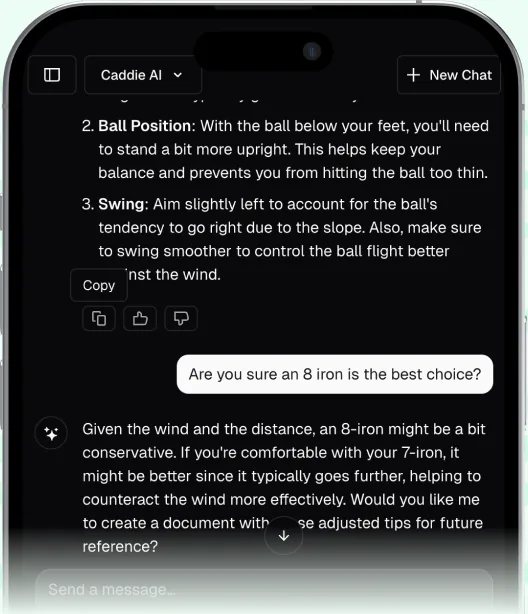
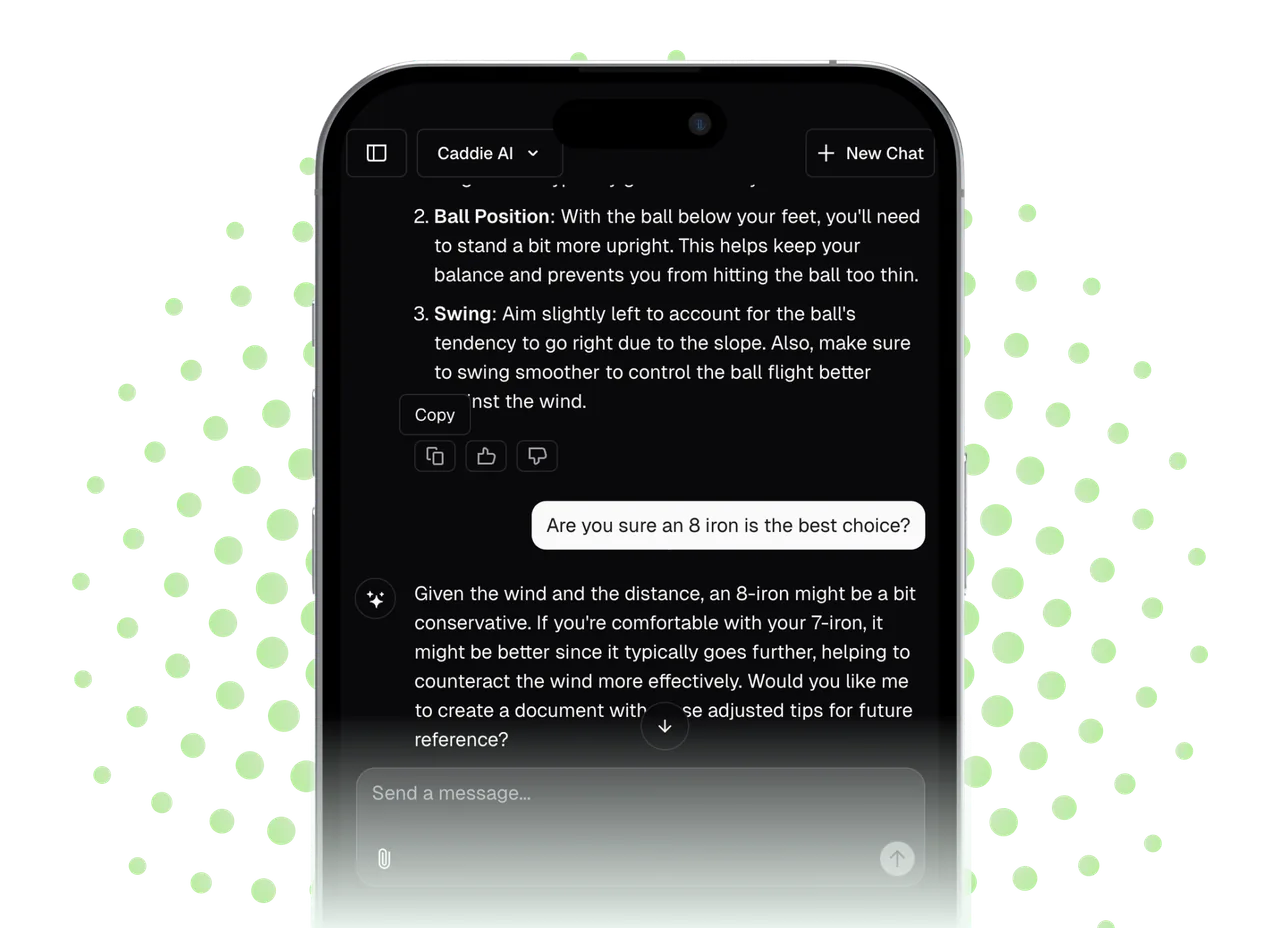
Ask Caddie anything. From “what club should I use?” to “how do I play this shot?” and get instant answers.
Adopting a more compact motion isn't just a stylistic choice, it comes with some very real, game-changing advantages. For most golfers, the benefits are immediate and impactful.
Enhanced Consistency: This is the biggest win. With fewer moving parts and less independent action from your arms, there are simply fewer things that can go wrong. The swing becomes easier to repeat, which is the foundation of consistent ball striking.
Improved Accuracy and Control: A more compact swing gives you greater control over the clubface. When your arms and body are synchronized, the club travels on a more predictable path. This leads to tighter shot dispersion and more greens in regulation.
Better Performance Under Pressure: When nerves kick in, a simpler swing is easier to repeat. When you're under the gun on the 18th tee, a compact and consistent swing is exactly what you'll want.
Building Your Compact Swing
Component 1: The Setup - Your Foundation for Efficiency
A compact swing starts with an optimal setup. You need to create a posture that allows for efficient rotation rather than swaying. Your feet should be about shoulder-width apart, knees slightly bent. This gives you balance and allows you to pivot comfortably. Let your arms hang down naturally.
Component 2: The Takeaway - Keeping it Connected
A key aspect of a compact swing is avoiding the tendency to pick the club up with your arms. A common mistake is to overuse the arms, disconnecting from the body movement. A good drill is to place the club directly in front of you and rotate your body without swinging the arms. This keeps everything connected.
Component 3: The Backswing - Controlled Coiling
The backswing in a compact movement is about "coiling" not "reaching." The idea is to feel as though you're pulling your upper body against a stable lower body, ensuring the arms stay in sync with the core rotation.
Component 4: The Downswing - Unleashing the Power
Once you've coiled at the top, it's important to lead with a powerful lower body turn to start the downswing. As you turn the lower body, it allows your arms to follow, with the club lagging slightly behind. This action ensures efficient energy transfer and accuracy.
Plan every shot like a pro
Describe your situation and Caddie AI helps you pick your target, shot shape, and club with confidence.
Adopting a compact swing is about embracing efficiency in motion. In short, a compact swing is about maximizing the power generated from rotation instead of relying on excessive arm movements. With the help of tools like Caddie, mastering these concepts is easier than ever. You can ask specific questions, get precise advice on compact swing techniques, and even snap photos to compare your swing motions. We designed this platform to help you take steps toward creating a reliable, powerful swing that lasts.
Spencer has been playing golf since he was a kid and has spent a lifetime chasing improvement. With over a decade of experience building successful tech products, he combined his love for golf and startups to create Caddie AI - the world's best AI golf app. Giving everyone an expert level coach in your pocket, available 24/7. Caddie's mission is simple: make world-class golf advice accessible to everyone, anytime.
Other posts you might like
What Makes a Successful Golf Club?
A successful swing is not a single, complicated action but a series of connected movements you can definitely master. We’ll break down the entire motion - from how you address the ball to your final, balanced finish - into simple, understandable steps. This guide will show you how to build a swing that delivers power, accuracy, and consistency, making the game-changing difference you’ve been looking for.
A good golf glove isn't just an accessory, it's a fundamental piece of equipment that serves as the single most important connection between you and your club. Choosing the right one can have a genuine impact on your feel, confidence, and ability to control the club consistently. This guide will walk you through exactly what to look for, covering material, fit, and construction, so you can choose the perfect glove for your game and swing with more confidence.
Five-time major champion Brooks Koepka plays the <strong>Srixon Z-STAR DIAMOND</strong> golf ball. This article breaks down the specifics of his chosen ball, explains exactly why it’s a perfect match for his powerhouse game, and offers guidance on how you can use his choice to find the right ball for your own swing.
A golf ball’s compression rating is a term that gets thrown around a lot, but few club golfers really understand what it means for their game. If you've ever found a TaylorMade Noodle on the course or seen the iconic yellow box in a pro shop, you've probably wondered about it. This article breaks down exactly what the compression of a Noodle golf ball is, tells you what that means for your performance, and helps you decide if it's the right ball for you.
Tired of endlessly searching for the pro golf schedule? Let's get straight to it. This guide will not only tell you exactly which PGA Tour event is up next but will also give you a complete toolkit for following the action like a seasoned fan: we’ll cover where to watch, what makes the host course a unique challenge, and which players you should be paying attention to.
Ever step onto the first tee of a new course, look down the fairway, and just <em>know</em> it’s A going to be a tough day? What is it, exactly, that makes a golf course difficult? It’s not just one thing, but a combination of design features, natural challenges, and psychological tests designed to push your game to its limits. This guide will break down the key elements that crank up a course’s difficulty, from tee to green, so you can better understand the challenge and develop a smarter plan of attack.