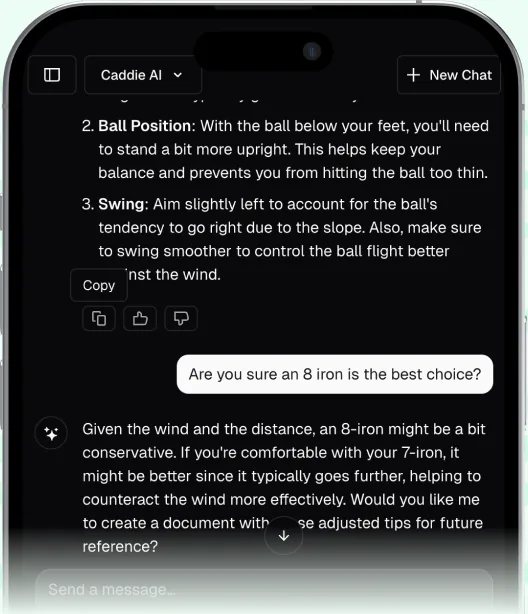
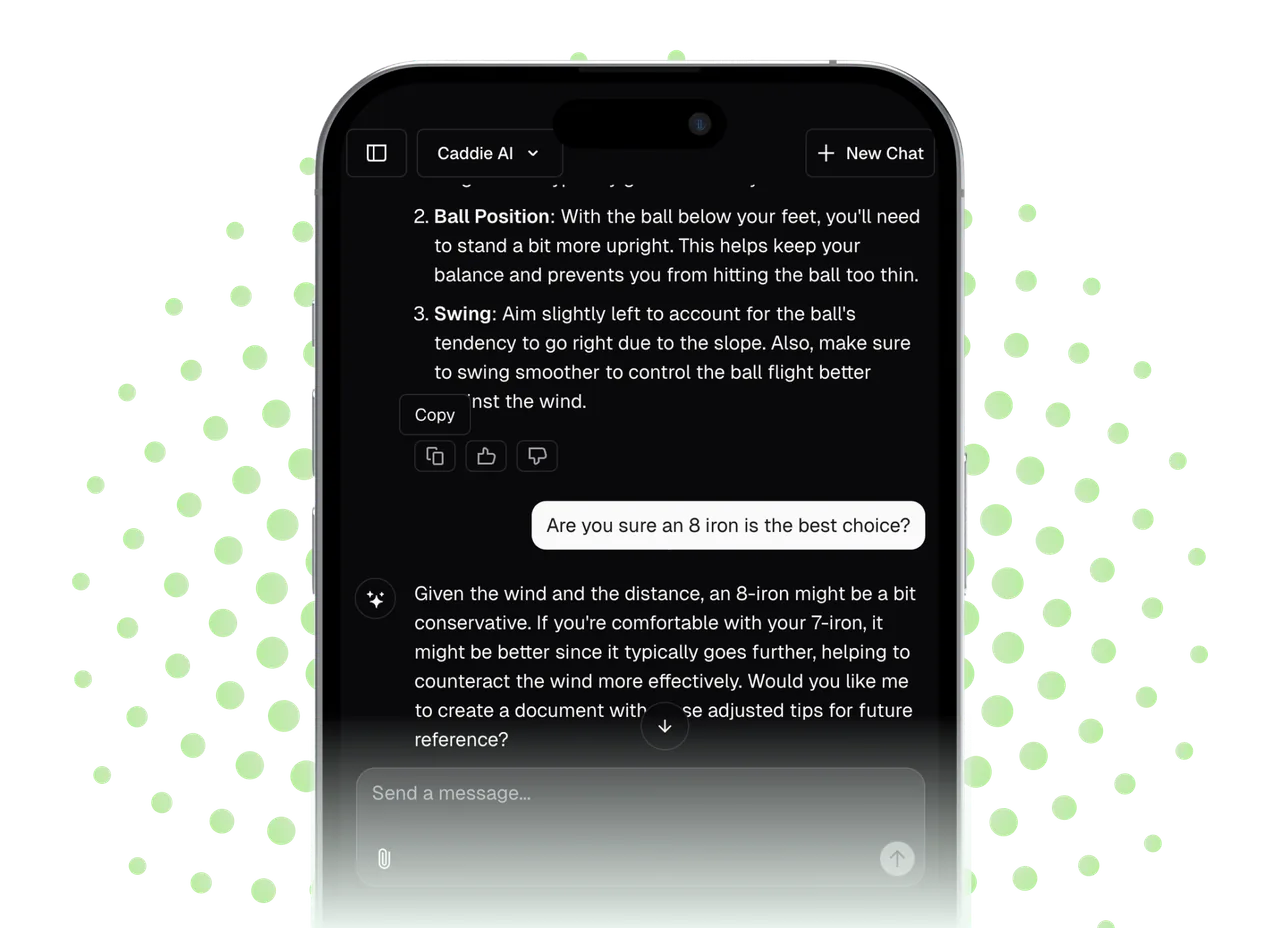
Carrying 14 golf clubs often feels more like a workout than a game, but there's a simpler, often smarter, way to navigate the course. A half set of golf clubs can not only lighten your bag but also sharpen your skills and bring more enjoyment to your rounds. This guide will walk you through exactly what a half set is, the surprising benefits of playing with one, and how you can build a perfect, personalized set of your own.
The best AI golf app: Caddie is your personal AI golf coach. Get expert-level golf advice instantly, 24/7 to help you play like a pro. Try it free →
What Exactly Is a Half Set of Golf Clubs?
The Rules of Golf allow you to carry a maximum of 14 clubs in your bag for any given round. A half set is simply a setup that uses significantly fewer clubs - typically somewhere between six and eight. There isn't a strict definition or a magic number, but the core idea is to carry only the most essential tools for the job.
Instead of having a club for every possible distance (e.g., a 150-yard club, a 160-yard club, a 170-yard club), a half set forces you to use a smaller arsenal. You’ll have a few key clubs spread out to cover the entire distance spectrum, leaving intentional gaps in between. It sounds like a handicap, but as you’ll soon see, these "gaps" are where the real improvement and enjoyment begin.
Get pro-level golf advice instantly, 24/7
Ask Caddie anything. From “what club should I use?” to “how do I play this shot?” and get instant answers.
As a coach, I've seen countless golfers - from beginners to seasoned players - rediscover their love for the game by switching to a half set. The popular belief is that more choices lead to better scores, but often, the opposite is true. Here’s why downsizing can upgrade your game.
It Simplifies The Game Dramatically
Standing over a shot and trying to decide between your 7-iron, 8-iron, or 9-iron can create indecision. That doubt creeps into your swing and leads to poor commitment. With a half set, if you have 145 yards to the pin and your 8-iron is the only club that gets *close* to that number, the decision is made for you. You just have to figure out *how* to hit that 8-iron. This removes mental clutter and allows you to focus all your energy on making a good, committed swing.
You Become a Better, More Creative Shot-Maker
This is the most powerful benefit of playing with fewer clubs. When you don't have the "perfect" club for a shot, you have to learn to manufacture one. Your 150-yard "stock" 7-iron now has to do much more work.
For a 140-yard shot: You learn to grip down a little, take a three-quarter swing, and "take something off" the shot. This is a feel-based skill called a "knockdown" that pros use all the time.
For a 160-yard shot: You learn to hit it a little harder, stand taller, and play for a small draw to get that extra yardage.
Suddenly, each club isn't a one-trick pony. Your 7-iron becomes your 140, 150, *and* 160-yard club. You start thinking about trajectory, spin, and feel, which is the heart and soul of ball-striking.
It's a Lighter, More Enjoyable Walk
This is the most obvious perk. A full set of 14 clubs, along with a cart bag, balls, water, and accessories, can weigh 30 pounds or more. Carrying that kind of weight for five miles can be draining. A half set in a lightweight carry bag can be half that weight, making walking the course far more manageable and fun. You’ll finish the round with more energy and a less sore back.
It Saves You Money
Quality golf clubs can be expensive. Building a good 14-club set can run into thousands of dollars. A half set, by definition, is more affordable. You can invest in 6-7 high-quality clubs that you absolutely love, rather than filling out a full bag with clubs you rarely use. It’s a great way for beginners to get into the game without a massive financial commitment.
Who Should Consider Playing a Half Set?
While any golfer can benefit from playing a few rounds with a simplified setup, certain types of players will find it especially well-suited to their game.
The Beginner: Learning 14 different swings at once is overwhelming. Starting with 6-7 clubs makes the learning curve much friendlier. You can master the fundamentals on a few key clubs before adding more complexity.
The Casual or Weekend Golfer: If you play for fun, exercise, and friendship, you don’t need a Tour-level bag. A half set has everything you need to enjoy a pressure-free round.
The Avid Walker: If carrying your bag is your preferred way to play, a half set is a game-changer. It makes the walk physically easier and more pleasant.
The Golfer in a Slump: Feeling lost and technical with your swing? A half set strips away all the noise. It forces you back to the basics of feel and strategy, which can be the perfect reset button for your game.
Plan every shot like a pro
Describe your situation and Caddie AI helps you pick your target, shot shape, and club with confidence.
Okay, you're convinced. But what clubs actually go in the bag? The goal isn't just to pick clubs at random. The goal is to choose a small, versatile team of clubs that can cover the widest range of shots. Here’s a blueprint for building a smart and effective half set.
Step 1: The Non-Negotiables (2 Clubs)
Every golfer needs these two clubs, regardless of their setup.
Putter: You use this on every hole. It's the most important club in your bag. This one is a must.
A Reliable "Scoring" Wedge: You'll need one tool for chipping, pitching, and getting out of greenside bunkers. For maximum versatility, a Sand Wedge (SW), typically 54 to 56 degrees of loft, is the best choice. It has enough loft to get out of trouble and the bounce on the sole makes it fantastic from sand and turf.
Step 2: Cover the Long Game (1 Club)
You need one club to get you off the tee or advance the ball a long way down the fairway. You have a few options here:
Driver: Offers the most distance potential but can be the hardest club to hit consistently for many amateurs.
3-Wood: A reliable 3-wood is often a better choice for a half-set player. It's much easier to hit off the fairway than a driver, providing more versatility, while still offering plenty of distance off the tee.
Hybrid: A low-lofted hybrid (like a 3-Hybrid ~19° or 4-Hybrid ~22°) can be the ultimate "get out of jail free" club. It’s fantastic off the tee, great from the fairway, and easy to hit out of the rough. For many, this is the smartest long-game choice.
Step 3: Fill in the Gaps with Irons (3-4 Clubs)
This is the heart of your half set. You need to select a few irons that give you playable gaps between them. You're not looking for perfect 10-12 yard gaps like a pro, you're looking for larger, 25-30 yard gaps that you can fill with your newfound shot-making skills.
Always work backward from your scoring wedge. Your next addition should be a Pitching Wedge (PW). Most modern PWs have around 44-46 degrees of loft, giving you a perfect club for full shots inside 120-130 yards.
From there, you skip every other iron. A classic and effective combination would be:
A "Short" Iron: ~9-iron. Great for medium-length approach shots.
A "Mid" Iron: ~7-iron. The workhorse of your iron set, used for longer approaches and long par-3s.
A "Long-ish" Iron or Hybrid: ~5-iron or 5-Hybrid. This bridges the distance between your 7-iron and your fairway wood/driver. A 5-hybrid is often a far easier and more versatile choice than a 5-iron for most golfers.
Play Golf like a Pro with Caddie
Learn and improve your golf game as you play. Get pro-level tips, strategy and guidance anytime.
Example Half Set Configurations (From 6 to 8 Clubs)
Let's put it all together into some sample sets. Think about your own game and which of these setups feels like the best fit for you.
Example 1: The 6-Club Minimalist
Perfect for an executive course, a quick nine after work, or the true minimalist.
Driver or 3-Wood
6-Iron
8-Iron
Pitching Wedge
Sand Wedge (~56°)
Putter
Coach's Note: This setup is all about feel. The gaps are big, forcing you to be very creative with your intermediate shots.
Example 2: The 7-Club "Sweet Spot"
This is arguably the most popular and versatile half-set configuration. It provides an excellent balance of options without being overwhelming.
3-Wood
4-Hybrid
7-Iron
9-Iron
Pitching Wedge
Sand Wedge (~56°)
Putter
Coach's Note: Replacing long irons with easier-to-hit hybrids is a smart play. This set provides a forgiving long game and good coverage through the scoring clubs.
Example 3: The 8-Club "All-Rounder"
This setup expands the short-game options, giving players a bit more precision around the greens - something lower-handicap players might prefer.
Coach's Note: By carrying two specialized wedges (a Gap and a Lob), you sacrifice a mid-iron. This is for the player who values a dialed-in short game over having more full-swing options from the fairway.
Final Thoughts
Switching to a half set isn't about accepting limitations, it's about unlocking a new level of freedom, creativity, and enjoyment. It simplifies your decisions, lightens your load, and forces you to become a more complete and resourceful player. Give it a try on your next round - you might be surprised at how much bigger your game feels with a smaller bag.
This new way of playing naturally leads to questions on the course. You might find yourself stuck between hitting a soft 7-iron or a full 8-iron. For moments just like that, confidence is everything. That's why we created Caddie AI. Our app provides you with instant, smart recommendations on club selection and strategy for any situation, taking the guesswork out of those tricky in-between yardages and helping you commit fully to every single swing.
Spencer has been playing golf since he was a kid and has spent a lifetime chasing improvement. With over a decade of experience building successful tech products, he combined his love for golf and startups to create Caddie AI - the world's best AI golf app. Giving everyone an expert level coach in your pocket, available 24/7. Caddie's mission is simple: make world-class golf advice accessible to everyone, anytime.
Other posts you might like
What County Is Augusta National Golf Club In?
When you hear the word Augusta, your mind probably jumps straight to a green jacket, pristine fairways, and the roars of the Masters Tournament. But what many golf fans don't know is the specific formal location of this iconic American golf club. Augusta National Golf Club is located in <strong>Richmond County, Georgia</strong>. This article will not only give you this direct answer but also explore the rich history of the area, explain why this specific piece of land was chosen, and provide a coach's insight into how the geography of Richmond County shapes the very character of the world's most famous golf course.
If you're wondering which top-tier professional golfers are playing XXIO clubs on the PGA or LPGA Tours, the answer is simpler - and more intentional - than you might think. While you’ll see its sister company, Srixon, in the hands of major champions, the distinct absence of XXIO from the bags of most tour professionals isn't an oversight. This article will explain exactly why that is, break down the brilliant engineering behind XXIO clubs, and help you understand who these premium clubs are truly designed for - which, in the end, might just be you.
Nothing sours a great drive like the shot that follows it - a thinly struck iron that buzzes up your arms and veers weakly to the right. That jarring, unsatisfying feeling often comes from one of the most common misses in golf: hitting the ball off the toe of the club. This article will break down exactly what causes those dreaded toe shots and give you clear, actionable drills to start finding the center of the clubface again.
Shopping for golf balls can feel overwhelming, with shelves full of options promising more distance, more spin, and lower scores. If you’re looking for a simple, effective ball that prioritizes distance and durability, the 2-piece golf ball is likely your perfect match. This guide will walk you through what a 2-piece ball is, who it's for, and help you pinpoint the best one to put in your bag for your next round.
Shooting consistently in the mid-80s means you're a solid golfer, better than a large portion of people who play the game. But what does that translate to in the official language of golf: the handicap index? This article will give you the direct answer, break down exactly how that number is calculated in simple terms, and provide some actionable, coach-approved advice a mid-80s player can use to start knocking on the clubhouse door of the 70s.
Thinking about what size golf ball you need? The surprising answer is that this is one part of your golf equipment you don't actually have to worry about. This article will quickly cover the official rules on golf ball size and then guide you through what really matters: matching the ball’s construction and performance characteristics to your specific game.