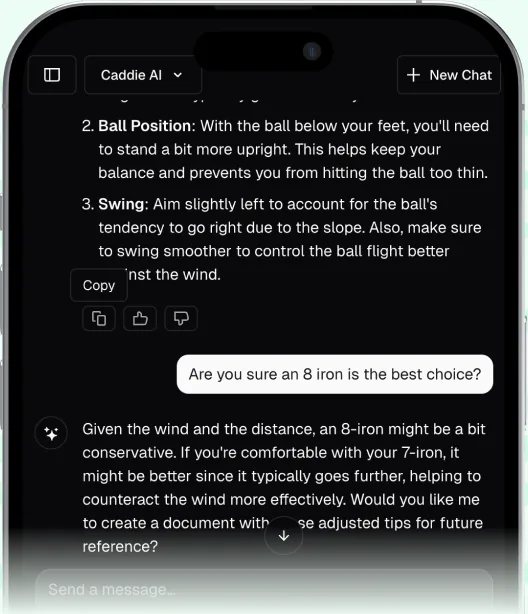
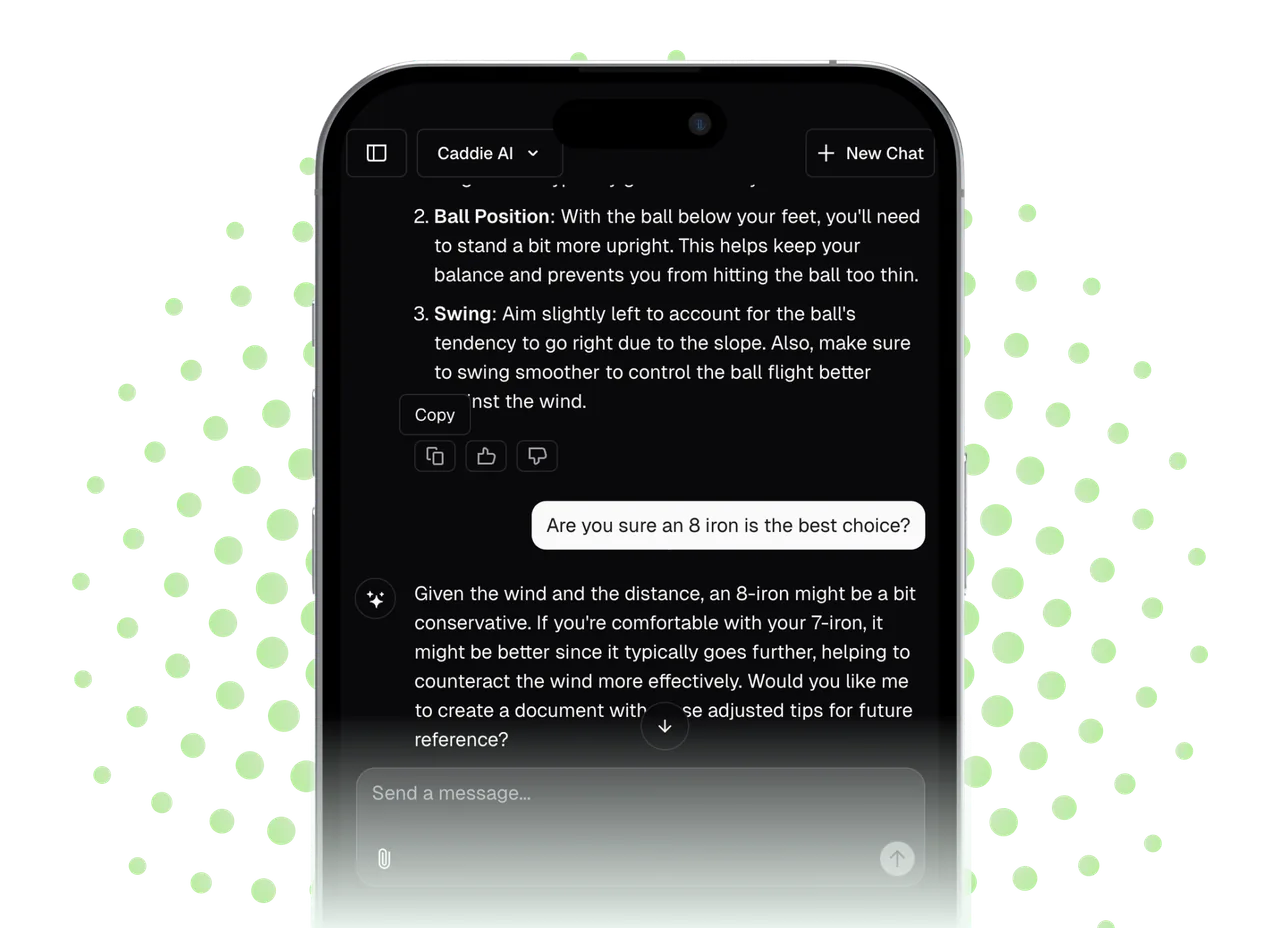
A senior shaft in a golf club is simply a shaft with more flexibility, designed to help golfers with slower swing speeds hit the ball farther and higher. It’s a common misconception that they are only for older golfers, in reality, they are for any player whose swing tempo can benefit from a little extra whip. This article will guide you through what a senior shaft is, who it's for, and how you can determine if it’s the right choice to improve your game.
The best AI golf app: Caddie is your personal AI golf coach. Get expert-level golf advice instantly, 24/7 to help you play like a pro. Try it free →
What Is a Golf Shaft Flex?
Before we can talk about a senior shaft, we need to understand the concept of "flex." Shaft flex is a rating system that describes how much a golf shaft bends during the swing. Think of it like a fishing rod - when you cast, the rod bends back and then springs forward to launch the line. A golf shaft does the same thing.
There are five standard categories of flex:
Extra Stiff (X): For the fastest swinging players, typically professionals and strong amateurs.
Stiff (S): For golfers with fast swing speeds who generate a lot of power.
Regular (R): The most common flex, suited for the average male amateur golfer.
Senior (A or M): More flexible than Regular, designed for slower, smoother tempos. The 'A' stands for Amateur or All-Flex, while 'M' often stands for Mature.
Ladies (L): The most flexible shaft, designed for the generally slower swing speeds of female golfers.
The goal is to match the shaft's flex to your swing speed. When you do, the shaft bends correctly ("loading" on the downswing) and then snaps back to straight just before impact ("unloading"), adding a burst of speed to the clubhead. A senior shaft is simply the one designed to perform this action optimally for a moderate swing speed.
Get pro-level golf advice instantly, 24/7
Ask Caddie anything. From “what club should I use?” to “how do I play this shot?” and get instant answers.
Let’s clear this up right now: a senior shaft has everything to do with swing speed and almost nothing to do with your age. A 25-year-old with a smooth, unforced swing might benefit just as much as a 70-year-old. The name "senior" is just a marketing term that has stuck around for decades.
So, how do you know if you fall into the senior flex category? It all comes down to data, specifically your driver swing speed.
Swing Speed Ranges for Shaft Flex
While manufacturers vary slightly, these are great general guidelines for driver swing speed:
97 mph and above: Stiff (S) or Extra Stiff (X)
84 mph to 96 mph: Regular (R)
72 mph to 83 mph: Senior (A or M)
Below 72 mph: Ladies (L)
As you can see, the window for a senior flex is quite significant. Many amateur golfers fall into this range without even realizing it because they assume they should be using a regular flex shaft.
Three Signs You Might Need a Senior Shaft
If you can't get on a launch monitor to measure your swing speed, you can look for other clues in your game.
1. Your Ball Flight is Too Low
Do you feel like your drives and iron shots fly low and run out, rather than soaring high and landing softly? A shaft that is too stiff for you will not flex enough at impact. This means the clubface arrives at the ball with less "dynamic loft" (the actual loft presented at impact). A more flexible senior shaft bends more, kicking the clubhead forward and upward through impact, which naturally adds loft and height to your shots.
2. You Consistently Hit a Slice or Fade
A slice is often caused by an open clubface at impact. While a slice has many potential causes, a too-stiff shaft can be a major contributor. Because it doesn’t bend as much, it feels heavier and takes more effort to swing. This can cause your hands to lag behind during the downswing, preventing you from "releasing" the club and squaring the face in time. The added flex of a senior shaft gives you a little more time in the downswing for the clubhead to catch up and square itself, often reducing or eliminating a slice.
3. Your Shots Feel "Hard" or Lack Distance
Does it feel like you have to swing out of your shoes just to get decent distance? Does contact feel harsh and dull, instead of a satisfying "click"? This is a classic sign of a shaft that’s too stiff. A proper shaft should feel like it's working with you, not against you. A senior flex shaft will feel easier to load and will give you the sensation of the club "whooshing" through impact, generating speed without extra physical effort.
The Tangible Benefits of Switching to a Senior Shaft
If you've checked a few of the boxes above, making the switch could significantly improve your performance and enjoyment. Let's look at the specific advantages.
Benefit #1: More Effortless Distance
This is the big one. The "whipping" action of a flexible shaft at the bottom of the swing acts like a force-multiplier. It translates the energy you create into more clubhead speed - without you having to swing any harder. For golfers in the senior flex swing speed range, this can mean an instant gain of 10, 15, or even 20 yards with the driver and a proportional increase with their irons.
Benefit #2: A Higher, Draw-Biased Ball Flight
As mentioned, the mechanics of a flexible shaft help increase dynamic loft for a higher ball flight. More carry time means more overall distance, especially on soft fairways. Furthermore, the shaft's tendency to help the clubface "turn over" through impact can straighten out a fade or turn it into a gentle, distance-adding draw. For many golfers, this is a game-changer.
Benefit #3: Much Better Feel and Rhythm
Golf is a game of rhythm and timing. Swinging a shaft that’s too stiff is like trying to dance in ski boots - it’s clunky and you can’t feel the flow. A senior shaft will feel livelier in your hands. You’ll be able to feel the clubhead loading at the top of your swing and releasing through the ball. This enhanced feel makes it easier to develop a smooth, consistent tempo, which is the foundation of repeatable ball striking.
Benefit #4: Less Strain on Your Body
When you have to fight your equipment, you start making compensations in your swing that can lead to bad habits and even injury. Trying to force a stiff shaft to work often leads to overuse of the arms and shoulders, placing unnecessary strain on your back and joints. A properly fitted senior shaft allows you to use your body's natural rotation, making for a biomechanically sounder and more comfortable swing.
Plan every shot like a pro
Describe your situation and Caddie AI helps you pick your target, shot shape, and club with confidence.
What Happens If You Use a Senior Shaft But Don't Need It?
Just as using a shaft that's too stiff is a problem, using one that's too flexible also causes issues. If your swing speed is too fast for a senior flex shaft (let's say over 95 mph), you'll experience:
Loss of Control: The shaft will feel "whippy" and difficult to time. Your shot dispersion will likely be huge, with shots going left, right, and everywhere in between.
A "Ballooning" Ball Flight: The shaft will add too much spin and dynamic loft, causing your shots to shoot high into the air without penetrating. You'll lose significant distance, especially into the wind.
Inconsistent Clubface at Impact: The excessive flex can cause the clubface to be either wide open or snapped shut at impact, leading to big hooks or pushes. It feels like you have no control over the club.
This is why understanding your swing is so important. Ego has no place in club fitting - using the right equipment is simply a matter of physics.
Play Golf like a Pro with Caddie
Learn and improve your golf game as you play. Get pro-level tips, strategy and guidance anytime.
The only surefire way to know if a senior flex is right for you is to visit a qualified club fitter. Here's why this is the best investment you can make in your game:
Objective Data: A fitter uses a launch monitor to capture precise data about your swing - clubhead speed, ball speed, launch angle, and spin rate. There’s no guessing involved.
Head-to-Head Comparison: You’ll be able to hit your current driver and then immediately test a similar model with a senior shaft. Seeing the numbers side-by-side provides indisputable proof of which shaft performs better for you.
Fine-Tuning: Professional fitters can also look at other shaft characteristics like weight and torque to find the perfect match for your tempo and release pattern.
If a full fitting isn't an option, head to a big-box golf store with simulators and ask to hit demo clubs with both regular and senior shafts. Pay close attention not just to the distance, but also to the shot shape and, most importantly, the feel. The right shaft will almost always be the one that feels easiest to swing smoothly. Ask yourself: “Which one allows me to produce my best shots with the least amount of effort?”
Final Thoughts
Senior shafts are not about age, they are a powerful tool for any golfer with a moderate swing speed looking to improve their launch, distance, and accuracy. By letting go of ego and embracing the equipment designed for your swing, you can make the game easier and much more enjoyable.
Understanding your equipment is just one part of playing smarter golf. If you're looking for guidance on everything from club selection for a tricky lie to course strategy, our app, Caddie AI, acts as your personal golf expert, available 24/7. It can help you think through your shots and make confident decisions on the course, so you can focus on swinging your best.
Spencer has been playing golf since he was a kid and has spent a lifetime chasing improvement. With over a decade of experience building successful tech products, he combined his love for golf and startups to create Caddie AI - the world's best AI golf app. Giving everyone an expert level coach in your pocket, available 24/7. Caddie's mission is simple: make world-class golf advice accessible to everyone, anytime.
Other posts you might like
What Are the Scores in Golf?
Figuring out the scoring in golf can feel like learning a new language, but the basic idea is incredibly simple: take the fewest shots possible to get your ball in the hole. Once you understand a few core terms, you'll be able to talk about your performance, track your progress, and get way more enjoyment out of every round. This guide will walk you through everything from the concept of 'par' to how to tally up your final score like a seasoned player.
A golf ball spinning through the air might sound like an advanced concept for tour pros, but it's actually the engine behind every shot you hit, defining both its distance and its behavior when it lands. Understanding spin rate is one of the most direct ways to gain control over your ball flight and start making smarter decisions on the course. This guide will break down what spin rate is, why it matters for every club in your bag, and how you can start using it to your advantage.
Finishing a round and scribbling a number on your scorecard can be a reality check, but what actually counts as a 'bad' score in golf? This isn’t a simple question with a one-size-fits-all answer. This guide will help you understand scores beyond just good or bad. We'll look at how to set realistic expectations based on your handicap, track your progress, and ultimately redefine what success means for you on the course.
When your buddy drains a monster 40-foot putt and someone from the group yells, Light the candle!, you know you've just witnessed something special. This isn't your average holed putt, it's one of the highest compliments in the golf lexicon, reserved for only the purest rolls. This article will break down exactly what lighting the candle means, explore its origins, and give you practical coaching advice on how to start rolling those picture-perfect putts yourself.
That little dent your golf ball makes when it lands on the green is called a pitch mark, and knowing how to deal with it is one of the most important, yet often overlooked, skills in golf. This guide will walk you through exactly what a pitch mark is, why caring for them is fundamental to the game's integrity, and the step-by-step process to fix them like a seasoned pro. By the end, you'll be leaving every green in better shape than you found it.
A driving iron might be the most misunderstood club in golf, yet it could be the secret weapon you've been searching for to take control of your long game. It's not a driver, and it's not quite a standard long iron - it's a specialist tool designed for windy days, tight fairways, and commanding your ball flight. This guide will walk you through exactly what a driving iron is, how it compares to your fairway woods and hybrids, and most importantly, how to hit one like a pro.