The golf ball you pull from your sleeve says more about you than you might think. It's part scorecard, part psychological profile, and a clear statement of your aspirations on the course. This guide will decode those messages, helping you understand what your ball choice reveals and how you can select the perfect one to match your unique game.
The best AI golf app: Caddie is your personal AI golf coach. Get expert-level golf advice instantly, 24/7 to help you play like a pro. Try it free →
Understanding the Unwritten Rules of the Golf Ball
Walk into any golf shop, and the wall of golf balls can feel overwhelming. Dozens of brands, endless models, and price tags ranging from a casual lunch to a fancy dinner. But beneath the marketing, each ball is engineered with a specific type of golfer in mind. By selecting one, you're subconsciously aligning yourself with a golfing philosophy. Let's look at some common player profiles based on their ball of choice.
The Premium Tour Ball Player: "I'm Here to Compete"
Common Choices: Titleist Pro V1/V1x, TaylorMade TP5/TP5x, Callaway Chrome Soft
If you've got a sleeve of these in your bag, you're sending a clear signal. You take your game seriously. You watch the pros, you understand the importance of spin separation, and you believe in using the absolute best equipment to give yourself every advantage. You're not just out for a casual walk, you're on a mission to shoot a number. Winning the Saturday morning Nassau is important enough to you to invest in the same technology the best players in the world use.
This player embraces the challenge of scoring. You understand that hitting a low, checking wedge or a high-spinning pitch shot requires a urethane cover, a feature you're willing to pay a premium for. You likely have a relatively high swing speed (or believe you do) and can "compress" the ball properly to get the most out of its multilayered construction. You're committed, you've probably had a lesson or two, and you're always working on your game.
A Coach's Perspective: Playing a tour-caliber ball is a statement of intent, and that's fantastic. It means you care. The important thing is to make sure your game is ready for it. These balls are designed for precision. Their high spin rates are a benefit on approach shots, but they can also magnify the side spin on a mis-hit drive, potentially turning a fade into a bigger slice. If you have the speed and strike consistency to take advantage of them, they are the pinnacle of performance. If not, you might be paying top dollar for technology that could accentuate your flaws. It's worth an honest self-assessment.
The Savvy Performer: "I've Done My Homework"
Common Choices: Srixon Z-Star/Q-Star Tour, Vice PRO, Bridgestone Tour B Series
This golfer is the smart consumer of the golf world. You know that premium, tour-level performance isn’t monopolized by the two biggest names on the box. You've read the reviews, maybe even watched a few ball-testing videos on YouTube, and you've found a ball that gives you 99% of the performance for a fraction of the price. You get a quiet confidence from knowing you haven't just bought into the hype.
Players who choose these balls are often brand-loyal and very knowledgeable. They can tell you exactly why they prefer the SpinSkin on a Srixon or the feel of a Bridgestone. They enjoy being a little different and proving that fantastic golf can be played without automatically reaching for the most common choice. There's a certain pride in having a preferred ball that others might overlook.
A Coach's Perspective: To you, I say, "Well done." You understand that the ball market is filled with incredible options, and you've found one that works for you. These golf balls are exceptional, offering urethane covers, multilayer construction, and high-performance benefits. The best advice for you is to stick with it. Find your model and commit to it. Playing the same ball every round is one of the easiest ways to build consistency in your distance control, especially on and around the greens.
The Feel-Good Golfer: "Comfort and Consistency Are Everything"
Common Choices: Titleist Tour Soft, Srixon Soft Feel, Callaway Supersoft, Bridgestone e6
If one of these is your ball, your top priority is enjoyment. You love the buttery-soft sensation of a well-struck iron and the low-compression feel off the driver face. You aren't trying to spin the ball back 15 feet - you just want to see it fly long, straight, and land softly. This ball is your trusted companion, designed to minimize your mistakes and maximize your fun.
This player often has a moderate or slower swing speed and wisely chooses a ball that helps them. Low-compression balls are engineered to reduce side spin, which means your slice or hook won't be as dramatic. You're a practical golfer who understands that finding more fairways is the fastest way to lower scores and have a better time on the course. Feel, for you, is non-negotiable.
A Coach's Perspective: You have correctly identified the most important thing for your game - a ball that makes you feel confident and mitigates your big miss. These balls are engineering marvels for the majority of amateur golfers. My guidance is simple: trust the technology. Don't feel you have to "upgrade" to a tour ball simply because you think you should. The best ball for you is the one that best matches your swing, and for millions of players, this is it. Focus on making a good, balanced swing and let the ball do its work.
The Scavenger &, Practical Golfer: "A Ball is a Ball"
Common Choices: Kirkland Signature, Found Balls, Budget Lake Balls
This golfer sees the game through a lens of pure practicality and resourcefulness. You might be a beginner who (wisely) doesn't want to lose a $5 ball on every other hole. You might be an experienced player who just can't stomach the high prices and gets a genuine thrill from finding a pristine Pro V1 in the woods. To you, golf is expensive enough, and this is an easy place to save a few bucks.
There's absolutely nothing wrong with this approach. It shows you love being on the course more than you love the gear. The ‘found ball’ user values the hunt and the story behind each ball. The Kirkland player is the ultimate pragmatist, having recognized one of the best values in the sport. You're not here to impress anyone with branding, you're here to play.
A Coach's Perspective: The only downside to playing with found or mixed balls is inconsistency. One shot you might be playing a soft, low-spin ball, and the next a firm, high-spin tour ball. This makes it very difficult to predict how far the ball will fly and how it will react on the green. My suggestion is to take a small step forward. If you can, buy one model of a value ball (like the Kirkland) and play it exclusively for a month. Committing to a single model will do wonders for establishing a consistent feel and understanding your distances.
The Confident Colors Player: "I Value Visibility"
Common Choices: Any non-white model (optic yellow, orange, pink, matte green)
For a long time, playing a colored ball was seen as unconventional. Not anymore. Choosing a yellow, orange, or even a hot pink golf ball says you are, above all, a pragmatist. You're confident enough to stand out, and you've recognized the simple truth: a golf ball you can see is a better golf ball.
You're tired of losing your ball in the rough, in the fall leaves, or on an overcast day. You tracked one across the sky once and thought, "Why would I ever go back to white?" You're less concerned with tradition and more interested in what works. You're probably a quick player because you spend less time searching.
A Coach's Perspective: Your logic is sound. Matte finishes reduce glare, and bright colors are scientifically easier for the human eye to track against a green and blue background. This is a smart choice that can tangibly improve your game by saving you strokes (and frustration) on lost balls. The great news is that a huge variety of balls now come in high-visibility options. You no longer have to choose between performance and color, you can get a Tour-level ball, a soft-feel ball, or a distance ball in your preferred color. You've unlocked a simple but effective gaming advantage.
Plan every shot like a pro
Describe your situation and Caddie AI helps you pick your target, shot shape, and club with confidence.
Ultimately, the golf ball in your bag is a highly specialized piece of equipment. Your choice is a direct reflection of your priorities on the course, whether that's greenside command, buttery-soft feel, or simply the confidence of being able to find it easily. Acknowledging your golfer personality is the first step toward arming yourself with the tool best suited to help you succeed.
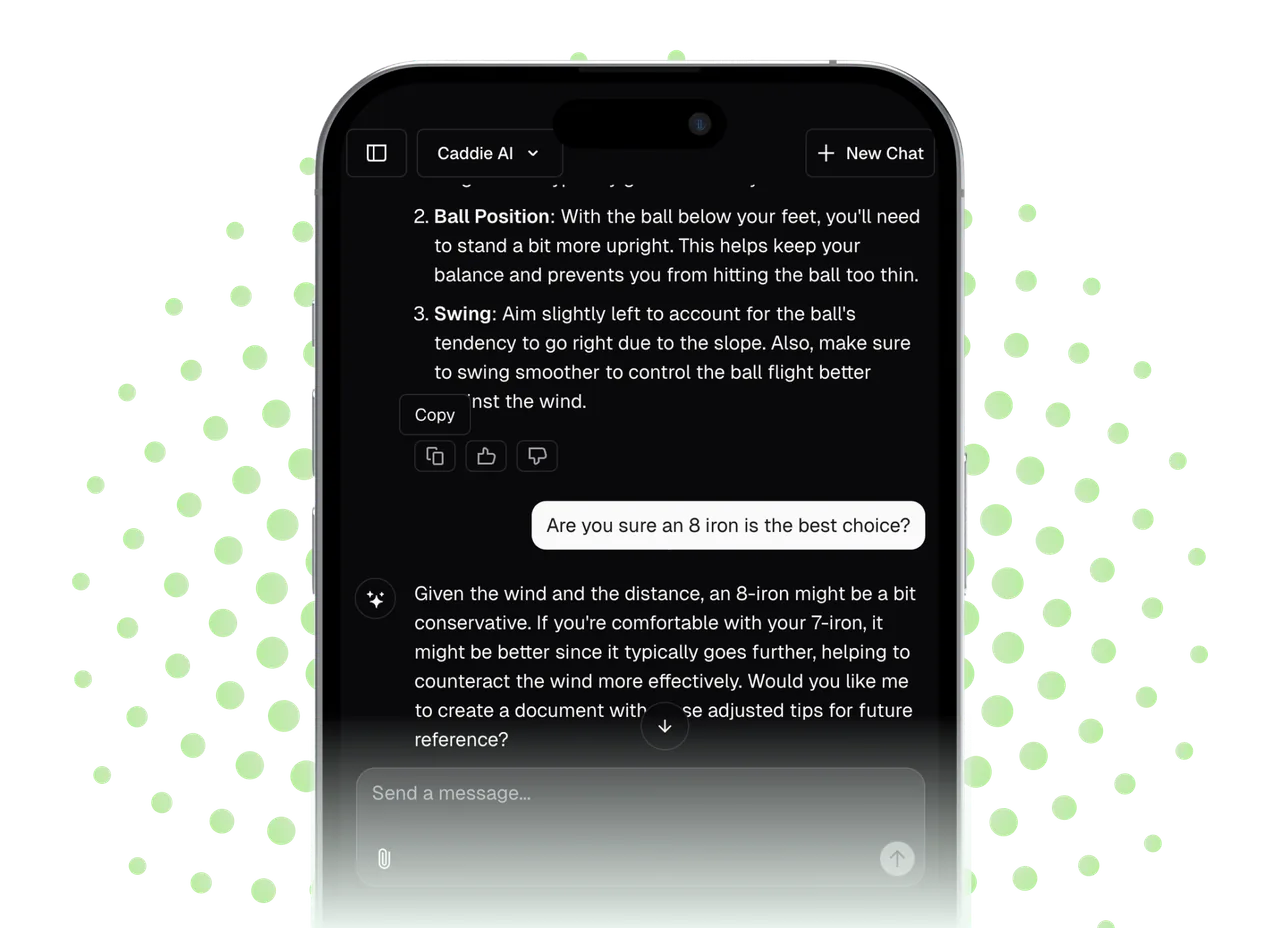
Making that choice demands an honest look at your own game - your patterns, your misses, and your strengths. Historically, getting that objective analysis was difficult, but today's technology delivers it directly to you. When we developed our app, Caddie AI, our goal was to remove the guesswork. You can get instant, on-demand advice and objective analysis of your shot patterns, helping you understand not just how to play the next shot, but what kind of golfer you truly are. That knowledge allows you to confidently choose the ball that's perfect for your game.
Spencer has been playing golf since he was a kid and has spent a lifetime chasing improvement. With over a decade of experience building successful tech products, he combined his love for golf and startups to create Caddie AI - the world's best AI golf app. Giving everyone an expert level coach in your pocket, available 24/7. Caddie's mission is simple: make world-class golf advice accessible to everyone, anytime.
Other posts you might like
What Degree Is a SW Golf Club?
A standard sand wedge (SW) almost always has between 54 and 58 degrees of loft, with 56 degrees being the most common by a long shot. But knowing that number is just the beginning of truly understanding what this club can do for your game. This guide will walk you through what that loft means, how it compares to your other wedges, and how to pick the right sand wedge that will become your trusted tool for getting out of trouble.
What Is the Maximum Number of Holes a Golf Course Can Have?
Ever found yourself on an amazing golf course and wished the round could go on forever? It’s a common feeling, but it leads to a fantastic question: what actually stops a course from having 20, 27, or even more holes? The answer is more fascinating than you might think, as there's technically no official rule book that dictates a maximum. This guide will walk you through why 18 holes became the global standard, explore courses that break the mold, and explain the real-world factors that limit a course's size.
Ever rolled up to a golf course and seen greens that aren't, well, green? A sand green golf course swaps out the pristine, manicured grass you’re used to for a surface made of sand. This article will walk you through exactly what these unique greens are, how to play them, and why they offer one of the most memorable rounds you'll ever have.
Trying to pick the right golf GPS device can feel like choosing a new driver - the options are endless and the marketing claims are loud. But getting a solid yardage is one of the quickest ways to build on-course confidence and lower your scores, so finding the right tool for the job is worth the effort. This guide will walk you through the different types of GPS devices, what features really matter, and how to find the perfect one for your game and your budget.
Nothing grinds a promising autumn round to a halt faster than hands that feel like frozen claws. When you can no longer feel the club, your swing suffers and your scores balloon. This guide will walk you through exactly what makes a great winter golf glove and break down the best options to keep your hands warm and your game sharp, no matter how low the temperature C-drops.
It happens to every golfer: one day the club feels like an extension of your body, and the next, you feel like you’ve never held one before. Your swing disappears, your confidence evaporates, and golf suddenly feels impossible. When your game goes missing, the key isn't to search for a new swing or a secret tip, but to follow a simple process to get back to basics and rebuild your confidence. This guide will walk you through a step-by-step plan for what to do on the course, at the range, and in your head to find your game again.