A golf belt feels like a simple accessory, but it's one of the most underrated pieces of gear in your wardrobe. Beyond just keeping your trousers in place, the right belt plays a significant role in your performance, your comfort, and even your ability to play on certain courses. This guide will walk you through exactly why a golf belt is a non-negotiable part of your equipment and how you can use it to actually improve your swing.
The best AI golf app: Caddie is your personal AI golf coach. Get expert-level golf advice instantly, 24/7 to help you play like a pro. Try it free →
More Than Just an Accessory: A Tool for Stability and Feel
Most players think of a belt as purely for style or to meet a dress code, but its functional benefits run much deeper. The golf swing is a powerful, rotational action that starts from the ground up and is driven by the core. A snug, properly fitted belt provides a constant, gentle pressure around your waist, serving as a point of physical feedback. It helps create a sense of being connected and "centered."
Think about it: your core is the engine of your good golf swing. Keeping it stable is fundamental for generating consistent power and maintaining balance. A belt provides proprioceptive feedback - your body's awareness of its position in space. By feeling the consistent hug of the belt, you become more aware of your core engagement, your posture, and any subtle sways or tilts that could throw your swing off plane. It's a physical reinforcement that encourages you to turn around a stable center axis, preventing the common fault of sliding back and forth. You're not just holding up your pants, you're giving your body an anchor point for one of the most athletic moves in sports.
Get pro-level golf advice instantly, 24/7
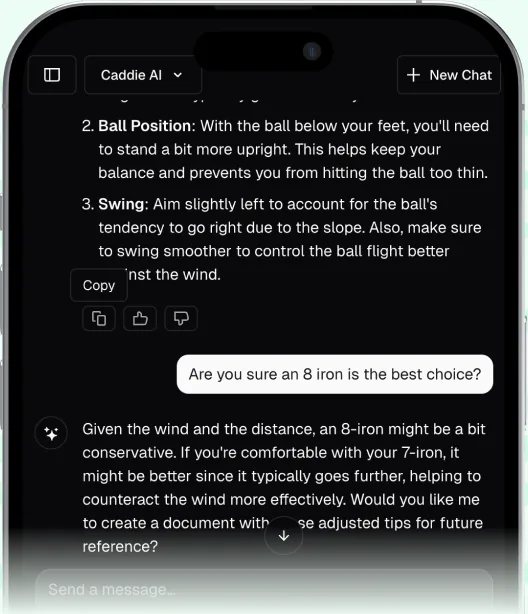
Ask Caddie anything. From “what club should I use?” to “how do I play this shot?” and get instant answers.
Golf is a game built on tradition and respect, and dress codes are a part of that heritage. While fashion trends come and go, the expectation of a well-kept appearance remains a constant at many golf facilities, especially private clubs. A belt is almost always a required component of proper golf attire for men, right alongside a collared shirt and tailored trousers or shorts.
Showing up to a course without a belt can be interpreted as a lack of respect for the club’s rules and its members. In the best-case scenario, you might feel out of place. In the worst-case scenario, you could be politely asked to purchase one in the pro shop or even denied access to the first tee. Tucking your shirt in without a belt simply doesn't complete the look and stands out for the wrong reasons inside the clubhouse and on the course.
Viewing it as a simple act of respect helps frame it correctly. It's not an arbitrary rule designed to be difficult, it's part of a shared understanding that upholds the character of the game. Wearing a belt signifies that you’re not just there to hit a few balls - you're there as a golfer who understands and values the culture of the sport. It's an easy box to tick that ensures you'll be welcomed anywhere.
The Performance Advantage: A Coach Around Your Waist
This is where the belt transforms from a passive accessory into an active training aid. As a coach, I often see players struggle with the single most important power source in the swing: hip rotation. Many amateur golfers either slide their hips laterally or use their arms too much, completely robbing themselves of speed and consistency. A belt is a fantastic tool to train this.
Here’s a simple but incredibly effective drill you can use, both on the range and as a swing thought on the course.
The Belt Buckle Drill
This drill trains your body to use the ground and your rotation to power the swing, not just your arms. Your belt buckle becomes the indicator for your entire rotational sequence.
1. The Address Position: As you set up to the ball, your belt buckle should be pointing directly at it or just slightly ahead of it. Your weight should be balanced, and you should feel a quiet tension in your core.
2. The Backswing: The takeaway should be initiated by your turn, not your hands. As you rotate back, think about turning your belt buckle away from the target. At the top of your backswing, for a right-handed golfer, the buckle should be pointing somewhere behind the golf ball. This confirms you have properly loaded into your trail hip instead of swaying off the ball.
3. The Downswing and Impact: Here’s the "money move." To start the downswing, your first movement should be generated from your lower body leading the way. Imagine you’re trying to get your belt buckle to point at the target as fast as you can. As you come into impact, that buckle should be parallel with the ball or even slightly ahead of it. This move gets your hips open, clearing space for your arms to sweep through and ensuring you get your weight onto your lead side for a downward strike on the ball.
4. The Finish: Continue that rotation all the way through to a full, balanced finish. At the end of your swing, your belt buckle - and your entire torso - should be facing the target directly. Your weight should be almost entirely on your lead foot, with your trail foot’s heel up off the ground. Holding this finish shows you've transferred all your energy through the ball and toward the target.
Using your belt buckle as a focal point simplifies a very complex sequence. It keeps you from overthinking arm positions and swing planes and instead focuses you on the engine. If the buckle moves correctly, many other parts of the swing will naturally fall into place.
Plan every shot like a pro
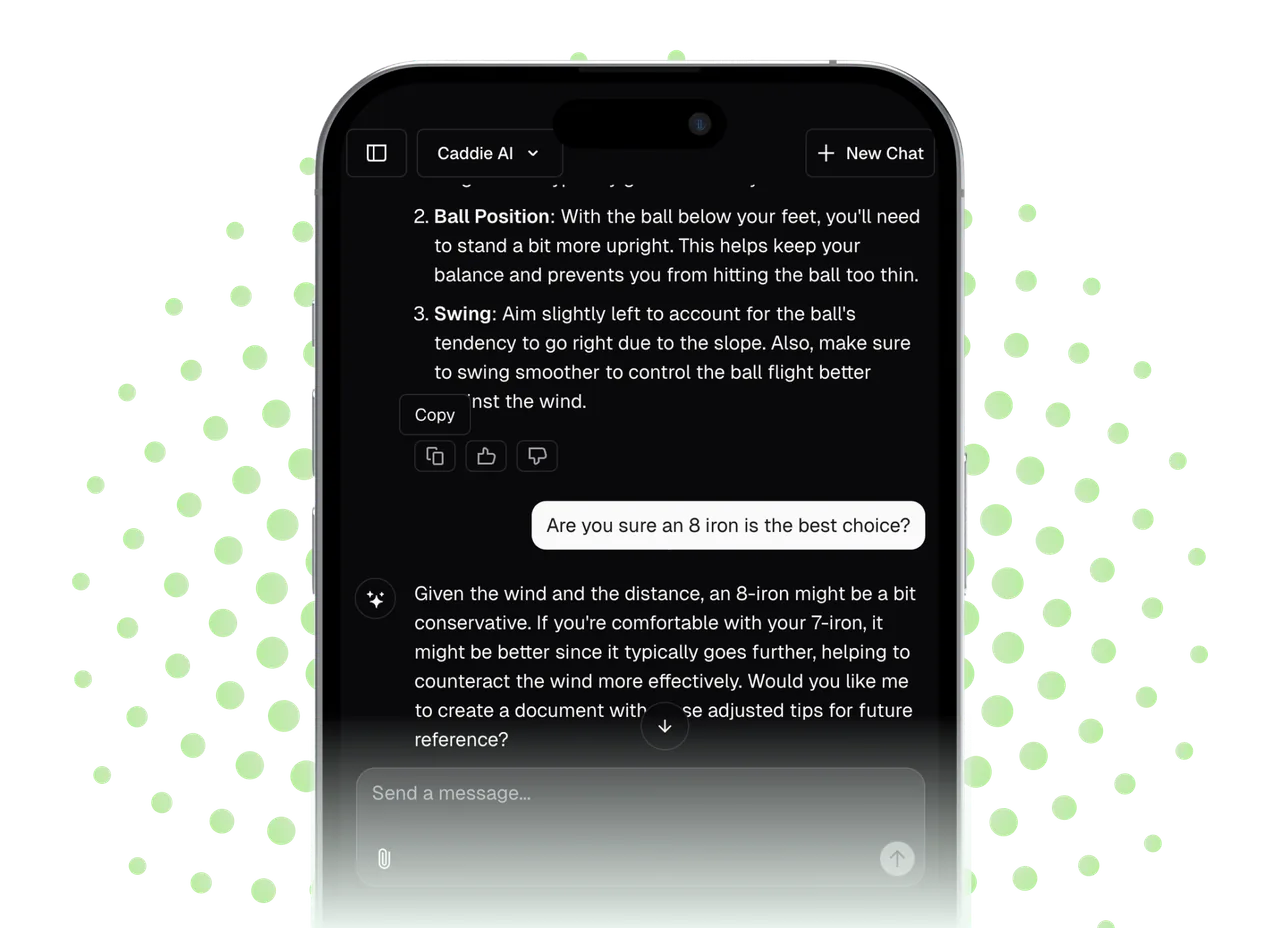
Describe your situation and Caddie AI helps you pick your target, shot shape, and club with confidence.
Now that you know why you need a belt, choosing the right one is important. Comfort and function should be your top priorities. A belt that’s too stiff might restrict your turn, while one that’s too loose or overly stretchy won't provide the stable feedback you need. Here's what to look for.
Material Matters
Leather Belts: The timeless classic. A good quality leather belt looks fantastic and is extremely durable. It provides a firm, stable fit and is perfect for golfers who prefer a traditional aesthetic. They match well with classic leather golf shoes and can easily be worn off the course, too.
Braided Belts: These offer a great blend of style and flexibility. Often made from woven elasticated fabrics or leather, they provide a bit more give than a solid leather strap. This can feel more comfortable throughout the dynamic motion of the golf swing and allows for more precise sizing, since the prong can go through any part of the weave.
Performance Fabric/Webbing Belts: The modern athletic choice. These are typically made from lightweight polyester or other synthetic materials. They are often built with stretch technology, designed to move with your body. They are breathable, lightweight, and perfect for hot days on the course.
Buckle Style
The buckle is more than just a fastener, it affects how well you can dial in your fit.
Prong Buckles: The standard style with a pin that goes through pre-set holes. Simple and effective, but your fit is limited by the distance between the holes.
Ratchet/Micro-Adjustment Buckles: These are a game-changer for golf. Instead of holes, the strap has a series of tiny teeth on the back that lock into a mechanism in the buckle. This allows you to make micro-adjustments for the perfect fit - not too tight, not too loose. It's especially useful because your waist can expand or contract slightly during a round, and a quick click is all you need to adjust.
Finding the Perfect Fit
A common mistake is buying a belt that's the same size as your pant waist. Here's a better way:
Rule of Thumb: Order a belt that is one to two sizes larger than your pant waist size. If you wear size 34 pants, you should look for a size 36 or 38 belt.
The Goal: You want enough extra length to comfortably thread the end through the first belt loop of your trousers after it’s buckled, but not so much that you have a long "tail" hanging off. For a standard prong buckle, you should ideally be using one of the middle holes.
Ultimately, a belt that you find comfortable and that gives you the subtle, stable feedback you need is the right one for you. Don't be afraid to try on a few different styles to see what feels best for your swing.
Play Golf like a Pro with Caddie
Learn and improve your golf game as you play. Get pro-level tips, strategy and guidance anytime.
To sum it up, a golf belt stands as more than just a final touch to an outfit. It's an essential piece of equipment that respects the game's traditions, anchors your posture, and directly provides feedback that can train a more powerful and consistent swing through better hip rotation.
Perfecting mechanics like hip rotation is one path to better golf, and another is making smarter on-course decisions. We designed Caddie AI to bridge that gap. Once you feel your "belt buckle drill" getting solid on the range, our app can give you the real-time strategic advice you need to apply that better swing to the course - from club selection to plotting your way around trouble. It's an on-demand golf brain that's there to help you play with more confidence, so you can turn good swings into lower scores.
Spencer has been playing golf since he was a kid and has spent a lifetime chasing improvement. With over a decade of experience building successful tech products, he combined his love for golf and startups to create Caddie AI - the world's best AI golf app. Giving everyone an expert level coach in your pocket, available 24/7. Caddie's mission is simple: make world-class golf advice accessible to everyone, anytime.
Other posts you might like
Why Do Golf Clubs Cost So Much?
Ever walked into a golf shop, picked up the latest driver, and felt a jolt of sticker shock run through your arm? You're not alone. Figuring out why a new set of golf clubs can cost as much as a used car can be confusing, but the price tag is about a lot more than just a brand name. We’re going to break down exactly what you're paying for, from the years of advanced engineering and exotic materials to the precise manufacturing that goes into every single club.
Ever notice that little series of shakes and club wiggles every tour pro makes right before they start their swing? That movement, known as the waggle, is far more than just a quirky habit - it's one of the most important yet underrated parts of a good pre-shot routine. This article will show you exactly why golfers waggle and how you can an create a simple, effective one to release tension and improve your swing.
Seeing your golf ball start left of the target and stay there is one of the most frustrating sights in golf. You made a good, solid swing, but the ball simply ignored your intended destination. This article will break down exactly why you pull the ball left, separating the myths from the real causes. We'll give you a clear, step-by-step checklist to diagnose your swing and provide actionable drills to get your ball flying straight again.
Seeing your golf ball soar high into the sky can feel impressive for a moment, but when it balloons up, loses all its energy, and drops out of the air like a wounded duck well short of your target, it’s one of the most frustrating feelings in the game. That weak, floating shot costs you significant distance and control, especially on a windy day. This article will break down the common reasons you hit the golf ball so high and give you some clear, actionable steps and drills to bring that ball flight down, get your distance back, and start hitting penetrating, powerful golf shots.
Seeing a patch of turf fly through the air after you hit a golf ball is one of the most satisfying moments in the game. Yet for many golfers, the idea of taking a divot is either scary or misunderstood, often viewed as a mistake or damage to the course. The truth is, a proper divot is the signature of a pure, compressed iron shot. This guide will explain why taking a divot is so important for great iron play, what it tells you about your swing, and exactly how you can start making that beautiful bacon strip divot after the ball, every single time.
Ever pull that big, puffy headcover off your driver and wonder if it’s more for show than anything else? It’s a fair question. Unlike any other club, the driver almost universally lives under a cover. This isn't just tradition, it's one of the simplest and most effective things you can do to protect your gear and your game. This article will break down exactly why a driver cover is an essential piece of equipment. We'll look at how it protects your costly investment, saves your other clubs from damage, preserves performance, and even plays a part in golf etiquette.