Seeing a + sign in front of a golf handicap can be confusing, but it signifies a level of skill that very few golfers ever reach. A plus handicap essentially means a player is better than scratch, and a +4 handicap golfer is operating in the elite stratosphere of the sport. This article will explain exactly what a +4 handicap means, break down the incredible skills required to achieve it, and offer some practical lessons you can apply to your own game, no matter your current skill level.
The best AI golf app: Caddie is your personal AI golf coach. Get expert-level golf advice instantly, 24/7 to help you play like a pro. Try it free →
What is a Golf Handicap, Anyway? A Quick Refresher
Before we can appreciate the plus, it helps to be clear on what a regular handicap represents. The World Handicap System (WHS) is designed to make the game more enjoyable by allowing players of different abilities to compete on a level playing field. Your Handicap Index isn’t your average score, it represents your demonstrated potential. It's calculated by taking the average of the best 8 of your last 20 scores.
Most amateur golfers have a "positive" number handicap, but without the plus sign. For example, a 15-handicap golfer can expect to shoot, on average, a score of around 15 over par in their best rounds. In a competition, they would get to subtract 15 strokes from their gross score to get their "net score." This allows them to compete against a scratch golfer, who has a 0.0 handicap.
A "scratch" golfer (0.0 handicap) is the baseline - a highly skilled amateur who, on a course of standard difficulty, is expected to shoot par or better. For most of us, getting to scratch is a lifetime goal. So, what happens when a player gets even better than that?
Get pro-level golf advice instantly, 24/7
Ask Caddie anything. From “what club should I use?” to “how do I play this shot?” and get instant answers.
The Plus Symbol: What Makes a Handicap "Positive"?
When you see a golfer with a handicap like +4.0, it can seem backward. Why the "plus"? It’s because they are so good, they have to add strokes to their score to compete fairly against scratch or bogey golfers. They are four strokes better than a 0.0 handicap player.
Here’s how it works in practice:
A +4 handicap golfer is expected to shoot an average score of 4-under par during their counting rounds on a par-72 course of standard difficulty. Their best scores will typically hover around 68.
In a net competition, instead of getting strokes taken off their total, they must add four strokes back on. If a +4 golfer shoots a gross score of 70, their net score would be 74.
On the scorecard, this is applied to the most difficult holes. The holes on a course are rated by difficulty from 1 (hardest) to 18 (easiest), known as the Stroke Index. A +4 player would have to add a penalty stroke to their score on the four hardest-rated holes (Stroke Index 1, 2, 3, and 4). If they make a par on Stroke Index 1, it’s recorded as a net bogey. If they make a birdie, it becomes a net par.
In short, a +4 handicap is a mark of exceptional, consistent, under-par golf. It tells you immediately that you are looking at a player of professional or top-tier amateur caliber.
The Anatomy of a +4 Handicap Golfer: What Does It Take?
Getting to a +4 handicap isn't just about having a few hot rounds. It's a reflection of a game with practically no weaknesses. Breaking down the components reveals a staggering level of skill across every part of the game.
Mind-Boggling Consistency
The primary trait of a plus-handicap golfer is consistency. Their bad shots are just less bad than everyone else’s. A 15-handicap’s awful shot might be out of bounds, leading to a triple bogey. A +4 player’s awful shot might be in the greenside bunker instead of on the green, where they still feel confident about getting up and down for par. They have almost entirely eliminated the blow-up hole from their game. Their rounds aren’t just peppered with birdies, they are defined by a near-absence of double bogeys.
Elite Ball Striking
To score this well, you have to give yourself a lot of birdie opportunities. A +4 player hits a very high percentage of Greens in Regulation (GIR). This means they are consistently hitting the ball with both distance and accuracy. When they do miss a green, the miss is strategic - they leave their approach shot in the easiest possible spot to chip from, avoiding short-siding themselves or landing in hazards. They have total command over their ball flight, able to shape shots left or right and control trajectory to fit the situation.
A "Weapon" Short Game
For a +4 player, chipping and pitching isn’t just about damage control, it’s an offensive tool used to salvage pars and even snag an unlikely birdie. Their ability to get the ball "up and down" (one chip/pitch followed by one putt) is extraordinary. They possess a variety of shots around the green - the low spinner, the high soft floater, the simple bump-and-run - and they know exactly which one to use. Bunkers don’t intimidate them, they often see a greenside bunker as an easier place to be than thick rough.
Mastery on the Greens
A great ball-striking round can be wasted with a cold putter. That’s not an issue for a +4 player. They are a master of both line and speed. Three-putts are almost non-existent in their game. They confidently roll in the majority of putts from inside 6-8 feet and have fantastic speed control on long lag putts, always leaving themselves simple tap-ins. This isn't just about a perfect stroke, it’s about an expert ability to read greens and visualize the ball’s path to the hole.
Bulletproof Course Management
This is arguably the biggest separator. A +4 golfer thinks their way around the course like a grandmaster playing chess. They have a clear strategy for every hole before they even step on the tee box. They know exactly where the trouble is, what a good "miss" is, and what side of the fairway provides the best angle for the approach shot. They don't just pull the driver on every par 4 and 5, they make calculated decisions based on probabilities, not ego. They are playing for the best possible score over 18 holes, not trying for the hero shot on every swing.
Plan every shot like a pro
Describe your situation and Caddie AI helps you pick your target, shot shape, and club with confidence.
How Rare is a +4 Handicap? Putting It in Perspective
To say a +4 handicap is uncommon would be a massive understatement. Based on data from the USGA, only about 1% of male golfers with an official Handicap Index are "plus" players at all. To reach +4 territory, you are talking about a tiny fraction of that already small group - likely less than 0.1% of all handicapped players.
Think about it this way: for every thousand golfers you find at your local club, you might find one with any plus handicap. A player in the +4 range is at the level of a top-tier collegiate golfer, a mini-tour professional, or one of the very best amateurs in the country. To put it in context with the best in the world, most PGA Tour pros maintain unofficial handicaps somewhere in the range of +5 to +9. A +4 golfer isn't just the best player in their weekend foursome, they are often the best player at their entire club, or even in their entire region.
Play Golf like a Pro with Caddie
Learn and improve your golf game as you play. Get pro-level tips, strategy and guidance anytime.
Actionable Lessons from a +4 Player (Even If You're a 20-Handicap)
While most of us will never achieve a +4 handicap, the way these players approach the game offers valuable lessons we can all apply to our own game.
Lesson 1: Eliminate the Double Bogey
High-handicap golfers often focus on making more birdies. Elite players focus on first eliminating big numbers. Before you add good, you have to subtract bad.
Actionable Tip: Change your definition of a "hero shot." When you are deep in the trees or in a terrible position, the smartest shot is often playing sideways back to the fairway. Take your medicine. Choosing a simple punch-out instead of trying a one-in-a-million shot through a tiny gap is a cornerstone of good course management and the fastest way to drop strokes.
Lesson 2: Know Your "Miss"
Plus-handicap players don't hit every shot perfectly, but they have a predictable miss. They know their 7-iron usually misses slightly left, so they aim accordingly, giving them a larger margin for error. They play with the swing they have on any given day.
Actionable Tip: Next time you’re at the range, pay active attention to your shot patterns. Where do you miss with your driver? Your mid-irons? Be honest with yourself. On the course, aim to accommodate that miss. If you almost always slice your driver, aim down the left side of the fairway and let your shot shape do the work.
Lesson 3: Master One Specific "Go-To" Shot
Elite players have a full bag of short-game tricks, but they all started by mastering one. By becoming an expert at one shot, you build confidence that spreads to the rest of your game.
Actionable Tip: Dedicate an entire practice session to a single type of shot. For example, a 40-yard pitch shot. Use just your favorite wedge and work on hitting a specific landing spot until the motion feels automatic. Having a reliable "go-to" shot will save you when the pressure is on.
Lesson 4: Make Every Putt a Two-Putt
The goal on any putt from outside 10 feet isn’t necessarily to make it, it’s to never, ever three-putt. Lag putting - controlling your speed on long putts - is a skill that dramatically lowers scores.
Actionable Tip: Instead of slamming long putts at the hole, change your goal. Your mission is to get the ball to stop inside an imaginary 3-foot circle around the cup. That one mental shift will force you to focus on an attainable goal and translate into fewer dreaded three-putts.
Final Thoughts
A +4 handicap represents complete mastery over the game of golf. It’s a testament to thousands of hours of dedication, combining elite physical skill with the strategic mind of a professional. It's a level of performance defined by its unwavering consistency and a game without any real weakness.
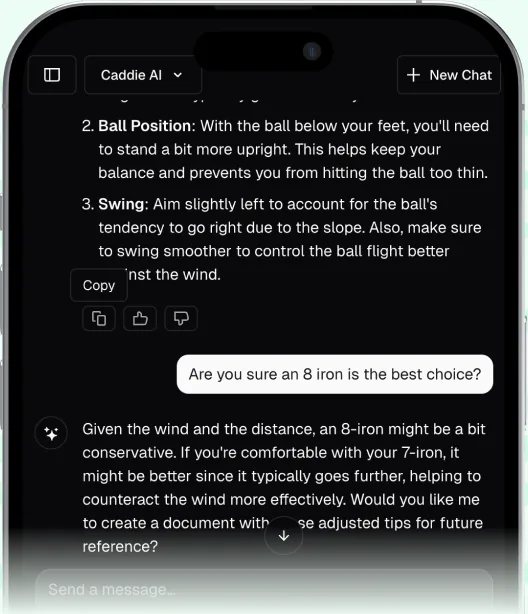
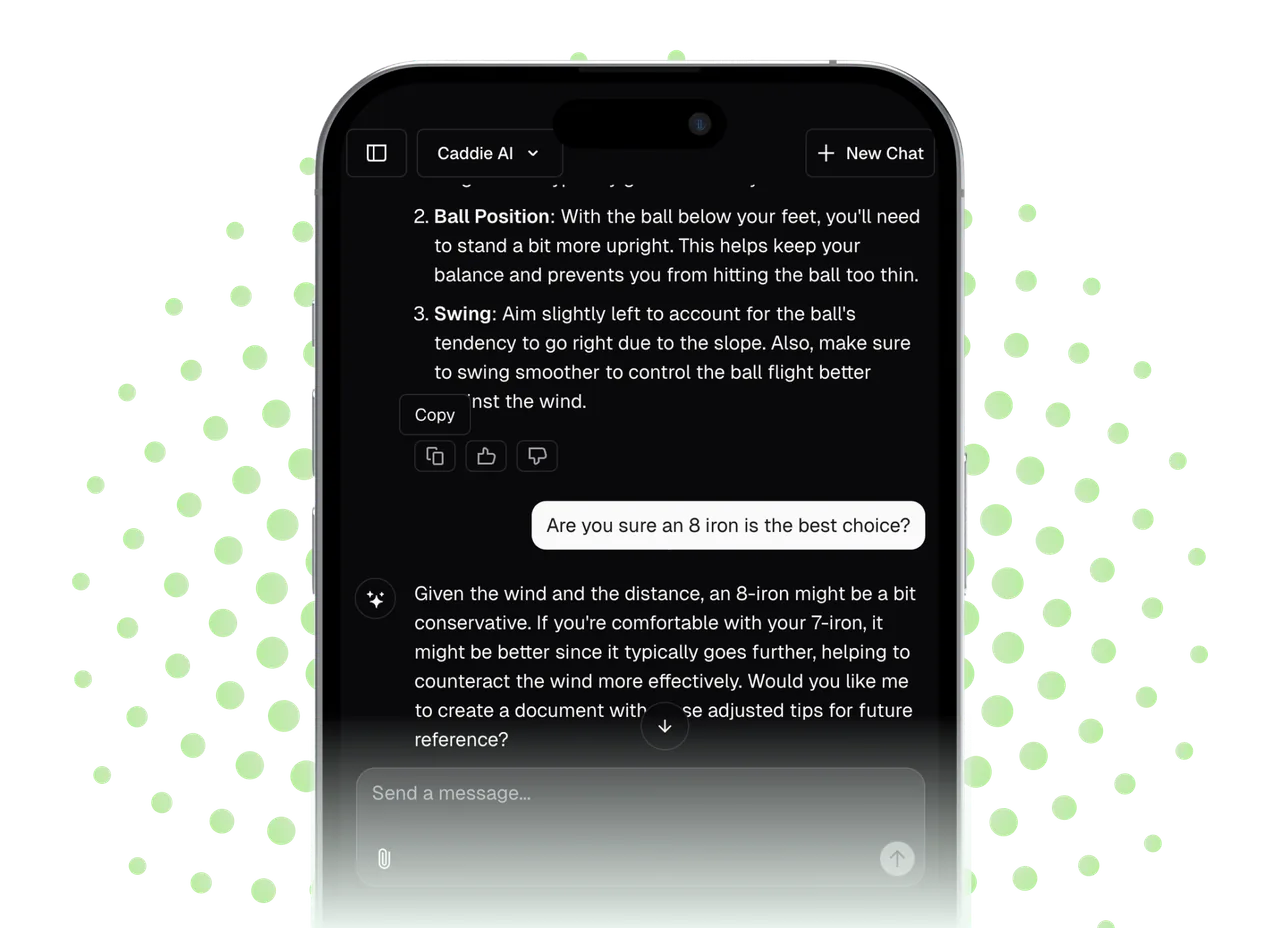
While few of us will reach that number, adopting the mindset of a +4 player is something any golfer can do. Much of their advantage comes from thinking smarter, and we built our tool to help every player do just that. With Caddie AI, you can get the kind of strategic on-course advice that used to only be available to pros. Whether it’s getting a smart game plan for a tricky par 5, analyzing a photo of a tough lie in the rough to recommend the best shot, or just helping you choose the right club, it brings the course management of a plus-handicap player right into your pocket.
Spencer has been playing golf since he was a kid and has spent a lifetime chasing improvement. With over a decade of experience building successful tech products, he combined his love for golf and startups to create Caddie AI - the world's best AI golf app. Giving everyone an expert level coach in your pocket, available 24/7. Caddie's mission is simple: make world-class golf advice accessible to everyone, anytime.
Other posts you might like
What Is a Lost Ball in Golf?
Nothing sinks that feeling in your stomach faster than watching your crisply struck tee shot sail towards the woods. A moment of hope turns to panic as the ball disappears from sight. We've all been there, and knowing the correct procedure for a lost ball is one of the most important things you can learn in golf. This guide will walk you through exactly what a lost ball is, what the penalty is, and the smart, simple ways to handle the situation to keep your round on track.
Ever found yourself looking at a set of irons and seeing the small letters CB or MB stamped on the clubhead, clueless as to what they actually mean? You're not alone. These two simple acronyms represent two fundamentally different designs in golf irons, and understanding them is the first step toward choosing equipment that actually helps your game, rather than hurting it. This guide will break down exactly what CB and MB mean, who should play each type, and how you can confidently decide which design is right for you.
The term 'choke shot' in golf probably sounds like the exact opposite of what you want - a moment of pressure-induced failure. But in reality, it's one of the most versatile, feel-based, and important shots you can have in your bag. This is a shot used for precision, control, and adapting to the weird situations a golf course throws at you. This article will show you exactly what a choke shot is, the two main reasons you should use it, and a step-by-step guide to mastering it for yourself.
Trying to find the right yardage device can feel like choosing a new driver - the options are overwhelming and everyone has a different opinion. The truth is, there isn't one single best device for every golfer. The right tool for you depends entirely on your game, your budget, and what you prioritize on the course. This guide will cut through the noise, breaking down the pros and cons of laser rangefinders, GPS watches, and handheld units so you can confidently pick the perfect partner for your game.
Seeing the term 4-GW on a set of golf irons can be puzzling, whether you're buying your first set or upgrading to a new one. It tells you which clubs are included in the package, but the GW can leave many golfers scratching their heads. This guide will break down precisely what a 4-GW set is, explain the vital role of each club in that collection, and help you understand how this modern setup can improve your game by eliminating troublesome distance gaps.
A game improvement iron is designed with one main goal: to make the challenging game of golf a little bit easier and a lot more fun for the average player. These clubs are built for forgiveness and distance, helping you get better results even when your swing isn't perfect. This guide will walk you through exactly what they are, how they work, and what type of player a game improvement set of irons fit with best to find more enjoyment – and consistency – out on the course