Choosing the right golf yardage app can feel like picking the right club for a tricky approach shot - there are a lot of options, and the right one depends on the situation. This guide cuts through the noise to show you what features truly matter, compares some of the best apps available, and helps you understand how to use one not just for numbers, but for real, tangible improvement.
The best AI golf app: Caddie is your personal AI golf coach. Get expert-level golf advice instantly, 24/7 to help you play like a pro. Try it free →
Why You Need More Than Just a Yardage Marker
Yardage markers on the course are helpful, but they tell a very small part of the story. They give you a single number, usually to the middle of the green. But what about the distance to carry the front bunker? Or the yardage to the fat part of the fairway on a dogleg right? A quality golf yardage app transforms your phone into a powerful course management tool that provides this critical information.
Think of it as moving from guesswork to certainty. A good app doesn't just tell you "it's 150 yards." It shows you that it's 142 to the front, 153 to the pin, and 165 to clear the sand trap behind it. Armed with this knowledge, you can make smarter, more confident swings. This shift from guessing to knowing is the first step toward shooting consistently lower scores and taking control of your game.
Get pro-level golf advice instantly, 24/7
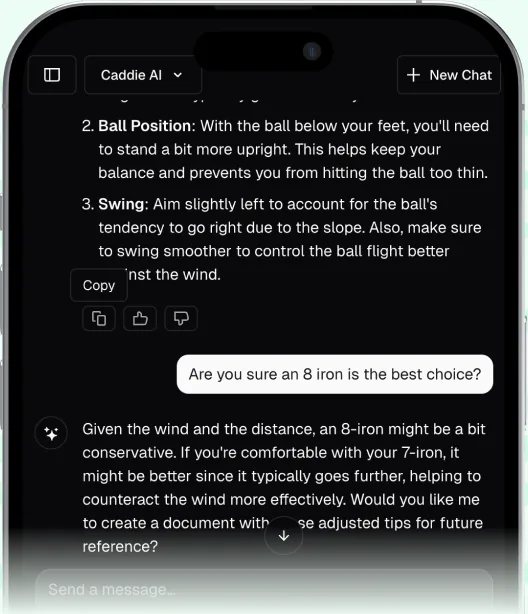
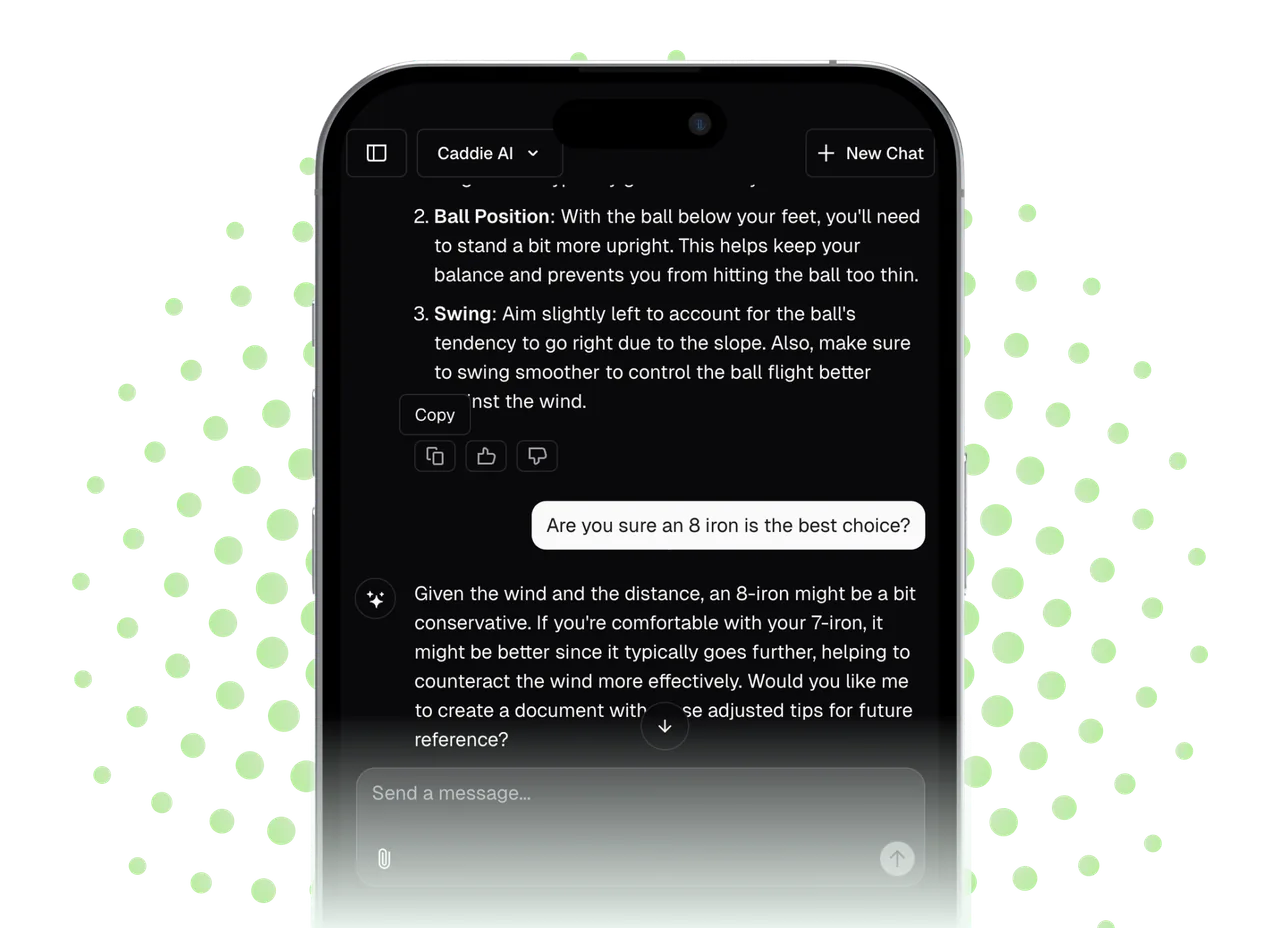
Ask Caddie anything. From “what club should I use?” to “how do I play this shot?” and get instant answers.
When you're comparing apps, you'll see a long list of features. Some are nice to have, but others are fundamental. Let's break down what you should look for.
1. Accurate and Detailed GPS Yardages
This is the foundation of any yardage app. The app should provide immediate, accurate distances to key points from anywhere on the course. At a minimum, this includes:
Distances to the Green: Front, middle, and back of the green. This is non-negotiable. Knowing these three numbers helps you understand where the pin is and where the safe miss is.
Distances to Hazards: You need to know the yardage to carry a water hazard or a bunker, as well as the distance to lay up short of it.
Distances to Layup Points: On par 5s or long par 4s, the app should give you distances to specific landing zones, like the 150-yard or 100-yard marks.
2. Green View and Pin Placement
Seeing a simple satellite image of the hole is one thing, but a detailed green view is a game-changer. Top-tier apps show you the shape of the green and allow you to move the pin position. If the pin is tucked in the front-left, your 150-yard middle-of-the-green number is far less useful than knowing it’s 141 to that specific quadrant. This feature lets you fine-tune your club selection for precise attack angles, turning a decent shot into a birdie opportunity.
3. Scorecard and Statistics Tracking
An app that only gives you distances is a digital rangefinder. An app that tracks your performance is a digital coach. This is where the real value lies for an improving golfer. Look for an app that makes it easy to track:
Your Score: Obviously.
Putts Per Round: A simple stat that can immediately highlight a weakness.
Greens in Regulation (GIR): From the fairway, how often do you hit the green on your approach?
Penalties: Did you go out of bounds? Find the water? You need to know how many strokes you're giving away.
After a few rounds, this data paints an honest picture of your game. You might feel like your driver is the problem, but the data might show that you're losing most of your strokes on approach shots from 100-125 yards.
One of the best features in premium app versions is the "Plays Like" or adjusted yardage. A 150-yard shot that's significantly uphill doesn't play like 150 yards - it plays longer. A great app will use GPS data, elevation changes, and sometimes even real-time weather factors like temperature, humidity, and wind to give you an adjusted number.
Instead of guessing, "is this enough club to get up the hill?", the app might tell you that your 150-yard shot actually plays like 162. That simple adjustment is the difference between being short in a bunker and putting for birdie.
A Quick Review of Top Golf Yardage Apps
Different apps excel in different areas. Here's a brief look at three popular options to help you decide which might be the best fit for you.
18Birdies: The All-Around Solid Performer
18Birdies is one of the most popular and user-friendly apps out there, and for good reason. It has a clean interface that’s easy to navigate on the course.
Best For: The social golfer who wants a fantastic all-around experience. It’s a great starting point for anyone new to golf apps.
Key Strengths: Excellent GPS and hole map visuals. The social features, like setting up tournaments with friends, are fun and well-executed. The free version is quite generous with its features.
Premium: The paid version unlocks "Plays Like" distances, advanced stats, and club recommendations.
TheGrint: The Data and Handicap Specialist
If you're serious about tracking your handicap and analyzing your game, TheGrint is a standout. It's often considered the best for its robust USGA-compliant handicap services.
Best For: The dedicated golfer who wants to maintain a formal handicap and dive deep into their performance data.
Key Strengths: Top-notch handicap tracking. Its "Strokes Gained" analysis (a premium feature) is something you typically see pros use, giving you incredible insight into which parts of your game are strongest and weakest compared to other golfers.
Premium: The "Pro" membership unlocks advanced stats, an advanced GPS rangefinder, and detailed analytics.
Golfshot: The Feature-Rich Contender
Golfshot has been around for years and continues to be a favorite thanks to its comprehensive features and reliability.
Best For: The tech-savvy golfer who wants powerful features and integrations, like syncing with an Apple Watch.
Key Strengths: It provides dynamic 3D flyovers of each hole, helping you visualize your strategy. The Auto-Strokes Gained feature (in the premium "Pro" version) is incredibly powerful and automates much of the data entry.
Premium: GolfShot Pro gives you "Plays Like" distances, personalized club recommendations, and advanced data visualization.
Plan every shot like a pro
Describe your situation and Caddie AI helps you pick your target, shot shape, and club with confidence.
Getting the app is the first step. Using it correctly is what makes the difference.
Trust it on the Course: When the app says it’s 155 yards, commit to the 155-yard shot. Don't let your eyes trick you. Trust the data to make a confident swing.
Perform a Post-Round Review: This is a powerful habit. After your round, take five minutes to look at your scorecard data. Don't just look at the final score. Look for patterns.
Did you have a lot of three-putts? Was it because of poor lag putting or missing short ones?
Where did you take your penalties? If they were all right off the tee with your driver, that tells you something.
What was your GIR percentage? If it’s low, your approach shots are your biggest opportunity for improvement.
Let the Data Guide Your Practice: Your post-round review gives you a clear practice plan. Instead of just banging a bucket of balls at the range, you now know what to work on. If your data shows poor scrambling, you can dedicate your next practice session to chipping and pitching from around the green. If approach shots from 100-150 yards are the issue, you can spend an entire session focused only on your wedges and short irons. This targeted practice is the fastest way to get better.
Final Thoughts
The best golf yardage app is the one that gives you the precise information you need to make confident decisions on the course, and the actionable data you need to improve off of it. Whether you choose a feature-rich premium app or a solid free version, moving from guessing distances to knowing them will fundamentally change how you play the game.
While an app can provide the critical numbers, the ultimate goal is to translate those numbers into smart strategy. This is where Caddie AI comes in, as we act as your on-demand course management expert. We help you go beyond asking "how far is it?" to answering "what's the right play here?". You can get a strategic plan for a tough par 5, get advice when you have a tricky lie by taking a picture of your ball, or simply ask any question about the game, anytime. Our goal is to give you that expert second opinion that eliminates uncertainty so you can commit to every shot with confidence.
Spencer has been playing golf since he was a kid and has spent a lifetime chasing improvement. With over a decade of experience building successful tech products, he combined his love for golf and startups to create Caddie AI - the world's best AI golf app. Giving everyone an expert level coach in your pocket, available 24/7. Caddie's mission is simple: make world-class golf advice accessible to everyone, anytime.
Other posts you might like
What Golfers Play Well at TPC Sawgrass?
Figuring out who will hoist the trophy at TPC Sawgrass is one of golf's most fascinating challenges because the course doesn't favor just one type of player. Pete Dye’s masterpiece is a unique test that demands a complete game and an unflappable mind. This guide will break down the specific skills and player profiles that consistently find success at THE PLAYERS Championship, giving you a clear blueprint for what it takes to win.
You consistently shoot bogey golf - about a 90 on a par-72 course - and you’re starting to wonder what that means for your official handicap. This article will show you exactly how to figure out your Handicap Index, moving past the simple assumptions to understand what your scores truly reflect about your game. We'll guide you through the key concepts of the World Handicap System (WHS) so you can finally get a clear answer.
The total par for an 18-hole round at the legendary Riviera Country Club is 71. This iconic layout, a masterpiece of strategic design, challenges golfers with a unique combination of ten Par 4s, four Par 3s, and four Par 5s that adds up to its famous Par-71 scorecard. This article will break down what par truly means, guide you through Riviera's scoring on a hole-by-hole basis, and provide practical tips on how to approach playing this historic course.
Your club's lie angle has a bigger impact on your shot direction than you probably realize, and a poor fit could be the hidden reason your best swings still end up missing left or right. This isn't some complex, pro-level concept, it's a fundamental part of how your equipment works. It’s also one of the easiest things to check and fix. This article will break down what lie angle is, show you exactly how it sends your ball off-target, and give you a simple step-by-step method to see if your clubs are a good fit for your swing.
Nothing is more frustrating than teeing up on a long par-5, winding up for a huge drive, and watching your ball shoot nearly straight up into the air and land just a few yards in front of the tee box. This shot, often called a pop-up or a sky ball, robs you of distance and confidence. The good news is that it’s almost always caused by a few common, correctable mistakes. This guide will walk you through exactly why you’re popping up your driver and provide clear, actionable steps to fix it for good.
Seeing yellow stakes or a yellow line on a golf course means you are dealing with a penalty area. Knowing the specific rules for these areas - and your options when your ball finds one - can save you strokes and erase any confusion. This guide breaks down exactly what those yellow markers signify, the two ways you can play your shot, and the smart strategy for navigating these challenging spots on the course.